

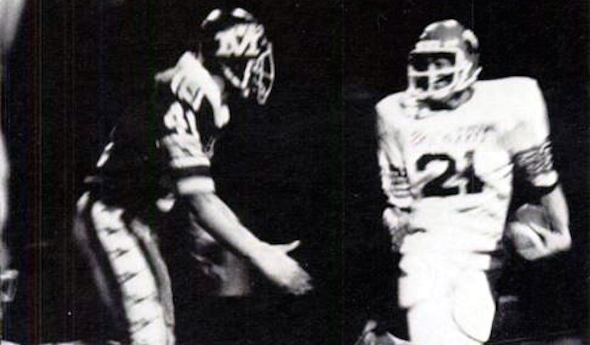
1979: Rice Meets Moeller in 'Biggest Game Ever'
August 30, 2019
By Ron Pesch
Special for Second Half
DATELINE: Cincinnati, Ohio, 1979
“The Brother Rice-Moeller game is the biggest game any Michigan high school football team has ever played.”
Hal Schram - ‘The Swami’
Detroit Free Press
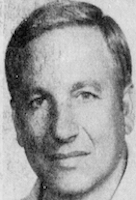
“I’m nervous as heck,” said Birmingham Brother Rice coach Al Fracassa to Free Press sportswriter Mick McCabe. “This is the biggest challenge of my life.”
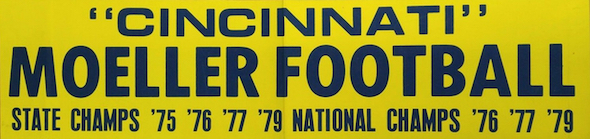
On Saturday, September 22, 1979, Fracassa’s Warriors travelled 270 miles south from the hotbed of Michigan high school football to the hotbed of Ohio high school football for a first-ever showdown with Cincinnati Moeller. Heading into the 1980s, many would argue that Brother Rice was the top football (and perhaps the top boys prep sports) program in the state of Michigan. At the same time, many would say Moeller had replaced Washington Massillon High School as the premier grid program in the Buckeye State, and that Moeller also represented the nation’s top prep football team. To quote McCabe in his pregame write-up:
 “Moeller had a 53-game winning streak snapped last fall after winning Ohio’s Class AAA state championship the previous three years. It also won the mythical national championship in 1976 and ’77. Seventeen players from (the 1978) Moeller team received college scholarships, including wide receiver Tony Hunter at Notre Dame and Larry Gates, the backup quarterback at Purdue.”
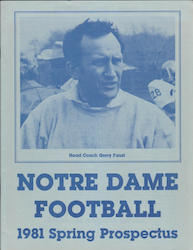
Moeller was coached by 44-year-old Gerry Faust – soon to become a Notre Dame legend. But in the fall of 1979, he was still building his impressive resume at Moeller.
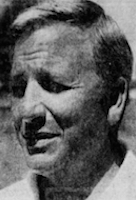 While both were all-male Catholic schools and maintained three football teams – varsity, JV and freshman – there were stark differences. Fracassa’s varsity coaching staff at the time included three members: Mike Popson, Ron Kalczynski and Mike Cieslak. In comparison, Faust had 17 assistant coaches on his varsity staff (and 25 student managers).
“Every year is a rebuilding year for us,” said Faust. “We average between 24 and 38 seniors a year and about 20 of them start.”
“Their second team is as good as most teams around here, and I’m not exaggerating,” Fracassa told McCabe.
Entering the contest, Faust had posted a 152-17-2 record in 17 seasons at Moeller, while Fracassa, in his 20th year as a head coach, was 123-31-8. A former Detroit Pershing and Michigan State quarterback, Fracassa was named head football coach at Royal Oak Shrine in June 1960. After eight seasons at Shrine, Fracassa moved to Brother Rice and compiled an 86-14-3 mark, including a Class A mythical state title in 1974. His Warriors began an impressive 24-game winning streak in 1976, earning an MHSAA Class A playoff title in 1977, but the streak was ended by North Farmington in the Semifinal round of the MHSAA tournament in November 1978.
Faust arrived at Moeller in 1960 to start a football team and had guided the squad since the school began playing varsity ball in 1963. He first started bringing outstate teams to Cincinnati in 1977 with a game against Monsignor Farrell High School of Staten Island, NY. Jesuit High from Dallas, Texas, followed with a visit to Moeller in 1978.
Both Moeller and Rice were undefeated to start the 1979 season. Faust’s Crusaders had allowed only three first downs over three games, including a big 34-7 win over city rival Cincinnati Princeton, the school that had ended Moeller’s long winning streak, and a 30-13 victory over powerhouse Pittsburgh Penn Hills, a school with an enrollment of 4,200 that had compiled consecutive Class AAA Western Pennsylvania Interscholastic Athletic League championships in the three previous years under coach Andy Urbanic. With the defeat of Penn Hills, the Crusaders were a flawless 3-0 against teams from across state lines entering the Brother Rice contest.
Undefeated in two games, Brother Rice was rated fourth in Class A in Hal Schram’s initial Top Ten rankings. Inexperienced following the graduation of quarterback Jon English (Michigan State) and receiver Marty Martinez (Stanford), the Warriors had downed St. Clair Shores Lake Shore, 21-7, then Grosse Pointe North, 13-7.
Game Time
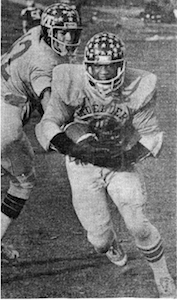
A crowd of 20,792 (including members of the Brother Rice pep band) packed the University of Cincinnati’s Nippert Stadium for the 8 p.m. prep version of the Michigan-Ohio State game. Moeller did not have its own field, playing games at Nippert, Cincinnati’s Riverfront Stadium (home to the NFL’s Bengals and MLB’s Reds), or a nearby high school field. Moeller dominated the first half with 282 yards of total offense to Brother Rice’s 64, but held only a 13-7 lead at the half. Senior wingback Eric Ellington awed the crowd with touchdown runs of 43 and 61 yards during the first quarter. Rice rebounded with a five-yard touchdown on a bootleg by 5-foot-11, 170-pound senior quarterback Brian Brennan following a fumble recovery by Emil Nagengast during the second period.
Starting their first possession of the third quarter on their own 33-yard line, Ellington ripped off a 34-yard run to the Rice 33 on Moeller’s first play of the drive. Three plays later, he went left for 10 yards and his third touchdown of the game. The Crusaders opened up a 33-7 lead in the fourth quarter before Rice got back on the scoreboard. Fracassa went to the playbook for some “razzle dazzle.”
Operating from their own 32-yard line with 2:19 left to play, “Brennan tossed a deliberate bounce pass on a lateral to reserve quarterback Dave Yarema,” wrote Randy Holtz in the Cincinnati Enquirer. “Yarema then fired a 68-yard touchdown to the wide open Steve Allen to finish the game’s scoring.”
“We’ve been using it a long time,” said Fracassa, commenting on the play with limited delight following the 33-14 loss. “We told the kids before the game that this would be one of the best teams they were ever going to play against. They’re really a tremendous team. If you can’t contain Ellington, you’re in trouble. You’ve got to be something else to catch this kid.”
Ellington ended with 178 yards on 10 carries.
“Eric really ran well,” added Faust. “He’s a great back, but you’ve got to give credit to (our) line up front.”
 Due to the early format of the MHSAA playoffs, which were introduced in 1975, the defeat likely had eliminated Brother Rice from the state playoff picture. A 10-7 loss to Catholic League opponent Detroit Catholic Central in Week 5 of the season and a 6-3 regular-season record ensured no postseason play for the Warriors in 1979. Detroit Catholic would end the year as Class A state champ with a perfect 12-0 record.
The Ohio High School Athletic Association had begun its football playoff system in the fall of 1972. To little surprise, Moeller went on to win the state’s Class AAA title for the fourth time in 1979, defeating Parma Padua Franciscan 41-7. Moeller again was proclaimed national champion by the National Sports News Service. (For those interested, highlights can be found here).
College Comes Calling
Back in Michigan, in February 1980, Fracassa applied for the head coaching position at Michigan State to replace Darryl Rogers, but wasn’t interviewed. When Frank “Muddy” Waters was named as MSU’s new coach, he offered Fracassa the position of offensive coordinator. But Fracassa chose not to go. In the fall, his Warriors again won the Class A championship. It wouldn’t be his last opportunity to jump to the college game.
The Great Experiment
In Ohio, Faust’s Crusaders would win the state and national titles again in late November 1980. After more than a month of rumors, on the day after winning the state title, Gerald Anthony Faust was officially announced as “the only head coach Notre Dame has ever selected from the high school ranks.”
Another Chance at MSU
Fracassa was a back-up signal caller at Michigan State. “I was always stuck behind the All-Americans,” he told the Detroit Times in 1960 shortly after taking charge at Royal Oak Shrine.
“First, he understudied Al Dorow,” wrote Wally Dwyer in the Times. “Then it was Tom Yewcic and finally Earl Morrall.”
Morrall’s son Matt, Leon Hart’s son Kevin, Tobin Rote’s son, Rocky, Roger Zatkoff’s son David and Jack Simmons’ son, Terry, were the offspring of past Detroit Lions who played on Fracassa’s 1974 champion.
 In December 1982, George Perles was named to replace Waters as head coach at Michigan State. A former teammate of Fracassa’s at MSU and, later, a coaching friend and rival when Perles coached Detroit St. Ambrose and Fracassa guided Shrine, Perles spoke to Fracassa about the possibility of joining the Spartans’ defensive staff. Again, Fracassa chose to remain at Brother Rice.
A Legacy Sealed …
In the fall of 1983, Fracassa’s Warriors grabbed another Class A title. It was the third of nine MHSAA championships his teams would ultimately earn. When he retired following the 2013 season, he was the state’s all-time winningest football coach with a 430-117-7 mark.
… and a Legacy Altered
In November 1985, Faust resigned from his position at Notre Dame.
“Faust said the job was ‘the fulfillment of a lifelong dream,’” wrote Mitch Albom in the Free Press, days after the announcement. “And he did it proud on most counts. He worked feverishly, turned out good men, a clean program. And technically, a winning program, 30-25-1. But nowhere near winning enough for Notre Dame.”
“Faust knew it.”
To the dismay of countless Irish fans, Notre Dame continued to honor its contract despite the losses. “No matter how loudly the fans yelled,” noted Albom, “the school would not fire Faust.”
“So, with a choked voice and moist eyes, he saved the university the ugliness of firing him by resigning with one game left on his contract.”
“We probably won’t see another Gerry Faust experiment again,” added Albom at the time. “Everyone will point out that it didn’t work the first time …”
“College football was once a game of its name. College kids playing football. That was long ago. Today it is a multimillion-dollar industry …”
The great experiment certainly altered memories of Faust, the structure of coaching contracts, and the path for all high school coaches who aspired to lead at a higher level. One might even say it was a turning point for winning and losing, and what would be ‘acceptable’ at all levels of sports across America.
P.S. Moeller and Rice again met in 2007, with the Crusaders again topping Brother Rice, this time 14-6. Both schools had entered this match-up with identical 2-1 records.
 Ron Pesch has taken an active role in researching the history of MHSAA events since 1985 and began writing for MHSAA Finals programs in 1986, adding additional features and "flashbacks" in 1992. He inherited the title of MHSAA historian from the late Dick Kishpaugh following the 1993-94 school year, and resides in Muskegon. Contact him at [email protected] with ideas for historical articles.
PHOTOS: (Top) Brother's Rice's Brian Brennan looks for an opening while a Moeller defender pursues. (2) Brother Rice coach Al Fracassa. (3) Moeller coach Gerry Faust. (4) A Moeller bumper sticker tells of its many successes during the 1970s. (5) Eric Ellington starred for Moeller against Brother Rice. (6) Faust left Moeller for Notre Dame in 1980. (Photos gathered by Ron Pesch.)
Drive for Detroit: 11-Player Semis in Review
November 23, 2015
By Geoff Kimmerly
Second Half editor
Winter Storm Bella received some of the headlines entering this weekend's MHSAA 11-player Football Semifinals.
But the teams that took the field in mostly snowy conditions earned the rest, with three clinching championship game berths for the first time and seven more undefeated teams keeping perfect records intact.
See below for a few highlights from all 16 Semifinals. There's plenty more to come this week, including previews of each championship game and coverage of each Friday and Saturday.
Division 1
Romeo 48, Grand Ledge 21 – This officially can be coined the best season in Romeo history with its first MHSAA Finals berth to go with a school record for wins and a Macomb Area Conference White title. The Bulldogs (12-1) didn’t take their first lead until Jackson Butcher caught a 62-yard touchdown pass from Paul Hurley with 2:19 to go in the first half, but they then scored the last three touchdowns of the game to pull away. Hurley completed 8 of 10 passes for 133 yards and two scores, and Butcher caught five for 103 yards. Ba Blamo went over 1,000 rushing yards for the season with 172 plus two scores for Grand Ledge (12-1), which finished its deepest run since 2000. Click for more from the Macomb Daily.
Detroit Cass Tech 48, Canton 41
The Technicians (11-2) got up 14 points during the first half and then held off a comeback attempt by Canton to make the Division 1 Final for the first time since 2012. Sophomore Aaron Jackson, filling in for injured quarterback Rodney Hall, completed 4 of 5 passes for 216 yards and two touchdowns and ran for a third score, while junior Donovan Johnson ran for 154 yards and two scores and junior Timothy Cheatham gained 91 yards and two scores. Canton (10-3), in its first Semifinal since 2006, was paced by Marcus Sanders’ 298 yards rushing and three touchdowns on the ground – including one with 38 seconds to play that pulled the Chiefs to within seven of the lead. Click for more from the Detroit Free Press.
Division 2
Lowell 49, Walled Lake Western 34
The Red Arrows (12-1) avenged a 42-40 opening night loss to Walled Lake Western to earn a trip to Ford Field for the first time since 2011. Quarterback Ryan Stevens continued his sharp play with three touchdowns passing and three more rushing to give him 47 combined this season. Walled Lake Western (12-1), pursuing its first Finals berth since 1999, led 10-7 after the first quarter and got back within four heading into the fourth before Lowell scored three times over the final 12 minutes. Quarterback Kyle Thomas ran for two scores and threw for a third. Click for more from the Grand Rapids Press.
Detroit Martin Luther King 40, Livonia Franklin 6
King (13-0) moved one more step closer to a perfect run by taking a 20-0 advantage after the first quarter and following senior quarterback Armani Posey and his three touchdown passes to a lead Franklin never threatened. The Crusaders will play in an MHSAA Final for the first time since winning in 2007. Franklin, making its deepest postseason run since 1975, the first year of the MHSAA playoffs, finished 9-4 – its best record since 2005. The Patriots were only 2-7 a year ago, their fourth straight sub.-500 finish. Click for more from MLive-Detroit.
Division 3
Orchard Lake St. Mary’s 14, East Grand Rapids 7
These two perennial powers have now met six times over the last decade, including three times in MHSAA Finals – but this was the first victory for St. Mary’s (11-1). The reigning Division 3 champion got its final edge on a 70-yard touchdown run by Ryan Johnson to open the second half and will play in its fifth championship game in six seasons. This was East Grand Rapids’ first Semifinal since 2011; the Pioneers (9-4) scored on their first possession but didn’t reach the end zone again the rest of the way. Click for more from the Oakland Press.
Chelsea 35, Coldwater 7
The winner was guaranteed the first MHSAA Finals appearance in school history, and Chelsea took hold early jumping to a 28-0 first-half lead. Junior quarterback Jake Bush threw three touchdowns passes and ran for a fourth score as the Bulldogs (12-1) set a team record for wins in earning a first trip to Ford Field. Coldwater ended its deepest playoff run and winningest season but continued an impressive run that’s seen the team go from 1-8 in 2011 and 2012, to 5-5 with its first playoff berth in 2013, to 8-2 in 2014 and 12-1 this fall. Click for more from the Ann Arbor News.
Division 4
Zeeland West 46, Ada Forest Hills Eastern 8
West’s rumbling run-heavy offense is perfect for days like snowy Saturday, and the Dux (13-0) piled up nearly 400 yards in earning a return to Ford Field after falling in the Semifinal a year ago. West’s defense also played a starring role, allowing single-digit points for the fifth time in six games. Forest Hills Eastern hadn’t been held to fewer than 13 points since 2012. The Hawks did end their best season at 11-2 after four straight sub-.500 finishes including 4-5 each of the last two years. Click for more from the Holland Sentinel.
Flint Powers Catholic 21, Detroit Country Day 14
The Chargers (11-2) will return to Ford Field for the second time in five seasons after quarterback Noah Sargent scored with 26 seconds to play to give them their first lead. The dual threat standout threw for 97 yards and a touchdown and ran for 88 in addition to his go-ahead score. Country Day (11-2), playing for its first Finals berth since 2012, took a 14-0 lead into the second half. Junior Steve Mann threw for 108 yards and a touchdown for the Yellowjackets. Click for more from the Flint Journal.
Division 5
Grand Rapids West Catholic 42, Lansing Catholic 13
West Catholic (11-2) will play in its fifth Final in six years after winning this rematch of last season’s championship game. Any ideas that the Falcons were in demise after a 1-2 start clearly were exaggerated; they’ve beaten four opponents during the playoffs that entered a combined 39-3. The Cougars scored first, but West Catholic scored three times during the second quarter; for the game, sophomore quarterback Gaetano Vallone ran for two touchdowns and threw for two more. Lansing Catholic (11-2) had been held under 20 points only one other time since opening night 2013. Click for more from the Grand Rapids Press.
River Rouge 28, Ida 26
River Rouge (12-1) turned its first Semifinal appearance into its first championship game berth by holding off a late comeback attempt by Ida and stopping a 2-point conversion try that would’ve tied the score during the final seconds of regulation. River Rouge built a two-score lead during the first half, but the teams were tied 20-20 when quarterback Antoine Burgess found Alexander Carter for a go-ahead scoring pass and then added the eventual game-winning points on the conversion. Ida finished 12-1 after also playing in its first Semifinal. Click for more from the Southgate News-Herald.
Division 6
Clinton 42, Grand Rapids NorthPointe Christian 20
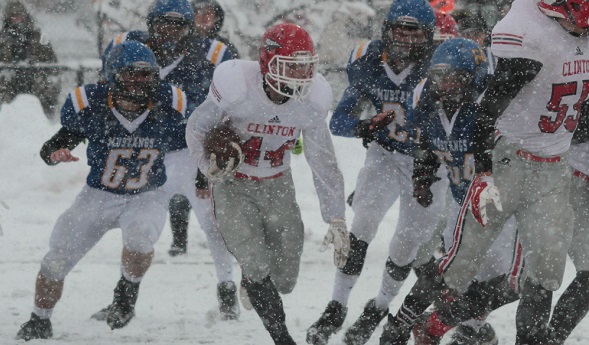
Clinton’s opponents were a combined 37-5 entering the playoffs, and beating previously-undefeated NorthPointe Christian earned the Redskins (13-0) a rematch of the 2013 Division 6 Final against Ithaca. Clinton’s running attack was nearly unstoppable; Noah Poore ran for 248 yards and two touchdowns, and Mathew Sexton ran for 182 yards and two scores. NorthPointe (12-1) saw its season end in the Semifinals for the second straight season and is 23-3 combined over the last two. Click for more from the Adrian Daily Telegram.
Ithaca 28, Traverse City St. Francis 19
Ithaca will play in its sixth straight Division 6 Final after coming back from a slow start to outscore St. Francis 22-6 over the final three quarters. Quarterback Jake Smith threw for 180 yards and two touchdowns and ran for 147 yards and two more scores for the Yellowjackets (13-0), who held St. Francis to eight first downs and took advantage of four turnovers. The Gladiators (12-1) scored immediately on a 95-yard return of the opening kickoff by Joe Trucco and still led 19-15 with just under 11 minutes to play. Click for more from the Mount Pleasant Morning Sun.
Division 7
Ishpeming 22, New Lothrop 14
The Hematites (12-0) will play in the Division 7 Final for the fourth straight season and for their third title in that time after winning this matchup of undefeated teams. The only game played inside this weekend – at Northern Michigan University’s Superior Dome – still looked like it was in the snow thanks to strong defenses on both sides. Ishpeming quarterback Ozzy Corp ran for 88 yards and two touchdowns and threw a scoring pass, and New Lothrop quarterback Erik Birchmeier threw for 132 yards and ran for a score as neither offense gained 200 total yards. The Hornets finished 12-1 after a sixth-straight perfect regular season. Click for more from the Marquette Mining Journal.
Pewamo-Westphalia 30, Detroit Loyola 0
Pewamo-Westphalia (13-0) will this time move on after this rematch of last season’s Semifinal that sent Loyola to Ford Field to win its first MHSAA title. The Pirates followed the snowy footsteps of running back Jared Smith, who rushed for 193 yards and two touchdowns – adding to his MHSAA single-season record for rushing scores of 52 and giving him the MHSAA record for rushing yards in a season with 3,094. The Pirates also handed Loyola (10-2) its first shutout since 2011. P-W played in a Final once before, in 2011, and Loyola played in the last three in Division 7. Click for more from the Lansing State Journal.
Division 8
Muskegon Catholic Central 33, St. Ignace 20
The Crusaders (11-2) will play for a third straight MHSAA championship after building a 20-0 lead as two running backs went over 100 yards – Walker Christoffersen had 192 and a touchdown and LaTommy Scot ran for 102 and scored both rushing and receiving. St. Ignace scored all 20 of its points during the fourth quarter with Andrew Goldthorpe running for a touchdown and catching a pass for another. The Saints (11-2) were playing in their third Semifinal in five seasons. Click for more from the Muskegon Chronicle.
Waterford Our Lady 36, Ottawa Lake Whiteford 20
The Lakers (13-0) will play for an MHSAA title for the first time since claiming Division 8 in 2002. Our Lady led only 22-14 heading into the fourth quarter before breaking away. Quarterback Clay Senerius threw two touchdown passes to bring his total to 34 this season. Whiteford (10-3) played in its first Semifinal and had more than 300 yards of total offense, but couldn’t keep pace during the fourth quarter and missed on a couple of scoring opportunities deep in Lakers territory. Click for more from the Oakland Press.
PHOTO: Clinton trudged through the snow to defeat Grand Rapids NorthPointe Christian in a Division 6 Semifinal. (Click for more from HighSchoolSportsScene.com.)