

1st & Goal: 2021 Week 3 in Review
By
Geoff Kimmerly
MHSAA.com senior editor
September 13, 2021
The anticipated came through during Week 3 of this football regular season, and the unpredicted provided an entertaining mix of storylines too.
As expected, the statewide headliners came from Detroit with Martin Luther King winning a much-heralded rivalry matchup – but also Livonia Churchill claiming the upset of this young season.
Elsewhere, Grand Blanc won close again over another highly-regarded opponent. Hudson continued to build on arguably the best small-school start in the state. A number of 8-player teams tried to wear out scoreboards – the 8-player schedule alone saw four games break 100 combined points and a fifth end up at 98, with Indian River Inland Lakes and Central Lake tying the 8-player scoring record by combining to put up 152.
Here’s a glance at those and other results that especially caught our attention.
Bay & Thumb
HEADLINER Grand Blanc 27, Midland Dow 23 Another week, another noteworthy win for the Bobcats (3-0), who have now handed first losses of this season to all three of their opponents. Hunter Ames connected twice with Tae Boyd on scores, the second during the third quarter ending up the game-winner, and the defense stopped Dow’s final rally on the Grand Blanc 15-yard line. Click for more from WJRT.
Senior Hunter Ames (@HunterAmes4) connected with Junior Tae Boyd for two touchdowns during @GrandBlancFB's 27-20 win over Midland Dow.#StateChamps x #MIArmyGuard pic.twitter.com/XOg4o9xgc0
— STATE CHAMPS! Michigan (@statechampsmich) September 11, 2021
Watch list Port Huron Northern 22, Fraser 15 The Huskies quickly are the only undefeated team left in the Macomb Area Conference Blue after handing Fraser (2-1) its first defeat, and Northern also is 3-0 for the first time since 1995.
Remember this one Fenton 39, Flushing 20 The win was only the first for Fenton (1-2) after opening with tough nonleague opponents Dow and East Lansing, and it also put the Tigers 1-0 in the Flint Metro League Stripes as those first two losses have nothing to do with Fenton’s opportunity to three-peat as league champion.
More shoutouts Millington 38, Hemlock 7 The Cardinals (3-0) have won by an average of just about 31 points per game, this one avenging last year’s 12-6 loss to the Huskies that decided the Tri-Valley Conference 10-1 title. Bad Axe 26, Unionville-Sebewaing 8 The Hatchets are 3-0 for the first time since 2001 and already halfway to posting their best record since that season.
Greater Detroit
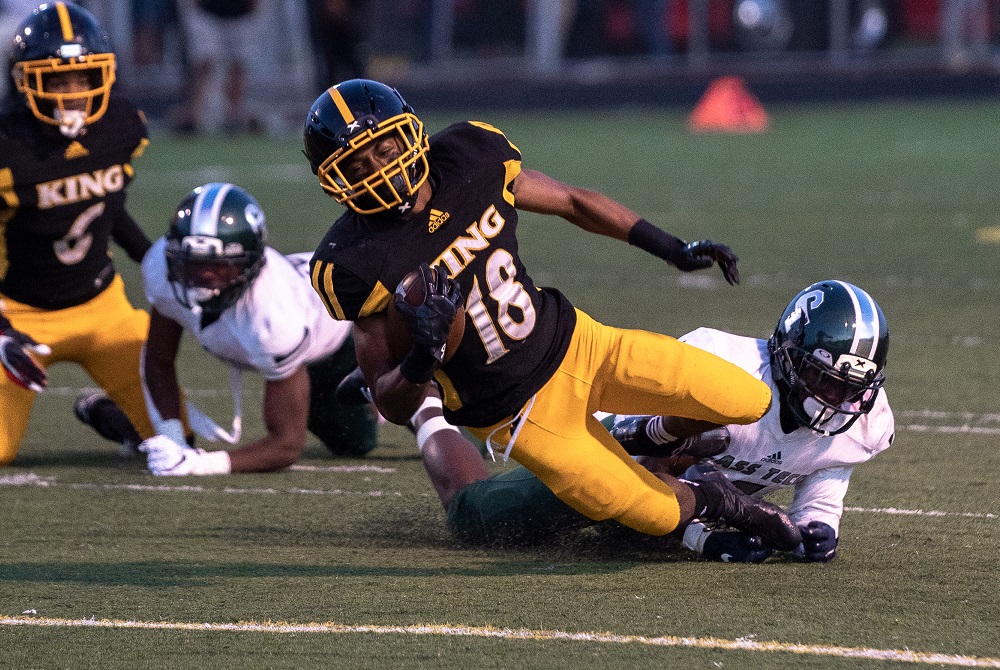
HEADLINER Detroit Martin Luther King 41, Detroit Cass Tech 34 As anticipated, this one absolutely was worth watching. (Watch the replay here.) Crusaders quarterback Dante Moore threw for 365 yards and five touchdowns including go-ahead scores with 33 seconds to play in the first half and 29 seconds into the fourth quarter as King (2-1) went on to avenge last season’s pair of losses to the Technicians (1-2). Click for more from the Detroit Free Press.
Our Mr. Football candidate Dante Moore (@dantemoore05) threw for 365 yards and five touchdowns as Detroit King (@DetKingFootball) went on to beat Cass Tech 41-34 on Friday night.
#MrFootball X @hungryhowies pic.twitter.com/TCQZN1erC0— STATE CHAMPS! Michigan (@statechampsmich) September 11, 2021
Watch list Livonia Churchill 28, Belleville 21 If not for King/Cass Tech, this would’ve been the headliner not only from the Detroit area but statewide. Belleville (2-1) hadn’t lost a regular-season game since Week 3 of 2016, and Churchill (3-0) had lost all three recent meetings by at least three touchdowns.
Remember this one Orchard Lake St. Mary's 28, Harper Woods 14 The four teams in the Detroit Catholic League Central are a combined 10-1 with league play set to begin, and handing Harper Woods (2-1) its first defeat ranks right up there with the most impressive of those 10 wins so far.
More shoutouts Pontiac Notre Dame Prep 23, Detroit Loyola 8 The Fighting Irish (3-0) are quietly 19-4 over the last three seasons and made statements on both sides of the ball scoring the first points Loyola (2-1) had given up and holding the Bull Dogs to only eight after they’d scored a combined 119 over their first two games. Armada 34, North Branch 28 The Tigers are 3-0 for the first time since 2011, after winning three games total last season and no more than four since 2012. They also sent reigning champ North Branch (1-2) to 0-2 in Blue Water Area Conference play.
Mid-Michigan
HEADLINER DeWitt 49, East Lansing 14 As expected, DeWitt’s offense keyed by quarterback Ty Holtz and receivers Tommy McIntosh and Nick Flegler immediately bounced back from scoring 17 points in a Week 2 loss to Portland. The Capital Area Activities Conference Blue looks a lot stronger top to bottom this season than the past few, but the Panthers have some history on their side going forward as East Lansing is the only league team to defeat DeWitt since it joined the Blue in 2018. Click for more from the Lansing State Journal.
A true dual-threat, Mr. Football candidate Ty Holtz (@tyholtz_) scored two @DHSPanthers touchdowns on the ground and three in the air. #MrFootball x @HungryHowies pic.twitter.com/VQdwNAzVOG
— STATE CHAMPS! Michigan (@statechampsmich) September 11, 2021
Watch list Ovid-Elsie 23, Montrose 22 The Marauders’ seven-point opening loss to still-undefeated Portland looks better by the week, and add to that a win over the Rams (2-1) after losing to them by 42 and 22 points the last two seasons.
Remember this one Mason 34, Williamston 27 The CAAC Red race started off with a massive comeback as the Bulldogs trailed 27-13 at halftime but then held the Hornets scoreless over the final two quarters.
More shoutouts Brighton 7, Hartland 6 The Bulldogs (2-1) earned the slim advantage with a 75-yard pass off a fake punt and their second straight week giving up just one score. St. Louis 35, Saginaw Michigan Lutheran Seminary 32 The Sharks (3-0) hadn’t won three games in a season since 2018 and at 41 points per game are on pace for their most productive offense since the 1960s.
Northern Lower Peninsula
HEADLINER Traverse City West 21, Cadillac 7 The Titans (3-0) guaranteed they will again have a loud say in who wins the Big North Conference holding off the Vikings (2-1) to set up this week’s possible league-title decider with reigning champ Traverse City Central. West ran its winning streak against 2020 Division 4 runner-up Cadillac to seven, led by a defense that has given up only one score each of the last two weeks. Click for more from MI Sports Now.
Watch list Mancelona 44, Elk Rapids 15 The Ironmen won three games total last season but are 3-0 for the first time since 2012 with a defense giving up just under 12 points per a game.
Remember this one Frankfort 32, Oscoda 16 The Panthers (2-1) handed Oscoda (2-1) its first regular-season defeat since Week 8 of 2019 – and they play each other again this week in a nonconference rematch.
More shoutouts Lake City 24, Manton 0 The Trojans (3-0) are quickly making their way back after finishing 2-4 a year ago, with this week’s Beal City matchup possibly the most telling so far this fall. Boyne City 44, Maple City Glen Lake 10 The Ramblers (3-0) have avenged their two 2020 regular-season losses in back-to-back weeks and have given up only 25 points total over their three wins this fall.
Southeast & Border
HEADLINER Hudson 36, Clinton 28 A great start just keeps getting greater for the Tigers, who added a league-opening win over the reigning Division 6 runner-up to their first 3-0 start since 2017. Hudson took a 28-14 lead into halftime and held off the Redwolves’ second-half rally. Nick Kopin tore through four touchdown runs including a 91-yarder. Click for more from the Adrian Daily Telegram.
Senior Nick Kopin (@nick_kopin) had an impressive day at Running Back for @HudTigFball, scoring 4 touchdowns for the Tigers.#StateChamps x #MIArmyGuard pic.twitter.com/Y5PeLsfMvb
— STATE CHAMPS! Michigan (@statechampsmich) September 11, 2021
Watch list Napoleon 20, Manchester 18 The Pirates (3-0) are off to their best start since 2002 with now as many wins this fall as they earned the last two seasons combined.
Remember this one Temperance Bedford 37, Dexter 36 (OT) With these two back in the same league for the first time in more than a decade, this could end up deciding the Southeastern Conference Red championship or at the very least keep Bedford (3-0) in contention to win it.
More shoutouts Monroe St. Mary Catholic Central 33, Carleton Airport 26 The Falcons are 3-0 for the first time since 2015 with Huron League powers Milan and Riverview up over the next two weeks, respectively. Saline 34, Ypsilanti Lincoln 14 Seven-time reigning SEC Red champ Saline (3-0) won its 40th-straight league game.
Southwest Corridor
HEADLINER Battle Creek Harper Creek 50, Parma Western 22 The Beavers might be one of the best 1-2 teams out there and got into the win column after an opening loss to Battle Creek Lakeview and then a three-point defeat to Hastings. Those two and Parma Western remain a combined 7-2 so far. Harper Creek also had defeated Parma Western in a playoff opener last season. Click for more from the Battle Creek Enquirer.
Watch list Watervliet 19, Buchanan 13 After winning two games each of the last three seasons, Watervliet (3-0) has put together an attention-grabbing start with two of those victories over teams that finished last season with winning records.
Remember this one Kalamazoo United 48, Schoolcraft 22 The Hackett/Kalamazoo Christian co-op opened with a difficult slate of Whitehall, Stevensville Lakeshore and now Schoolcraft, and this first win might get the ball rolling with league play coming up.
More shoutouts Cassopolis 28, Comstock 0 The Rangers (2-1) bounced back from a Week 2 loss by shutting out a Comstock team that had scored a combined 82 points during a 2-0 start. Battle Creek Central 34, Lansing Everett 12 The Bearcats (2-1) also showed the ability to rebound nicely, following up a Week 2 defeat by dealing the Vikings (2-1) their first.
Upper Peninsula
HEADLINER Calumet 28, Ishpeming Westwood 14 The Western Peninsula Athletic Conference Copper race just opened back up with previously-winless Calumet handing Westwood its first defeat. The Copper Kings (1-2) slowed a Patriots offense that had totaled 80 points over the 2-0 start. Click for more from ABC 10
Watch list Bark River-Harris 40, Kalkaska 20 The Broncos have piled up three double-digit wins for their first 3-0 start since 2015.
Remember this one Houghton 21, Iron Mountain 14 These two have been facing each other as members of the West-PAC Copper together since 2018 – and Iron Mountain (1-2) had won the previous two games of the recent series with Houghton (2-1) by a combined 81-0.
More shoutouts Menominee 35, Gladstone 34 The Maroons (3-0) held off a late scare from Gladstone (1-2) to open Great Northern Conference play. Marquette 50, Escanaba 21 The reigning GNC champ improved to 2-1 and ran its winning streak over rival Escanaba (1-2) to four with its highest-scoring game since 2017.
West Michigan
HEADLINER Muskegon 28, Zeeland West 20 The Big Reds (2-1) bounced right back from a Week 2 loss to Cass Tech with an impressive opening win in the Ottawa-Kent Conference Green. The teams were tied midway through the fourth quarter before Muskegon pulled away from the Dux (1-1). Click for more from the Muskegon Chronicle.
Jason Hutton (@jhutt5) brings you the highlights of the Muskegon (@MuskCoFootball) vs. Zeeland West football game from Friday night. @OnMuskegon @mbigredsports
📹WXMI-TV#StateChamps X @hungryhowies pic.twitter.com/uloCFXsrLs— STATE CHAMPS! Michigan (@statechampsmich) September 13, 2021
Watch list Caledonia 24, Grandville 14 The Fighting Scots (3-0) joined the O-K Red in 2016 and have yet to make their mark in that league – but it could be on the way with this win avenging last year’s 42-7 loss to the Bulldogs (1-2).
Remember this one Grand Rapids Christian 13, East Grand Rapids 11 The Eagles (1-2) ran their winning streak over EGR (1-2) to four, and this O-K White opener could become much more important when the league schedule wraps up in six weeks.
More shoutouts Grand Rapids West Catholic 51, Allendale 14 The Falcons (3-0) have picked right back up from last October’s scoring surge averaging nearly 41 points per game over this start. Allendale (2-1) had given up a total of seven over its first two games. Comstock Park 34, Sparta 27 The Panthers (3-0) had won a combined four games over the last three seasons, but a late score helped pull them within a win of equaling that this week.
8-Player
HEADLINER Deckerville 82, Genesee 48 Scoring a combined 130 points, this matchup exceeded expectations for high-powered offense. Ethan Bowerman set the MHSAA 8-player record with six touchdowns in a quarter and finished with seven total for the Eagles (2-0). Genesee (2-1) saw its scoring average fall to just 50 points per game in defeat. Click for more from the Sanilac County News.
Watch list Waldron 34, Camden-Frontier 22 The Spartans (2-1) had given up at least 44 points every time in losing their first four meetings with C-F (2-1) after the latter moved to 8-player in 2016.
Remember this one Indian River Inland Lakes 86, Central Lake 66 While it’s unfortunate either team lost a game like this, it will live on as it tied the 8-player record for most points in a game where both teams scored at least 40. Inland Lakes remained undefeated at 3-0 while Central Lake fell to 1-2.
More shoutouts Crystal Falls Forest Park 62, Ontonagon 60 (2OT) Hardly a consolation prize on a night of historic 8-player scoring, this game now ranks third all-time among highest-scoring 8-player overtime games. The Trojans improved to 3-0 while Ontonagon (2-1) suffered its first loss. Au Gres-Sims 62, Mio 54 These two combined for only 116 points as the Wolverines (3-0) stayed at the top of the North Star League and handed Mio (2-1) its first defeat.
PHOTO: Detroit King’s Rashawn Mersier (18) is taken to the ground after a gain during Friday’s win over Detroit Cass Tech. (Photo by Quintin Love Jr.)
1st & Goal: 2021 Week 2 Preview
By
Geoff Kimmerly
MHSAA.com senior editor
September 1, 2021
Last week's return to "normal" football was as good as anticipated, if not better. And the good news is we're just getting started.
As we cruise into Labor Day weekend, the great majority of Week 2 games will again be played Thursday. Additionally, more than 150 games will be viewable live on MHSAA.tv, with Bally Sports Detroit broadcasting Friday's Detroit Cass Tech at Muskegon game on its PLUS cable channel and State Champs! Sports Network streaming live Saturday's Grand Rapids Catholic Central game against Merrillville (Ind.) Andrean. See the full schedule from the MHSAA Score Center.
In addition to our weekly glance at some of the games to watch in every corner of our state, we're also introducing a new feature for this season -- an "Unforgettable 5ive" of highlights from MHSAA.tv and media partner broadcasts. See below for our Week 1 5ive, which includes the following:
► Marquette's Jordan Demay with the Pick 6 in Marquette's 49-14 win over Alpena.
► Clinton Township Chippewa Valley's Cephus Harris with the 60-yard TD run in a 45-20 win over Detroit Catholic Central.
► Dearborn Fordson's Alex Osman connecting with Antonio Gates Jr. for a 37-yard TD in Fordson's 38-23 win over Canton.
► DeWitt's Tyler Holtz throwing a 30-yard touchdown pass to Bryce Kurncz in DeWitt's 47-27 win over Traverse City Central.
► Grand Blanc's Elijah Jackson-Anderson sealing a 40-34 win over East Lansing with a 40-yard TD run.
Bay & Thumb
Elkton-Pigeon-Bay Port Laker (1-0) at Ubly (1-0), Thursday
Both got off to solid starts last week, Laker downing Flint Beecher and Ubly upending Unionville-Sebewaing. By October, both could be contending for league championships as well. Ubly was third in the Greater Thumb Conference East last season, while Laker came in third in the GTC West.
Keep an eye on these: THURSDAY Saginaw Swan Valley (0-1) at Frankenmuth (1-0), Saginaw Nouvel (1-0) at Millington (1-0). FRIDAY North Branch (1-0) at Croswell-Lexington (0-1), Lapeer (0-1) at Midland (0-1).
Greater Detroit
Muskegon Mona Shores (1-0) at Detroit Martin Luther King (0-1), Friday
Mona Shores began its drive last week for a third-straight Division 2 championship with a 42-point win over Lowell, and they’ve lined up 2019 Finals foe King for a second-straight regular-season meeting. The Sailors have won both of those last two matchups, and the Crusaders also have plenty driving them from last week’s 42-40 loss to Indiana power Carmel – decided on a 35-yard touchdown catch on the game’s final play.
Keep an eye on these: FRIDAY Davison (0-1) at Detroit Catholic Central (0-1), West Bloomfield (0-1) at Oak Park (0-1), River Rouge (1-0) at Warren De La Salle Collegiate (1-0), Dearborn (1-0) at Belleville (1-0).
Mid-Michigan
Lansing Catholic (1-0) at Williamston (1-0), Thursday
Formerly league rivals until 2018, both again have league title aspirations after the Capital Area Activities Conference didn’t award championships last season due to the shortened schedule. Williamston, from the CAAC Red, set the tone coming off last year’s Division 4 Semifinal trip by doubling up Croswell-Lexington on the road last week. Lansing Catholic, in the CAAC White, made the Division 5 Semifinals last season and doubled up Lansing Waverly in its opener.
Keep an eye on these: THURSDAY Lansing Everett (1-0) at Lansing Eastern (1-0), DeWitt (1-0) at Portland (1-0), Pewamo-Westphalia (1-0) at Laingsburg (1-0), Jackson (1-0) at Grand Ledge (1-0).
Northern Lower Peninsula
Maple City Glen Lake (1-0) at Kingsley (1-0), Thursday
These are two more who could emerge as league champions over the next eight weeks. Kingsley – from the Northern Michigan Football Conference Legends division – has made the best of last year’s unfortunate circumstance, when the undefeated Stags were unable to take the field for their District Final. Kingsley opened with a 54-8 win over McBain, last season’s Highland Conference champion. Glen Lake was second in the NMFC Leaders last fall, ending a four-year league title streak, but opened last week with a 35-6 win over 2020 Highland co-runner-up Houghton Lake.
Keep an eye on these: THURSDAY Marquette (1-0) at Traverse City Central (0-1). FRIDAY Grand Haven (1-0) at Traverse City West (1-0), Escanaba (1-0) at Petoskey (1-0), Grayling (1-0) at Traverse City St. Francis (1-0).
Southeast & Border
Erie Mason (1-0) at Hudson (1-0), Thursday
The Eagles were one of the best stories of the 2020 season, breaking a string of 15 straight sub-.500 finishes to win the Tri-County Conference in their first season in the league. If this fall’s Week 1 is an indication, former Lenawee County Athletic Association foe Hudson could be a candidate for a similar 2021. The Tigers earned some statewide attention with a 59-14 opening win over annual power Ithaca.
Keep an eye on these: THURSDAY Jonesville (1-0) at Homer (0-1), Ida (1-0) at Ottawa Lake Whiteford (1-0), Michigan Center (1-0) at Hanover-Horton (1-0), Harper Woods (1-0) at Pinckney (1-0).
Southwest Corridor
Three Rivers (1-0) at Edwardsburg (1-0), Thursday
Even with reigning Division 6 champion Montague undergoing a bit of a fresh start, few results jumped off the page more last week than the Eddies’ 38-0 win in their opening matchup. A little more undercover but intriguing also was Three Rivers’ 36-34 overtime win over Paw Paw, the most frequent runner-up of late to Edwardsburg’s Wolverine Conference dominance. Three Rivers’ victory also gave it as many wins as it totaled all last season, and this week will be another opportunity to show what’s possible.
Keep an eye on these: THURSDAY Niles Brandywine (1-0) at Cassopolis (1-0), Schoolcraft (0-1) at Centreville (0-1), Battle Creek Pennfield (1-0) at Marshall (1-0), Kalamazoo Hackett Prep (0-1) at Stevensville Lakeshore (1-0).
Upper Peninsula
Ishpeming Westwood (1-0) at Iron Mountain (1-0), Thursday
The Mountaineers have a chance to stake a pretty serious claim as Western Peninsula Athletic Conference Copper favorites if they can add a win over Westwood to last week’s two-pointer over Negaunee. The Patriots similarly would enjoy a major boost with another Copper contender, Calumet, up next. Iron Mountain and Westwood have split their last four meetings on the field.
Keep an eye on these: THURSDAY Calumet (0-1) at Negaunee (1-0), Bark River-Harris (1-0) at West Iron County (0-0). FRIDAY Gladstone (1-0) at Kingsford (1-0), Marinette, Wis. (0-2) at Menominee (1-0).
West Michigan
Detroit Cass Tech at Muskegon, Friday
This was another anticipated matchup that couldn’t be played last fall because of the late start, but this would be a massive draw any season. Both are coming off big wins, and as in years past both feature plenty of future college players. The Technicians are riding a 10-game regular-season winning streak – but Muskegon has lost only twice at home over the last six seasons.
Keep an eye on these: THURSDAY Cedar Springs (1-0) at Rockford (1-0), Muskegon Oakridge (1-0) at Whitehall (1-0). FRIDAY Grand Blanc (1-0) at Grand Rapids Forest Hills Central (1-0), East Grand Rapids (0-1) at Grand Rapids South Christian (1-0).
8-Player
Hale (1-0) at Pellston (1-0), Friday
Pellston is a combined 15-3 over the last two seasons, and Hale is 12-6 over the same span of time – and Pellston won their league matchups in 2018 and 2019 before both moved into different conferences and didn’t play each other last season. This return of the series could feature strength on strength. Hale hasn’t given up more than 20 points in a game since last season’s opener, while Pellston’s 64 points last week followed the 45+ they scored six times a year ago.
Keep an eye on these: THURSDAY Marion (1-0) at Brethren (0-1), Mount Pleasant Sacred Heart (1-0) at Deckerville (0-0). FRIDAY Rapid River (0-1) at Lake Linden-Hubbell (1-0), Ironwood (1-0) at Ontonagon (1-0).
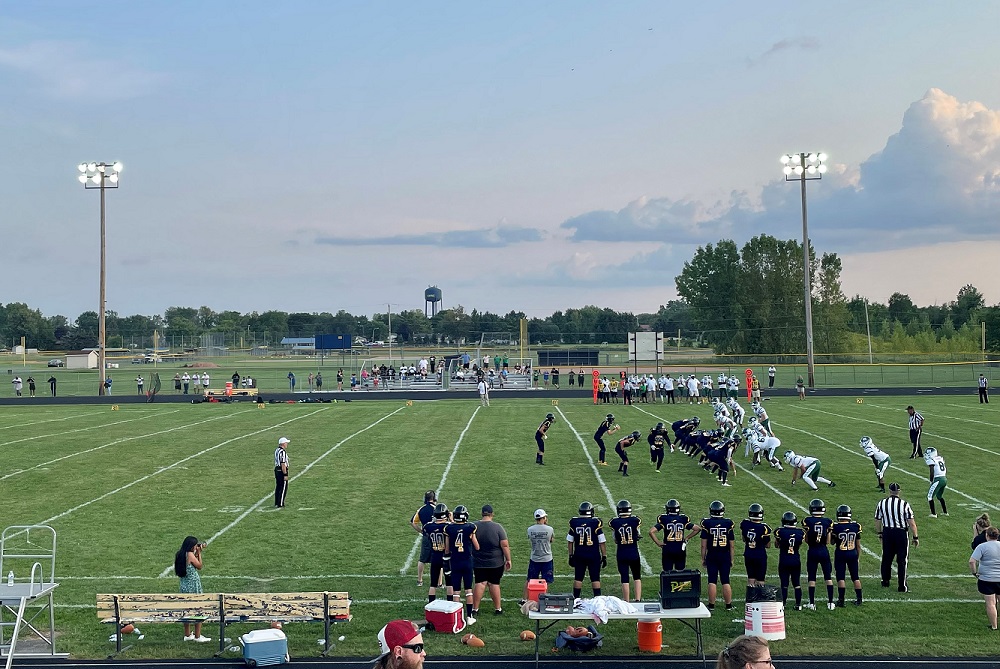
PHOTO: Capac and New Haven kicked off their season last week. Capac, returning after playing only one game a year ago, won 22-0. (Photo by Robert Batzloff.)