

2 Quarterbacks Vault Muskegon to #1
November 1, 2016
By Tom Kendra
Special for Second Half
Stopping the Muskegon High School offense has never been easy.
 This year, it’s twice as tough.
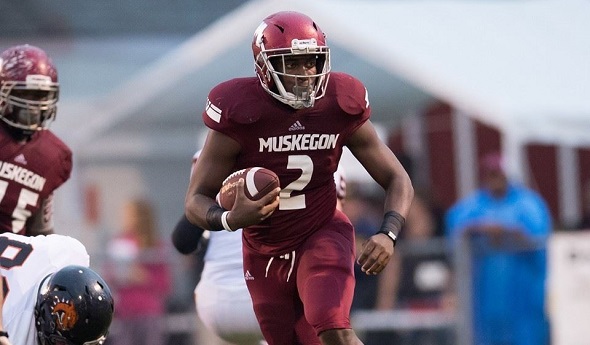
The Big Reds, 9-1 and ranked No. 1 in the season-ending Associated Press Division 3 poll, are attacking opponents with a two-headed monster at quarterback – diminutive senior Kalil Pimpleton (5-7, 160) and physically imposing junior La’darius Jefferson (6-2, 210).
“I’m blessed with two great men, two great leaders, at quarterback,” said seventh-year Muskegon head coach Shane Fairfield, whose team won the Ottawa-Kent Conference Black title. “Using both of them makes us a better team. We don’t go into games with a specific plan for when each will play (quarterback). We see what the defense is doing and how our kids are responding and go from there.”
The result of the dual QB attack has been a Muskegon offense which is averaging 54 points and 428 total yards per game heading into Friday night’s Division 3 District championship game against visiting East Grand Rapids (8-2).
Pimpleton, who has run a 4.4 in the 40-yard dash and has verbally committed to Virginia Tech, has started all 10 games for the Big Reds.
He is primarily a running threat, regularly taking snaps out of the pistol formation from senior center Devin Sanders and then finding a seam somewhere along the line to squeeze through. “KP,” as he’s known, has carried 101 times for 1,081 yards and 17 rushing touchdowns. He also has been effective through the air, completing 34 of 66 passes for 639 yards and six more TDs.
“I look at the system we use as a chance for me to use all of my weapons,” said Pimpleton, who also has three punt returns for touchdowns on his resume. “It doesn’t matter if I am at QB or in the slot. My character doesn’t change, and my focus doesn’t change.”
As good as Pimpleton has been, there have been times in recent years where opponents have bottled up Muskegon’s running quarterbacks.
One example was the 2014 Division 3 championship game at Ford Field, where Orchard Lake St. Mary’s shut down the Big Reds in a 7-0 victory. Another was last year’s Division 2 Regional championship game at Lowell, where Pimpleton and the Muskegon attack got stuck in the mud in a 36-7 loss.
 If that same scenario begins to unfold this fall, Muskegon offensive coordinator Brent White has a Plan B.
And what a Plan B it is.
Jefferson, who has the look of Cam Newton and the big arm to match, presents a whole new set of challenges for opposing defenses when he enters the game, which is normally around the Big Reds’ third offensive series. Jefferson brings a deep vertical passing threat, mixed with the size and strength to run over linebackers.
“I always tell myself that I can’t be stopped – that’s the mentality I like to play with,” said Jefferson, who also has delivered some big hits this fall during limited playing time at outside linebacker. “I just want to thank my coaches for using a two-QB system. Now we’ve got two hungry guys trying to win a state title.”
The benefits of Muskegon’s dual quarterback offense were apparent in last week’s 63-14 Division 3 Pre-District victory over visiting Grand Rapids Forest Hills Northern.
Muskegon’s offense struggled briefly in the early going before Jefferson ignited the Big Reds and their crowd with a 56-yard TD pass to Pimpleton, who had moved out to slot receiver. Near the end of the first quarter, Jefferson scored on a 2-yard run.
In the second quarter, it was back to Pimpleton at QB and he led a scoring drive, ultimately sprinting in from five yards out. And then it was back to Jefferson, who hit standout senior wide receiver Jacorey Sullivan on a 44-yard bomb over the top to complete Muskegon’s first-half scoring.
“The idea is that we have a system and our kids know how to play with either quarterback,” explained Fairfield. “If we do it right, it puts much more pressure on the defense, not knowing what they are going to get.”
Jefferson finished the win over Forest Hills Northern 7 of 8 passing for 175 yards and three touchdowns, along with 11 rushes for 91 yards and two more touchdowns. For the season, Jefferson has completed 42 of 69 passes for 724 yards and 15 touchdowns, against just two interceptions. He has rushed 66 times for 534 yards and 10 TDs.
The two quarterbacks are by far Muskegon’s top two rushers in an offense that lines up with four receivers on most downs. The lone starter in the backfield is senior Division I linebacker prospect Andrew Ward (6-1, 210), who is a devastating lead blocker. In recent weeks, the Big Reds have started to hurt opponents with jet sweeps featuring speedy juniors Da’vion McCall, Clinton Jefferson and Lonnie Clark Jr.
Fairfield, whose team has ripped off eight straight wins after a Week 2 loss to pass-happy Lincolnshire (Ill.) Stevenson, has guided Muskegon to MHSAA Finals three times in his first six years as head coach. The Big Reds have failed to take that final step on each of those occasions, falling to Birmingham Brother Rice in 2012 and 2013 and Orchard Lake St. Mary’s in 2014.
Given that recent heartbreak, the Big Reds have made it clear since Day 1 that the only acceptable outcome this season is an MHSAA title. The next challenge is a dandy matchup in Friday’s District championship game between two of the top tradition-rich programs in Michigan high school football history.
Muskegon is the state’s winningest with 816 wins and 17 state titles, including five in the MHSAA playoff era. East Grand Rapids, meanwhile, has won 11 championships since the playoffs began in 1975, including five in a row from 2006 to 2010. The Pioneers have won seven straight this fall after stumbling to a 1-2 start.
The two powers have played only two times in history, with Muskegon winning both times.
“We need to come out and play our game,” said Pimpleton. “We believe in our coaches and that they will put us in the best spots to win. That’s really all that matters. We can’t lose sight that no matter who is out there, that is our one goal.”
 Tom Kendra worked 23 years at The Muskegon Chronicle, including five as assistant sports editor and the final six as sports editor through 2011. E-mail him at [email protected] with story ideas for Muskegon, Oceana, Mason, Lake, Oceola, Mecosta and Newaygo counties.
PHOTOS: (Top) Muskegon quarterback La'darius Jefferson picks up yards on the ground this season against Byron Center. (Middle) Kalil Pimpleton, here following through on a pass, also is a threat to run. (Jefferson photo courtesy of Muskegon football program, Pimpleton photo by Tim Reilly.)
Whiteford Completes Championship Climb
December 15, 2017
By Geoff Kimmerly
Second Half editor
Ottawa Lake Whiteford football had been building toward this.
Coach Jason Mensing took over a program in 2012 that had gone 4-5 the previous fall, and immediately the Bobcats doubled their wins to finish 8-2. Next came seasons of 9-3, 7-4, 10-3 and program’s first MHSAA Semifinal in 2015, and 13-1 with its only loss in the Division 8 championship game a year ago.
 And yet, for the bulk of this season Whiteford still had to look up at a few others, relatively speaking. Reigning champion Muskegon Catholic Central was most people’s favorite to win the division again – until the Crusaders lost their District Final to Mendon, which became the new favorite.
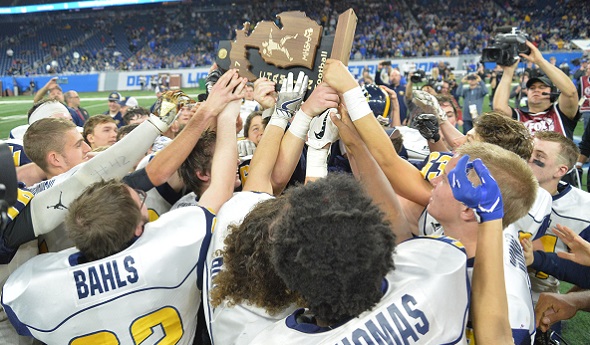
Meanwhile, Whiteford – the MHSAA/Applebee’s Team of the Month for November – bided its time until receiving its opportunity to make history. The Bobcats made the loudest statement with a 50-21 win over Mendon in their Semifinal on Nov. 17, and then assumed the top spot in Division 8 for the first time with a 42-21 championship game win over Saginaw Nouvel on Nov. 24 at Ford Field.
The Bobcats moving forward will still be looking up – but now at a championship banner to be hung and at a goal that certainly will seem more attainable now that they’ve achieved it for the first time.
“My hope is all the boys within our community and school see it and want to accomplish that for themselves,” said Mensing, also the school’s athletic director. “Obviously, it’s not realistic that it’s going to happen every year. But that aspiration for greatness and success … the idea that I can accomplish this, the idea I want this and I’m going to strive for it. Wherever you end up matters less (than) the pursuit of excellence.”
Whiteford pursued and attained excellence and dominance this fall on the way to a 14-0 record, starting with an offense that scored 737 points – tied for second most in MHSAA history, and an average of 52.6 per game.
Tri-County Conference rival Petersburg-Summerfield came within 16 points of catching the Bobcats in the District Final, Whiteford’s closest game of the entire fall as they won on average by nearly 40 points. During the playoffs alone, Whiteford outscored five opponents by an average of 50-18.
The Bobcats had fallen in the 2016 title game 35-6 to Muskegon Catholic Central, but certainly benefited from that first-time experience. Mensing sensed his team’s calm this time around, but also praised his players and coaches for staying focused week in and week out on improving and paying attention to details – no small tasks when everyone knew early on that Whiteford should be in the championship mix.
To win it all, teams generally must have size and speed, and Whiteford certainly had both, even as a school with roughly 240 students – but with nearly 50 on the roster for the championship game.
 Let’s start with size. Senior Lucas Tesznar (6-foot-5, 285 pounds) set the tone up front offensively and senior Jarret Atherton (6-1, 255) was an all-stater on both sides for the ball. Junior DeShaun Williams (6-5, 280) was an all-leaguer on defense.
Speed and skill? Senior quarterback Thomas Eitniear and junior running back Logan Murphy keyed a dynamic backfield – Eitniear throwing for 1,403 yards and 17 touchdowns and running for 919 yards more, while Murphy ran for 1,873 yards. Together they combined to set eight school records including Murphy’s for yards gained on the ground. Junior Braden Clark-Gilmore added another school record with 10 receiving touchdowns.
On a defense that gave up only 206 yards of offense and 13 points per game, junior Ty Eitniear set a school record with seven interceptions. Senior lineman Matthew Taylor, senior linebacker Eli Shelton and junior defensive backs Hunter Lake and Zack Bertz joined Atherton as all-state picks on that side of the ball.
Total, eight players secured some level of all-state recognition and 13 Bobcats earned first-team honors in the Tri-County Conference.
The Bobcats are turning their attention to other sports this school year and a future in football without 14 hard-working seniors who will graduate in the spring. But the memories of this fall surely will be lasting, even as the program is poised to continue making runs at top finishes.
“There have been a lot of well wishes, to our kids and our staff, and the school as a whole,” Mensing said. “There are so many people who invest in a football program at all schools, let alone one getting that deep into the playoffs. All of those people who have invested and worked at it have some pride and sense of accomplishment.”
Past Teams of the Month, 2017-18
October: Beaverton volleyball - Report
September: Shepherd girls golf - Report
PHOTOS: (Top) Ottawa Lake Whiteford raises its Division 8 championship trophy at Ford Field last month. (Middle) Senior Eli Shelton leads the Bobcats onto the field.