

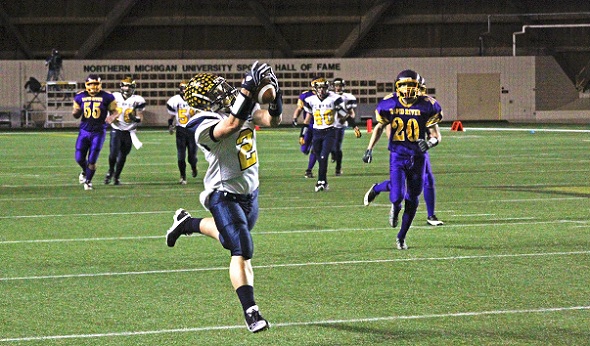
2011 8-Player Final: Carsonville-Port Sanilac Wins Inaugural Title
December 16, 2011
MARQUETTE – Carsonville-Port Sanilac sophomore Dan Rickett emerged from his team’s final huddle of this season, pulled close to an assistant coach and said, “This one says MHSAA this time.”
His Tigers also celebrated a championship last season – a perfect season in fact, but unofficial title because the MHSAA has not yet instituted playoffs for the now 3-year-old sport.
This year, the first playoffs were held. And that made Friday’s 59-20 win over Rapid River at the Superior Dome – and the trophy C-PS then received – mean so much more.
The Tigers are the first MHSAA 8-player football champions.
“All the people saying last year was nothing, this will shut them up,” C-PS senior quarterback Hayden Adams said. “It means a lot more because we actually had to make a run in the playoffs. It’s that much harder, and we had to play that much better every game.
“I think we topped it off at the end of the season.”
A total of 1,433 fans – most wearing Rapid River’s purple and yellow – cheered on the teams in the inaugural game. C-PS finished 12-1 overall to move to 21-1 in coach Tim Brabant’s two seasons. The Rockets finished 11-2 in their first season of 8-player.
The sport was added by the MHSAA in 2009 to provide another option for schools with enrollments so small they had difficulty fielding an 11-player squad. Playoffs were added this season after the necessary 20 schools announced they’d be sponsoring 8-player teams.
That was not lost on either team, even for Rapid River in the loss. The Rockets had won one game each of the last two seasons playing 11-player teams.
“We had never played in the postseason at all since I’ve been here,” Rapid River senior running back Jacob Berglund said. “To make it this far, it’s awesome.”
Offense has reigned in the early stages of the MHSAA 8-player game. The Final kept to that standard.
The teams combined for 901 yards. Adams completed 12 of 17 passes for 324 yards and five touchdowns, and ran for 130 more yards and two scores. Two of his scoring passes were to his brother Trevor Adams, also a senior, including a 43-yarder on the second play of the game. Rickett ran for 78 yards and a touchdown on five carries, and also caught six passes for 133 yards and two scores.
The Tigers jumped out to a 19-0 lead and pushed it to 27-6 by the end of the first quarter. But in 8-player football, a 21-point advantage generally is not a safe one.
Rapid River outscored C-PS in the second quarter to get within 39-20 by halftime. After completing just one pass during the first quarter, Rockets sophomore quarterback Jake Pearson threw for 144 yards and two scores during the second.
But then something somewhat unimaginable happened. The Tigers held the Rockets scoreless the rest of the game.
“At halftime we made some adjustments on what we should do when they motioned. We picked it up real fast,” said C-PS senior linebacker Steven Koehler, who finished with a game-high 20 tackles, including 12 solos.
“I think that the fact they had 10 seniors, and the speed. They’re a year older, two years older in some cases,” Rapid River coach Steve Ostrenga listed as reasons his team had difficulties. “You get two more years of development in that respect as far as strength, and their speed was noticeable. I think that was the big key, their speed.”
Half of C-PS’s players were seniors who had served large roles on this and last season’s teams.
“It’s very fun to watch when we have a group of kids who are that athletic, hard working, and very polite. It’s hard for me to send these guys off,” Brabant said. “I get emotional just thinking about it. But … I know they’re going to be very successful in life.”
The Rockets, meanwhile, graduate just seven players, and also had seven freshmen and three sophomores this fall. Said Pearson, “It was a great learning experience. We know what we have to do for next year now.”
“Now all the teams are going to see what we do,” Adams said. “And they’re going to start doing all the things we do.”
1st & Goal: 2021 Week 4 Preview
By
Geoff Kimmerly
MHSAA.com senior editor
September 17, 2021
For the last 20 years, we would have entered Week 4 of football season discussing how many teams would have to win the rest of their games to guarantee making the playoffs.
 But the six-wins-and-in era is done (and never existed for 8-player), and there’s still plenty of time for every team to impact its destiny – especially with only 130 of 598 teams still undefeated and 12 more sure to fall off that list this weekend.
MHSAA.tv will carry 170 games live this weekend, with Bally Sports Detroit broadcasting Friday's Traverse City Central/Traverse City West matchup on its PLUS cable channel. See the full schedule from the MHSAA Score Center and see below for some of the games with the most intriguing storylines as we take another step toward the regular season’s midpoint.
Bay & Thumb
Davison (1-2) at Grand Blanc (3-0)
This is the fourth season these two will meet in the Saginaw Valley League Red, and Davison has won all four meetings of the recent series including for a Division 1 District title last year. Coming off three one-score wins over highly-touted foes – East Lansing, Grand Rapids Forest Hills Central and Midland Dow – Grand Blanc could be ready to take its turn in the rivalry. But the Cardinals’ record is deceptive. Coming off last season’s second-straight trip to the Division 1 Final, Davison opened this fall with losses to Clarkston and then Detroit Catholic Central, falling by just three to the still-undefeated Wolves.
Keep an eye on these FRIDAY Mount Pleasant (3-0) at Midland Dow (2-1), Standish-Sterling (3-0) at Millington (3-0), Freeland (3-0) at Essexville Garber (3-0), Harbor Beach (2-1) at Ubly (3-0).
Greater Detroit
Warren De La Salle Collegiate (2-0) at Bloomfield Hills Brother Rice (3-0)
The four Detroit Catholic League Central teams are a combined 10-1 this fall, and this week begins a must-see title race. These two have opened league play against each other since 2010, with seven meetings (including one in the playoffs) decided by seven or fewer points. Rice won the 2019 matchup 16-14 and last year 27-25, but the Pilots followed up the latter by reaching the Division 2 Final for the third time in four seasons. The Warriors haven’t given up a point since a season-opening win over Macomb Dakota, but De La Salle can claim the biggest headliner so far after downing last season’s Division 3 runner-up River Rouge 38-29 in Week 2.
Keep an eye on these FRIDAY Grosse Pointe South (2-1) at Romeo (3-0), Detroit Country Day (3-0) at South Lyon (3-0), Marine City (3-0) at Wyandotte Roosevelt (3-0), Southfield Arts & Technology (2-1) at Clarkston (3-0).
Mid-Michigan
Haslett (2-1) at Mason (2-1)
Last week’s Mason comeback win over Williamston thrust this game quickly into the spotlight as it’s almost sure to have Capital Area Activities Conference Red implications. Mason has won the league the last two seasons, while Haslett is returning to contention – the Vikings already have as many wins this fall as in 2020 and 2019, and they need one more point to also equal last year’s scoring over seven games. Both of these teams have intriguing offensive skill players, but both also needed time last week to get rolling – Williamston trailed 27-13 at halftime before winning 34-27, and Haslett was up 7-0 at halftime on the way to defeating Lansing Eastern 33-14. Getting on track first could be key.
Keep an eye on these FRIDAY Lake City (3-0) at Beal City (2-1), Big Rapids (2-1) at Central Montcalm (3-0), Holt (2-1) at DeWitt (2-1), Lansing Everett (2-1) at Grand Ledge (3-0).
Northern Lower Peninsula
Traverse City West (3-0) vs. Traverse City Central (2-1) at Thirlby Field
The annual “Patriot Game” is the place to be in northern Michigan – crowds every season of 10,000+ would agree – and this year’s chapter could read more like the one-score classics from most of the last decade after less-characteristic big wins (both by Central) the last two seasons. They’ll go together into the Saginaw Valley League for football next season, and started their final Big North Conference schedules last week with wins – West 21-7 over last season’s Division 4 runner-up Cadillac. The only loss by either so far has been Central’s season opener to reigning Division 3 champion DeWitt.
Keep an eye on these FRIDAY Traverse City St. Francis (3-0) at Maple City Glen Lake (1-2), Frankfort (2-1) at Oscoda (2-1), Harbor Springs (1-2) at Boyne City (3-0), Petoskey (3-0) at Gaylord (1-2).
Southeast & Border
Michigan Center (3-0) at Addison (3-0)
Addison has won two straight Cascades Conference titles and 16 straight league games, but this will be its first matchup with Michigan Center since 2019. They didn’t see each other during last year’s abbreviated regular season, although the Cardinals finished second in the league with a loss coming to Hanover-Horton. Addison has outscored its three opponents so far – including Hanover-Horton last week – by a combined 145-35. But the Cardinals have been just as impressive if not more – outscoring their three opponents 136-0, including a 42-0 avenging against Hanover-Horton in Week 2.
Keep an eye on these FRIDAY Monroe St. Mary Catholic Central (3-0) at Milan (3-0), Monroe (2-1) at Saline (3-0), Ann Arbor Huron (2-1) at Temperance Bedford (3-0), Clinton (2-1) at Ida (2-1).
Southwest Corridor
Vicksburg (3-0) at Edwardsburg (3-0)
It’s early, of course, but statistically this Edwardsburg team is following the pattern of its best over the last decade. The offense has scored more every week, from 38 to 55 to 61 against Niles in the latest win, and the defense has given up seven points total. Next up are the Bulldogs, who lost twice to Edwardsburg last season but have been a playoff team five of the last seven years. The three opponents the Eddies defeated are all 2-1, and league rivals are lined up – undefeated Plainwell is next after Vicksburg, with Paw Paw coming up in Week 6.
Keep an eye on these FRIDAY Three Rivers (2-1) at Niles (2-1), Battle Creek Lakeview (2-1) at Battle Creek Central (2-1), White Pigeon (3-0) at Comstock (2-1), St. Joseph (3-0) at Kalamazoo Central (1-2).
Upper Peninsula
Ishpeming Westwood (2-1) at Ishpeming (1-1)
This rivalry will be restored after Ishpeming did not field a varsity last season. The Patriots solidly ended a 23-game losing streak to the Hematites the last time they met, however, claiming the 2019 matchup 38-0. Westwood’s fast start this fall ran into an obstacle last week with a loss to Calumet, but there would hardly be a better way to pick back up than with a win tonight. Ishpeming was off last week and has had plenty of time to prepare for a game that could pay big dividends toward its rebound as well.
Keep an eye on these FRIDAY Kingsford (3-0) at Marquette (2-1), Iron Mountain (1-2) at L'Anse (2-1), Negaunee (2-1) at Manistique (2-1). SATURDAY Houghton (2-1) at Bark River-Harris (3-0).
West Michigan
Muskegon Oakridge (3-0) at Montague (2-1)
A fresh start with some new faces saw Montague shut out in Week 1 by a strong Edwardsburg team. But the reigning Division 6 champion Wildcats stormed right back with back-to-back shutouts the last two weeks of North Muskegon and Hart. And they could get another big boost against rival Oakridge, which they’ve beaten three of the last four seasons including 42-6 a year ago. The Eagles are coming off a forfeit win/bye last week but already own a pair of solid wins over Sparta and Whitehall. Another this week combined with the Week 2 victory over the Vikings would put the Eagles in pretty strong position in the West Michigan Conference title race.
Keep an eye on these FRIDAY Zeeland West (2-1) at Muskegon Mona Shores (2-1), East Grand Rapids (1-2) at Byron Center (3-0), Manton (2-1) at Evart (3-0), Grand Rapids South Christian (2-1) at Grand Rapids Catholic Central (3-0).
8-Player
Mendon (3-0) at Bridgman (3-0)
These two are likely league title contenders in the Southwest Michigan 8-Man Football League Tier 1 and 2, respectively. Mendon had been one of the last southwestern holdouts its size before switching to 8-player football for this fall, and the Hornets brought a run of 13 winning seasons over their last 14 with them. So far so good after the switch, as the offense is averaging just more than 63 points per game. Bridgman successfully made the switch in 2018 and is a combined 18-2 since the move. The Bees are scoring 55 points per game so far – but more notably for this matchup, giving up only seven.
Keep an eye on these FRIDAY Adrian Lenawee Christian (3-0) at Athens (3-0), Norway (2-1) at Ironwood (2-1), Lawrence (3-0) at Morrice (3-0). SATURDAY Lake Linden-Hubbell (2-1) at Powers North Central (3-0).
Second Half’s weekly “1st & Goal” previews and reviews are powered by MI Student Aid, a part of the Office of Postsecondary Financial Planning located within the Michigan Department of Treasury. MI Student Aid encourages students to pursue postsecondary education by providing access to student financial resources and information. MI Student Aid administers the state’s 529 college savings programs (MET/MESP), as well as scholarship and grant programs that help make college Accessible, Affordable and Attainable for you. Connect with MI Student Aid at www.michigan.gov/mistudentaid and find more information on Facebook and Twitter @mistudentaid.
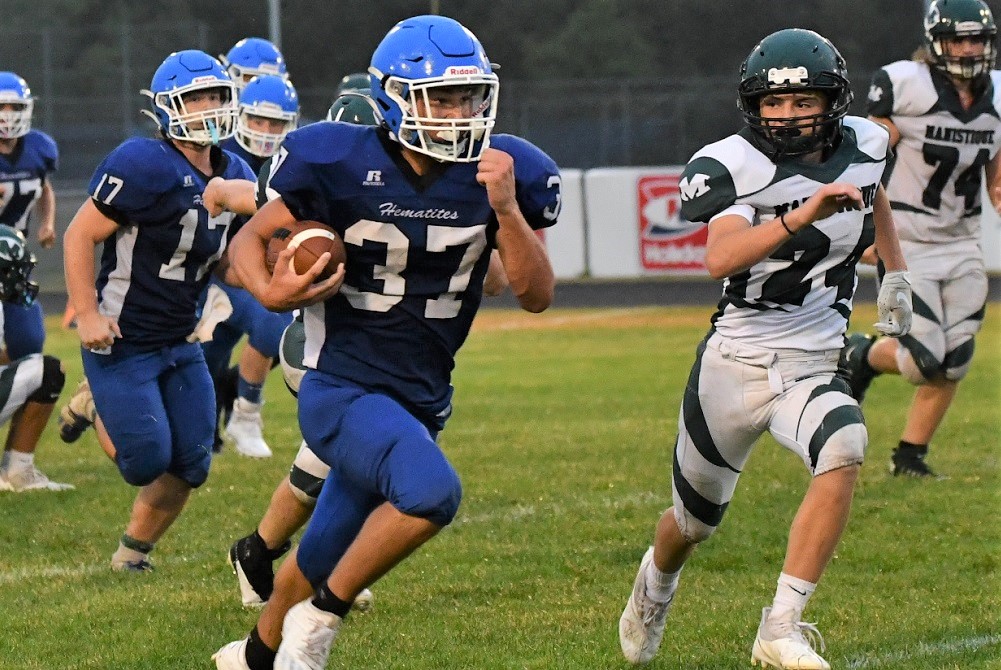
PHOTO: Ishpeming's Preston Gauthier (37) is chased by Manistique's Austin Hinkson (24) during their teams’ Week 1 matchup. (Photo by Cara Kamps.)