

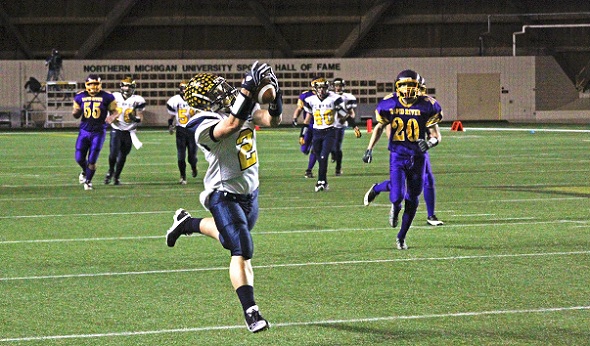
2011 8-Player Final: Carsonville-Port Sanilac Wins Inaugural Title
December 16, 2011
MARQUETTE – Carsonville-Port Sanilac sophomore Dan Rickett emerged from his team’s final huddle of this season, pulled close to an assistant coach and said, “This one says MHSAA this time.”
His Tigers also celebrated a championship last season – a perfect season in fact, but unofficial title because the MHSAA has not yet instituted playoffs for the now 3-year-old sport.
This year, the first playoffs were held. And that made Friday’s 59-20 win over Rapid River at the Superior Dome – and the trophy C-PS then received – mean so much more.
The Tigers are the first MHSAA 8-player football champions.
“All the people saying last year was nothing, this will shut them up,” C-PS senior quarterback Hayden Adams said. “It means a lot more because we actually had to make a run in the playoffs. It’s that much harder, and we had to play that much better every game.
“I think we topped it off at the end of the season.”
A total of 1,433 fans – most wearing Rapid River’s purple and yellow – cheered on the teams in the inaugural game. C-PS finished 12-1 overall to move to 21-1 in coach Tim Brabant’s two seasons. The Rockets finished 11-2 in their first season of 8-player.
The sport was added by the MHSAA in 2009 to provide another option for schools with enrollments so small they had difficulty fielding an 11-player squad. Playoffs were added this season after the necessary 20 schools announced they’d be sponsoring 8-player teams.
That was not lost on either team, even for Rapid River in the loss. The Rockets had won one game each of the last two seasons playing 11-player teams.
“We had never played in the postseason at all since I’ve been here,” Rapid River senior running back Jacob Berglund said. “To make it this far, it’s awesome.”
Offense has reigned in the early stages of the MHSAA 8-player game. The Final kept to that standard.
The teams combined for 901 yards. Adams completed 12 of 17 passes for 324 yards and five touchdowns, and ran for 130 more yards and two scores. Two of his scoring passes were to his brother Trevor Adams, also a senior, including a 43-yarder on the second play of the game. Rickett ran for 78 yards and a touchdown on five carries, and also caught six passes for 133 yards and two scores.
The Tigers jumped out to a 19-0 lead and pushed it to 27-6 by the end of the first quarter. But in 8-player football, a 21-point advantage generally is not a safe one.
Rapid River outscored C-PS in the second quarter to get within 39-20 by halftime. After completing just one pass during the first quarter, Rockets sophomore quarterback Jake Pearson threw for 144 yards and two scores during the second.
But then something somewhat unimaginable happened. The Tigers held the Rockets scoreless the rest of the game.
“At halftime we made some adjustments on what we should do when they motioned. We picked it up real fast,” said C-PS senior linebacker Steven Koehler, who finished with a game-high 20 tackles, including 12 solos.
“I think that the fact they had 10 seniors, and the speed. They’re a year older, two years older in some cases,” Rapid River coach Steve Ostrenga listed as reasons his team had difficulties. “You get two more years of development in that respect as far as strength, and their speed was noticeable. I think that was the big key, their speed.”
Half of C-PS’s players were seniors who had served large roles on this and last season’s teams.
“It’s very fun to watch when we have a group of kids who are that athletic, hard working, and very polite. It’s hard for me to send these guys off,” Brabant said. “I get emotional just thinking about it. But … I know they’re going to be very successful in life.”
The Rockets, meanwhile, graduate just seven players, and also had seven freshmen and three sophomores this fall. Said Pearson, “It was a great learning experience. We know what we have to do for next year now.”
“Now all the teams are going to see what we do,” Adams said. “And they’re going to start doing all the things we do.”
Whiteford Scores 1st Title with Epic Offense
November 24, 2017
By Geoff Kimmerly
Second Half editor
DETROIT – Next time, no one will leave Ottawa Lake Whiteford out of the conversation.
 It wasn’t like the Bobcats felt overlooked. But coming into this season’s Division 8 playoffs, it was pretty easy to pencil in four-time reigning champion Muskegon Catholic Central to win again.
Then, when the Crusaders lost to 12-time champion Mendon in the Regional Finals, the Hornets assumed the status as favorites – while on the other side of the bracket, reigning runner-up Whiteford continued building a run historic both locally and statewide.
“Everybody kinda knew Muskegon (CC) was the favorite going in, and Mendon beating them, that was a big win,” Bobcats senior lineman Lucas Tesznar said. “But we knew what we had. We knew we were talented. We just had to play our game every game, and good things would happen.”
And they experienced the best Friday – the first MHSAA football championship in school history, with a 42-21 win over previously-undefeated Saginaw Nouvel to kick off the weekend at Ford Field.
Last year’s trip to the Division 8 Final was Whiteford’s first appearance in an MHSAA title game in this sport.
The Bobcats lost to MCC 35-6, but a year later left the field having scored 737 points this fall – tied for second most in one season with Beal City’s 2013 team – to average 52.6 per game, tied with the Aggies for ninth-most all-time.
Whiteford finished 14-0, winning all of its games by at least 16 points. It’s 27-1 over the last two seasons and 37-4 over the last three.
“Four years ago if you would’ve told me we were going to be in back-to-back states, and win it my senior year, I wouldn’t have believed you,” Tesznar said. “It wasn’t just us. It was the whole community. Everybody around us just pushed us to get better, and the support was non-stop. It was just amazing.”
Whiteford put nonstop pressure on Nouvel, starting with the opening kickoff – an onside bouncer recovered by Bobcats senior quarterback Thomas Eitniear, the first successful onside kick to open an MHSAA Final since Spring Lake succeeded against Jackson Lumen Christi in the 2000 Division 5 game.
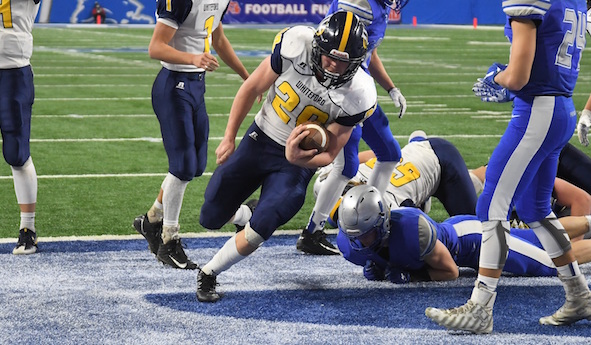
 Two plays later, Eitniear ran 37 yards to put his team on the board. By the end of the first quarter, junior Logan Murphy had added two running scores to push the Bobcats’ advantage to 20-0. Eitniear ran for another four minutes into the second quarter to make the score 28-0 and give Whiteford all of the offense it would need for the day.
The Bobcats gained 484 yards, with Eitniear running 10 times for 129 and three touchdowns and throwing for 143 on 7 of 11 passing. Murphy had 126 yards rushing and three scores as well.
They succeeded behind an all-senior line anchored by the 6-foot-5, 285-pound Tesznar. He was joined up front by Jordan Book, Jacob Lewis, Alex Kohler, Jarret Atherton and tight end Matthew Taylor.
“We work every day in practice, just to get better each and every day. But I’m not surprised … our o-line has worked as hard as they can all year,” Eitniear said. “That whole offense is all based on them. All of that is all them.”
Nouvel had a tougher time stopping the Bobcats’ attacking defense, which had 11 tackles for losses including four sacks by junior Ian Slick and two by Taylor. Whiteford didn’t allow more than 22 points in a game this season, an impressive feat that got lost a little behind all of the accomplishments on offense.
Senior Tate Hausbeck threw for 175 yards and two touchdowns on 11 of 26 passing for Nouvel (13-1), with senior Ken Kujawa catching both scoring tosses. Junior Joshua Kuligowski added a score on the ground. Senior Alex Wrobel led Nouvel with 14 tackles, and Kujawa had 10.
“All the looks we had out there were pretty much what we planned for. When you’re playing against a good football team, you’ve got to make some plays, try to find a way to make plays,” Nouvel coach Mike Boyd said. “I thought at times we moved the ball extremely well. I think probably when we reflect on things, we’ll see some opportunities that got away from us. They got a lot of pressure on Tate, and if we had more from a protection standpoint we might have had some big plays out there.”
Whiteford coach Jason Mensing talked after of the support his program has received from various groups in the community since he and his staff took over six years ago – and how all of it has made a difference as the Bobcats have continued to rise.
On their way back to Detroit, they found what they needed to climb one step more and finish as the last Division 8 team standing.
“The chemistry this year was just so amazing. Everybody got along with each other, and it was just a family. I think that’s what put us over the top,” Tesznar said. “We put Whiteford on the map, and it’s amazing. I think we all wanted a little revenge on Muskegon, but this feels just as good winning the state title.”
The MHSAA Playoffs are sponsored by the Michigan Army National Guard.
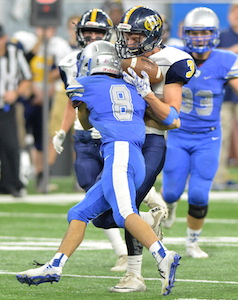
PHOTOS: (Top) Whiteford's Logan Murphy rumbles into the end zone for one of his two touchdowns Friday. (Middle) Bradyn Clark-Gilmore holds on to a catch as Nouvel's Ken Kujawa wraps him up.