

'22 Game' Lasts 2 Plays, Lives on
By
Ron Pesch
MHSAA historian
October 26, 2015
What would you do with 22 seconds to right a wrong?
In Michigan, the longest football game in high school sports history was played on September 23, 1977 when Detroit Southeastern defeated Detroit Northeastern 42-36 in nine overtimes.
But what is the shortest?
On the evening of Thursday, Nov. 5, 1953, Eaton County foes Bellevue and Vermontville squared off in a Tri-C Conference battle. It was a home contest for Vermontville, but without illumination at its field, the game was staged just west beneath the lights at Nashville High School in Barry County.
The dominant team in Tri-C play over the previous three years, Bellevue’s Broncos had posted three consecutive undefeated seasons from 1950 and 1952. However, graduation took its toll and with only five returning veterans in the fall of 1953, Bellevue lost its nonconference season opener to Homer. The Broncos had also dropped a pair of league contests, to Lake Odessa and Olivet, just prior to the Vermontville game, and entered with a 4-3 record.
Vermontville brought a 4-2 mark into the contest, and was in a four-way tie with Bellevue, Nashville and Lake Odessa for second in the conference.
The Broncos and Wildcats were evenly matched and played to a scoreless tie in the first half. Vermontville opened up a 6-0 lead on a 20-yard end sweep by the Wildcats’ quarterback Pete Benton in the third quarter, but entered the final minutes of the game trailing 12-6 thanks to a TD run by Bellevue’s Jim Smith and an early-fourth quarter scoring pass from Smith to Bob Babbitt.
Coach Dave McDowell’s Wildcats mounted a long final drive, and fans strapped in for a thrilling finish. Pushing deep into Bellevue territory, Vermontville faced a fourth down and eight from the 16-yard line with under a minute to play when Benton launched a desperation pass to the end zone.
The pass fell incomplete, but Bellevue was flagged for pass interference. Officials stepped off the penalty and awarded Vermontville the ball at the one-yard line, but the Wildcats’ plunge into the line fell an inch short on what was called a repeated fourth down play. Vermontville took possession and ran out the clock.
Following the game, Coach McDowell protested the ruling to officials, correctly stating that his team should have been awarded an automatic first down and goal from the 1-yard-line on the penalty, according to high school rules. Appealing the call, the situation was brought to the attention of the league, MHSAA executive director Charles Forsythe and the MHSAA athletic board.
On Wednesday, Nov. 11, the state athletic board agreed an error had been made, but did not order a replay. Instead, they noted three possible solutions:
- Result left as it was.
- Called a no contest.
- Replay it at the point of infraction.
The board moved a final decision back to the league. Because of the possible impact on the final conference standings, and eventually, the awarding of the league’s all-sports trophy, the Tri-C Conference opted to replay the contest from the point of infraction – the 1-yard line – with 22 seconds placed on the clock.
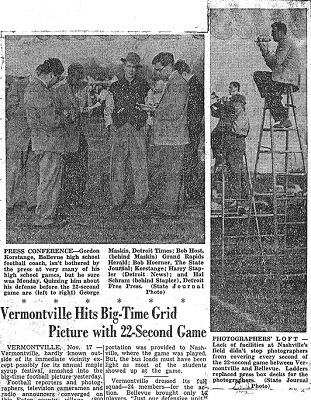 The news of the league’s decision was blasted out by the news services nationwide, and immediately, the pending replay of a small town contest captured the imagination of reporters and sports fans across the United States.
“Shortest ‘Game’ in History?” read the headline in the Lexington, Kentucky Herald. From Biloxi, Mississippi, to Boston, Massachusetts, from Rockford, Illinois to Omaha, Nebraska and Seattle Washington, sports aficionados read the news about the error. Best of all, details flowed forth on the plan to replay critical seconds that might alter the result, fulfilling every fan’s dream.
So began the longest huddle in history.
“What would you do?” was the question on the lips of coaches and followers in barber shops and factories. Detroit Free Press writer George Puscas asked that very question to some of Michigan’s top coaches.
Detroit Lions coach Buddy Parker offered his advice to Vermontville’s coach McDowell.
“The other team will be expecting a run,” noted Parker, “so I would fake a run off tackle then throw a pass in the other direction – with three receivers downfield.”
Michigan State’s legendary Biggie Munn stated the obvious:
“Call a scoring play.”
University of Michigan head coach Bennie Oosterbaan was tied up preparing for the Wolverines’ upcoming contest with MSU, so instead U-M end coach Bill Orwig weighed in with a tongue-in-cheek recommendation:
“Take the time out.”
Earl “Dutch” Clark, in charge at the University of Detroit, suggested that McDowell diagram “two of the most unusual offensive formations … anything to confuse the defense. The first play should be a running play and if it didn’t work, take time out then try again.”
Wayne University’s coach Lou Zarza was the most specific of them all.
“On a goal line stand, the defense usually drifts toward the middle. So I would fake the ball to the right halfback on a slant, then send the fullback with the ball wide to the right, outflanking the defense. It’s a good goal line play on the T formation.”
Suggestions came from all over. A gentleman in Syracuse, New York, even penned a personal letter to McDowell with a sure-fire suggestion.
Three days after the 1953 prep season had officially ended, on the afternoon of Monday, Nov. 16, the same officiating crew and the Vermontville and Bellevue squads emerged and again travelled to Nashville to line up for what can arguably be called the shortest – or perhaps the longest – game in high school football history.
Reporters from Detroit, Grand Rapids, Lansing and Battle Creek converged on the city for 22 seconds of football. High school reporting legends Hal Schram of the Detroit Free Press, Bob Hoerner of the Lansing State Journal, George Maskin of the Detroit Times, Harry Stapler of the Detroit News and writers from the Associated Press and United Press International all descended upon mid-Michigan, “almost as if the Rose Bowl was to be played.”
“That game brought more publicity to coach Gordon Korstange’s 6-3 squad then his teams received for posting three consecutive unbeaten seasons in 1950, 1951 and 1952,” recalled 80-year old Burton H. Brooks, who was the only reporter who had covered the original contest, and one of many covering the replay. A graduate of Bellevue, he was a freshman at Michigan State at the time, earning money as a sports stringer for the Bellevue Gazette and Charlotte Republican Tribune.
Beneath sunny skies, “a crowd of over 500 fans and curiosity seekers, most of them attired in shirt sleeves, lined the field on both sides near the east end of the Nashville gridiron,” wrote Brooks, many years later. “At 5:00 the shrill blast of an official’s whistle split the air, announcing time for the game.”
Attendance was way up from the original contest, and in an unusual move for the time, Kalamazoo television station WKZO announced that they would send a crew to Nashville and then televise the game – (all 22 seconds of it!) – Tuesday evening. In addition, 10 newspaper photographers were on site to capture images from the game.
While the size of the crowd was up, turnout on the football squads had decreased. Vermontville dressed its full squad of 24 for the showdown, but kept out two regular tackles and his first-string quarterback, as all had been on the injured list at the end of the first clash.
Meanwhile, Bellevue brought only 14 players.
“Just our defensive unit and enough to run back the kickoff,” Korstange told the Lansing State Journal, prepared for a situation that could arise if Vermontville scored.
“Three of the defensive starters had decided to go deer hunting instead,” said Brooks discussing the shortened game, “so Bellevue needed to call up some kids for the game from the junior varsity squad.”
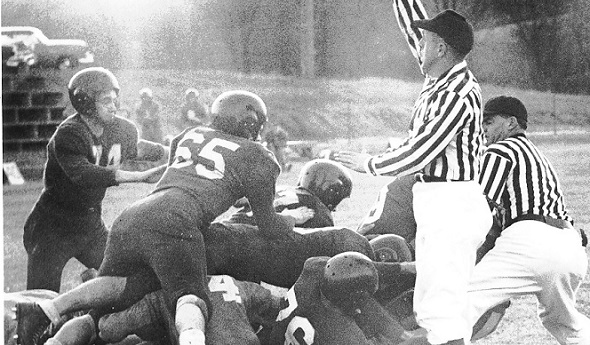
“Bellevue won its sixth game of the year, downing Vermontville in a sensational goal line stand in the famous ‘22’ Game” at Nashville last Monday,” wrote Brooks in the Bellevue Gazette. “Coach Dave McDowell’s Wildcats ran two plays against Bellevue, but couldn’t dent the solid Bronco defense. On the first play the Wildcats sent big Bob Steward up center, but he was driven back a yard by the entire center of the Bellevue line.”
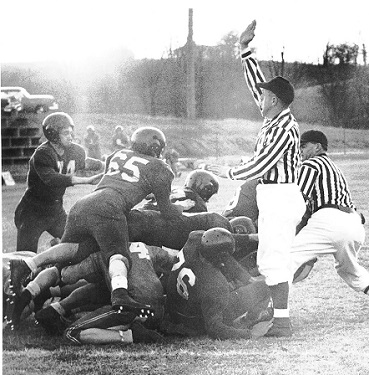 Following a timeout, the Green and White tried to sneak quarterback Pete Benton across the line to the left of center as the ball carrier on the second play, but the hole was quickly plugged by tackle Donald Rogers and guard Jerry Babbitt. Steward had been stopped by Bellevue guard Wayne Lesser. Dale Spotts, Bob Babbitt, Harold Messenger, Ralph Hales, Dick Moon, Jim Smith, Gordon Smith, and Ed Bessemer filled the other defensive spots and ensured the result of the first game went unchanged.
Once again, the wire services blasted their report from sea to shining sea.
“Officials Didn’t Rob Vermontville Team” screamed the headline in the Miami Daily News. Beneath an AP photo, residents of the Florida town were treated to a detailed account of the contest.
“Prep Grid Game Ends Same Way Following 11-Day Break” read the caption in the Dallas Morning News in football-crazed Texas.
“Replayed Grid Game Ends with the Same Result as Before,” read the headline in the Seattle, Washington, Daily Times.
As noted at the time, it certainly wasn’t the first, nor would it be the last, that a refereeing crew made a mistake in a game. Fans then, like now, were reminded officials are only human.
Bellevue ended the extended season in a tie for second with Lake Odessa, with 5-2 marks. For the first time in league history the Tri-C gridiron championship was awarded to Olivet, which, at 8-0, posted its first unbeaten season and, as it turned out, unseated Bellevue for the league’s 1953-54 all-sports trophy.
More than 60 years later, a forgotten showdown between high school football teams, played out before national attention in little Nashville, Michigan, still stands as one of the most entertaining and unusual sports moments in the history of America.
 Ron Pesch has taken an active role in researching the history of MHSAA events since 1985 and began writing for MHSAA Finals programs in 1986, adding additional features and "flashbacks" in 1992. He inherited the title of MHSAA historian from the late Dick Kishpaugh following the 1993-94 school year, and resides in Muskegon. Contact him at [email protected] with ideas for historical articles.
PHOTOS: (Top and below) What's believed to be a Battle Creek Enquirer photo shows one of the goal line stands by the Bellevue defense against Vermontville. (Middle) The Lansing State Journal reported on the nationwide reporting of the "22-second game."
TC Fans Enjoy 50 Years of Familiar Voices
October 21, 2015
By Dennis Chase
Special for Second Half
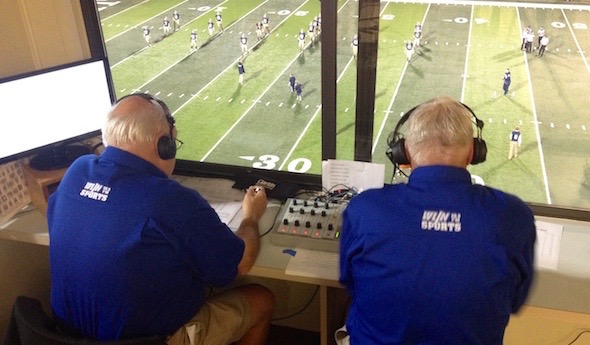
TRAVERSE CITY – For 50 years, John Sonnemann and Don Wiitala have put their hearts, souls and voices into Traverse City athletics.
The two, who are still going strong, were recognized this fall for their contributions – Sonnemann as the public address announcer for Traverse City Central, Wiitala as the radio broadcaster for Traverse City St. Francis.
 "It keeps us young and involved," Sonnemann said. "I think Don feels the same. We feel like we're part of the program - and that's important to us."
Credit two former football coaches/athletic directors for bringing two unmistakable voices to the microphone. Elk Rapids' Don Glowicki and Traverse City Senior High's Irv Menzel started Wiitala and Sonnemann on their journeys back in 1966.
That was the year Glowicki approached radio station WLDR, which had just gone on the air in July, about broadcasting high school sports.
"We weren't thinking about doing sports," Wiitala said. "We were just trying to keep our heads above water."
After some discussion, though, WLDR took the plunge.
"We said we'll give it a try," Wiitala recalled. "I wasn't even a broadcaster. I was the sales manager."
WLDR started covering Elk Rapids and St. Francis football that fall, and Gladiators basketball that winter. Soon after, the station began broadcasting all St. Francis football games. WTCM was covering Traverse City Senior High football and basketball, so now both schools had an outlet on radio.
It remained that way until about eight years ago when WLDR dropped its game coverage. But WLJN stepped in, picked up football, and Wiitala continued on as the Voice of the Gladiators.
"Who would have thought that 50 years later I'm still in the broadcast booth," Wiitala said. "I never realized how close I would grow to the St. Francis community. It's been a wonderful (association)."
Wiitala, 79, was inducted into the Grand Traverse Area Catholic Schools Hall of Fame this month.
"Don's a class act," St. Francis athletic director Tom Hardy said. "He does things the right way. He's part of our family. When you talk about St. Francis football, one of the first names to come up is Don Wiitila. He's brought St. Francis games into so many homes. We are so fortunate, so lucky for his dedication."
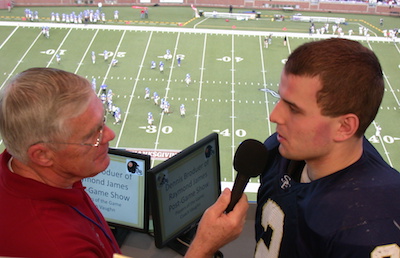 Back in 1966, Sonnemann had just graduated from Michigan State University when he landed a job as a social studies teacher at Traverse City Senior High. He had done his student teaching at the school the previous year and worked the chain gang during the football season – so his indoctrination into Trojans football had already started.
Soon after he was hired, Menzel called him into his office.
"He grabbed me by the knee and said, 'I want you to announce on Friday.'" Sonnemann said. "That was it."
To this day, the 72-year-old is synonymous with Traverse City Central sports.
"It's been a pleasure," the Voice of the Trojans said. "I've enjoyed all 50 years, although it doesn't seem like it's been that many,"
Sonnemann was honored for his work during the Central-West game in September.
"Remarkable," Central athletic director Mark Mattson said in describing Sonnemann's career. "The best part is that John is one of the most gentle, kind human beings that you'll ever meet. To have that legendary voice be part of your program for 50 years is special."
Sonnemann, who retired as the school's athletic director nine years ago, still announces a number of school and community events. On any given day in the fall, he can be seen and heard at Central football, soccer and volleyball games.
He said he has a hard time remembering when he retired because he's still so active doing what he loves.
"Some people would say I flunked retirement," Sonnemann said, laughing.
He, of course, does not see it that way. Neither does Wiitala. Their jobs, they say, energize them.
So when people ask how much longer they'll keep announcing, their answers are similar.
"As long as I feel good – and I do feel good – I want to keep doing it," Wiitala said. "Vin Scully (Los Angeles Dodgers announcer), what is he, 87?"
On fall weekends, Thirlby Field is their home away from home.
"We've seen a lot of great athletes, a lot of great teams, a lot of great games," said Sonnemann, who in 2001 received an Allen W. Bush Award from the MHSAA for his many unsung contributions to high school athletics.
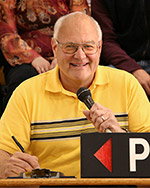 Sonnemann recalled a game in 1970 when the Trojans lost 2-0 to Bay City Central, coached by the legendary Elmer Engel.
"They were the cream of the crop in the state," he said, "and that's where Traverse City wanted to be."
It didn't take long. Traverse City reached the inaugural MHSAA Finals in 1975, and then claimed championships in 1978, 1985 and 1988.
St. Francis was going strong in those days, too, claiming mythical state championships in 1973 and 1974. The Gladiators were able to maintain their success when the MHSAA playoffs began, capturing crowns in 1992, 1999, 2003, 2005, 2008 and 2009. They were MHSAA runner-ups in 1983, 1998 and 2007.
Wiitala recounted the 28-26 loss to Detroit dePorres in 1983 – the school's first trip to the Pontiac Silverdome – when the Eagles scored late to pull out the victory.
"To this day I still remember this kid from Detroit dePorres, with about a minute and a half left, laying out horizontal to catch a pass in the end zone for a TD," he said. "That play has run through my mind hundreds of times over the years. I don't know why. Had he not caught the pass, St. Francis would probably have won the game."
Sonnemann witnessed two of the most dramatic last-second wins in Trojans history – 21-20 over Muskegon Catholic in 1975 and 22-21 over Muskegon in 1985. The Muskegon game was on the road so Sonnemann was there in another role – as the advisor, he had taken the school's pep club to the game. The Big Reds had surged to a 21-14 lead on an interception return for a score in the final minute. It seemed like that would be the play that would decide this battle between the two 5-0 heavyweights.
But on the last play of regulation Central quarterback Chris Hathaway connected on a pass to Jeff Durocher, who then pitched the ball to Doug Lautner, catching the Muskegon defense by surprise. Lautner raced the final 33 yards to the end zone to pull the Trojans to within a point. Coach Jim Ooley opted to go for the win, and Hathaway hit Durocher on the winning two-point conversion.
Trojans fans who were there reveled in the win, except the bus driver.
"The bus driver had gone out to warm up the bus and missed the end of the game," Sonnemann said. "When we got on the kids were hootin' and hollerin' and just having a good time. They were so excited. The bus driver looked at me and said, 'If they're this excited after a loss I would hate to see what they would do after a win.' I had to tell him, 'We won it.' It (the suddenness of the win) felt a lot like that MSU game the other day."
Wiitala has been a fixture at the MHSAA Finals – football and basketball – covering St. Francis, as well as other area schools.
"When St. Francis got beat (in the tournament) we would pick up the next team that was going well," he said. "People in those communities appreciated that."
Wiitala said when he first started broadcasting games there were a number of radio stations doing likewise. That's not the case now.
"Stop and think about it," he said. "When St. Francis was in the North Central Conference (in the 1980s) five schools had radio stations broadcasting games. Now we hardly ever see another station at a game."
Wiitala became the majority owner of WLDR in 1972. He would remain the owner for nearly 30 years. When he sold, the station continued to broadcast St. Francis football games with Wiitala on play-by-play. He’s continued in that role now that WLJN has taken over the broadcasts.
The Mesick graduate has never strayed from the hometown feel of his broadcasts. He still conducts pre-game interviews with the coaches, profiles other school activities at half, and has several players come up to the booth for postgame interviews.
"I know people who get in their cars after the game and then turn the radio on to hear the kids (comment on the game)," he said.
WLJN also offers an internet broadcast, which allows St. Francis fans across the world an opportunity to listen. Wiitala often asks fans to send him e-mails during a game and he's always stunned when he learns the locale of his listeners.
"We've received emails from alumni in Iraq, Iran, Hawaii," he said. "It's unbelievable."
Wiitala has had numerous analysts on the broadcasts over the years. For the last five years, Sonnemann has served in that capacity when there's not a conflict with a Central home game. When there is?
"Don always says, 'John's on assignment," Sonnemann said with a chuckle.
Well, often times, Sonnemann is on assignment. Once fall sports end and winter sports begin, he'll switch to boys and girls basketball, wrestling, hockey and every so often downhill skiing. In the spring, it's on to track and field, girls soccer and graduation, which takes advance work to make sure it's done right.
"One of the things I pride myself on is pronouncing names correctly," he said. "Mine has been mispronounced enough times that I think it's important to get those names right the one time they get to shine up there on stage."
Sonnemann, who always has the best seat in the house, also takes pride in how he presents himself. He wants to make sure that he's always fair and objective.
"I try not to be partial to one team or another, although certainly I bleed black and gold," he said. "I try to call the games in as fair a manner as possible. Some announcers will try to emulate what you hear in the pros, especially the NBA, and I feel that has no place in high school sports. You should treat the visiting team as equally as you treat the home team."
Wiitala has a belief he stands by, too.
"I've never been controversial," he said. "I'm broadcasting sports about kids 15, 16, 17 years old. I'm not going to say, 'Oh, No. 88 is terrible out there.' I don't do it that way. That's not me. I like to treat people the way I would like to be treated."
Like Wiitala, Sonnemann plans to continue keeping fans abreast of who's doing what on the field, the court, the pitch, the ice, the mat, the track and the slopes.
"As long as I still enjoy it, as long as I'm still healthy, I'd like to keep doing this," he said. "I'm not setting any timetable."
For Sonnemann and Wiitala, it's 50 going on 51.
 Dennis Chase worked 32 years as a sportswriter at the Traverse City Record-Eagle, including as sports editor from 2000-14. He can be reached at [email protected] with story ideas for Manistee, Wexford, Missaukee, Roscommon, Ogemaw, Iosco, Alcona, Oscoda, Crawford, Kalkaska, Grand Traverse, Benzie, Leelanau, Antrim, Otsego, Montmorency, Alpena, Presque Isle, Cheboygan, Charlevoix and Emmet counties.
PHOTOS: (Top) John Sonnemann, left, and Don Wiitala provide the radio broadcast for a Traverse City St. Francis football game. (Middle) Wiitala interviews St. Francis' Luke Popp at Ford Field after the Gladiators' Division 7 championship win in 2009. (Below) Sonnemann announces a variety of Central sports played both indoors and out. (Photos courtesy of Traverse City St. Francis athletic department and Traverse City Central High School.)