


5 Questions for 8-Player Football
April 10, 2017
The 2017 8-Player Football Playoffs will be conducted over four weeks in two divisions of 16 teams each for the 60-plus teams sponsored by Michigan High School Athletic Association Class D schools.
That much was decided by the MHSAA Representative Council on March 24.
There are five questions (at least) that the Council still must answer:
-
How should teams qualify? Since the first 8-player tournament in 2011, teams have qualified by playoff point averages – the 16 highest qualified for the tournament. Should this be changed to a system of automatic qualifiers on the basis of wins, plus additional qualifiers on the basis of playoff points to complete the field – like the 11-player tournament operates?
-
When should divisions be determined? Should it be in late March when division breaks for other “equal divisions” tournaments are set? Or should divisions be determined nearer the start of the season – say, September 1 – so all late additions, deletions, and cooperative program changes can be factored in before the two divisions, based on enrollment, are determined?
-
Where will the championship games be played? Should the Council designate a doubleheader at the Superior Dome in Marquette so the MHSAA can focus all its resources on one climate-controlled facility? Or should two sites be designated now (perhaps the Superior Dome in Marquette and Legacy Field in Greenville), and the specific games and times assigned as the playoffs progress in an attempt to reduce travel times for teams and spectators?
-
Should the maximum enrollment for the 8-player tournament be the moving target of the Class D maximum (203 in 2017) or a fixed number – for example, 215, the Class D maximum in 2011 when the 8-player tournament began? This decision could be deferred to the Council’s meeting in December.
-
Should there be a “grace period” for schools that are eligible for the 8-player tournament one year but have enrollments that exceed the 8-player limit the next year – for example, eligible only the following year and only if the enrollment does not exceed the 8-player enrollment limit by more than 12 students? This decision could also be delayed to the December meeting of the Council.
As our excitement builds for the expanded 8-player tournament, so do the questions.
A Game for Every Fan: Week 8
October 18, 2013
By Geoff Kimmerly
Second Half editor
Week 8 of the high school football season can mean a lot of things to teams and communities, depending on one’s circumstances.
On one side of the scale, those that have been eliminated from playoff contention are hoping to finish on a positive note and send out their seniors with one last memory. On the other, there are 61 undefeated teams left in Michigan – and 12 face off in six of our best games this week.
There’s definitely a challenge in forecasting which from this week’s slate might end up the most significant when all is said and done. In fact, a number of Detroit-area games not mentioned below are worth mentioning now: Detroit Martin Luther King (6-0) faces Detroit Mumford (6-1) and Detroit Cass Tech (7-0) faces Detroit East English (5-2) in Detroit Public School League semifinals, and Northville (6-1) faces Canton (7-0) with Grand Blanc (6-1) at Walled Lake Western (7-0) in Kensington Lakes Activities Association semis. In the Detroit Catholic League, second-placers Detroit Catholic Central (6-1) and Warren DeLaSalle (5-2) face off Saturday with a Prep Bowl berth on the line.
See below for more from an incredible statewide slate of games this weekend, and remember to check the MHSAA Score Center all weekend for updated scores and standings.
Southwest and Border
Portage Central (7-0) at St. Joseph (7-0)
Although St. Joseph still must face a competitive Mattawan squad in Week 9, the Southwestern Michigan Athletic Conference West probably comes down to this matchup. Portage Central’s totals this fall certainly are more impressive – 326 points for and 83 against, while St. Joseph has outscored opponents only 201-103 – but because of its strong nonleague slate, St. Joseph projects to have the second-highest playoff point average in Division 3 (Portage Central currently falls sixth among teams expected to be in Division 2).
Others that caught my eye: Battle Creek Harper Creek (6-1) at Battle Creek Lakeview (7-0), Decatur (5-2) at Watervliet (7-0), Dowagiac (6-1) at Edwardsburg (7-0), Otsego (5-2) at Paw Paw (7-0).
Greater Detroit and Southeast
Clinton Township Chippewa Valley (7-0) at Macomb Dakota (7-0)
Twitter followers of @DakotaFootball got a feel for this game Thursday from a few selected re-tweets from players, including one that read: “Tomorrow is the biggest game of our lives.” Dakota, during its nearly two-decade history, has lots of experience in these types of games – the winner tonight will claim the Macomb Area Conference Red title outright – and Chippewa Valley and Dakota have the second and third-highest playoff point averages, respectively, among teams expected to be in Division 1. This is the first time in a decade the Big Reds have been in this spot, and if they can crack Dakota’s defense (35 points allowed this fall), it could be another classic.
Others that caught my eye: St. Clair (7-0) at Marine City (7-0), Birmingham Groves (7-0) at Birmingham Seaholm (7-0), Lake Orion (6-1) at Clarkston (6-1), Warren Michigan Collegiate (5-2) at Harper Woods Chandler Park (6-1).
Lower Up North
Elk Rapids (5-2) at Boyne City (6-1)
Both co-leaders of the Lake Michigan Conference have tough matchups this week, but Elk Rapids being third in the league gives this game a potentially heavier impact. Boyne City faces Grayling in Week 9 in a game that should decide the league title – both are 4-0 in LMC play heading into this weekend – but Elk Rapids definitely could throw a wrench and did beat the Ramblers in two straight before falling last fall.
Others that caught my eye: Lake City (6-1) at Evart (6-1), West Branch Ogemaw Heights (5-2) at Traverse City Central (4-3), Sault Ste. Marie (4-3) at Kingsley (5-2), Grayling (6-1) at East Jordan (4-3).
Mid-Michigan
Lansing Sexton (7-0) at Lansing Everett (5-2)
Those who don’t follow Lansing-area football closely probably don’t realize that Sexton, with roughly 680 students, is slightly more than one-third the size of the biggest schools in the Capital Area Activities Conference Blue – and pushed to rejoin the league with its traditional rivals after a few years playing in other divisions. That makes this Big Reds run even more impressive – although Everett would love to keep their rivals from celebrating a league title this week. The Vikings looked like favorites coming into the fall, and this one could be closer than some might expect.
Others that caught my eye: Portland (7-0) at DeWitt (7-0), Battle Creek St. Philip (7-0) at Portland St. Patrick (7-0), Constantine (5-2) at Olivet (6-1), Haslett (5-2) at Williamston (4-3).
West Michigan
Grand Rapids Christian (6-1) at Lowell (7-0)
Lowell’s wild October run through the rest of the O-K White contenders ends tonight in the likely league-deciding matchup against Grand Rapids Christian, which like the Red Arrows is 3-0 in the division. Lowell’s strong competition has paid off not just in preparation for games like this, but in helping the Red Arrows build the highest playoff point average in the MHSAA. Only Muskegon during Week 2 has tripped up the Eagles (Lowell beat Muskegon two weeks later), who continue to await the season debut of injured star receiver Drake Harris.
Others that caught my eye: Muskegon Reeths-Puffer (6-1) at Muskegon Mona Shores (6-1), East Grand Rapids (4-3) at Caledonia (5-2), Muskegon Catholic Central (5-2) at Fruitport (5-2), Holland Christian (4-3) at Byron Center (5-2).
Bay and Thumb
Marlette (7-0) at Harbor Beach (6-1)
It’s fair to say this is turning into Marlette’s best season ever – or at least since the Red Raiders went 8-1 in 1975. And it would become infinitely sweeter if they are able to beat defending MHSAA Division 8 champion Harbor Beach to win the Greater Thumb Conference East title. Harbor Beach is riding a 15-game league winning streak and owns two straight wins over Marlette, including by a score of 66-10 a year ago. The Pirates’ only loss this season was in Week 3 to much larger Menominee.
Others that caught my eye: Fenton (7-0) at Swartz Creek (4-3), Richmond (6-1) at Yale (5-2), Deckerville (4-3) at Peck (7-0), Vassar (4-3) at Cass City (4-3).
Upper Peninsula
Bessemer (5-2) at Crystal Falls Forest Park (7-0)
This scenario bears similarity to 2012; Forest Park was cruising through the Great Western Conference before getting run over by Bessemer 46-15 in Week 8, a result that created an eventual three-team sharing of the league title. Forest Park is 3-0 in the league again. And while Bessemer at 2-2 in the conference has only an outside shot at sharing the title this time, the Miners have come back from a midseason two-game losing streak to get within a win of qualifying for the playoffs for the second season in a row.
Others that caught my eye: Lake Linden-Hubbell (4-3) at Felch North Dickinson (6-1), Marquette (5-1) at Negaunee (6-1), Bellaire (5-2) at Cedarville (6-1), Hancock (3-4) at Iron River West County (7-0).
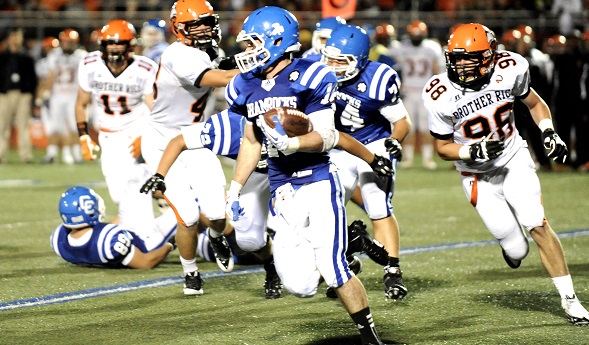
PHOTO: Detroit Catholic Central (in blue), here during a Sept. 27 loss to Birmingham Brother Rice, faces Warren DeLaSalle this week for the opportunity to face Brother Rice again in next weekend’s Detroit Catholic League Prep Bowl. (Click to see more from High School Sports Scene.)