


5 Questions for 8-Player Football
April 10, 2017
The 2017 8-Player Football Playoffs will be conducted over four weeks in two divisions of 16 teams each for the 60-plus teams sponsored by Michigan High School Athletic Association Class D schools.
That much was decided by the MHSAA Representative Council on March 24.
There are five questions (at least) that the Council still must answer:
-
How should teams qualify? Since the first 8-player tournament in 2011, teams have qualified by playoff point averages – the 16 highest qualified for the tournament. Should this be changed to a system of automatic qualifiers on the basis of wins, plus additional qualifiers on the basis of playoff points to complete the field – like the 11-player tournament operates?
-
When should divisions be determined? Should it be in late March when division breaks for other “equal divisions” tournaments are set? Or should divisions be determined nearer the start of the season – say, September 1 – so all late additions, deletions, and cooperative program changes can be factored in before the two divisions, based on enrollment, are determined?
-
Where will the championship games be played? Should the Council designate a doubleheader at the Superior Dome in Marquette so the MHSAA can focus all its resources on one climate-controlled facility? Or should two sites be designated now (perhaps the Superior Dome in Marquette and Legacy Field in Greenville), and the specific games and times assigned as the playoffs progress in an attempt to reduce travel times for teams and spectators?
-
Should the maximum enrollment for the 8-player tournament be the moving target of the Class D maximum (203 in 2017) or a fixed number – for example, 215, the Class D maximum in 2011 when the 8-player tournament began? This decision could be deferred to the Council’s meeting in December.
-
Should there be a “grace period” for schools that are eligible for the 8-player tournament one year but have enrollments that exceed the 8-player limit the next year – for example, eligible only the following year and only if the enrollment does not exceed the 8-player enrollment limit by more than 12 students? This decision could also be delayed to the December meeting of the Council.
As our excitement builds for the expanded 8-player tournament, so do the questions.
Drive for Detroit: Week 9 Preview
October 19, 2017
By Geoff Kimmerly
Second Half editor
Maybe because it still feels like summer some days downstate, but it seems like we’ve gotten to Week 9 of the football season more quickly this fall.
 So let’s get right into it. Playoff fields will be announced at 7 p.m. Sunday on FOX Sports Detroit PLUS. But there is still much to be decided. There are 80 automatic playoff bids still available in 11-player – this observer’s guess is that 55 will be filled by weekend’s conclusion – and a handful of league titles remain up for grabs.
Our “Drive for Detroit” preview below might look like it’s not hitting on some of the best games in your area this weekend, but that’s by design – today’s report, powered by MI Student Aid, is focused on those final league-deciding battles, some key rivalries, but for the most part picks out games that could have the most bearing on who continues on into next week.
There were 20 games statewide Thursday, and those results like all this weekend can be found on the MHSAA Score Center. Click to monitor records and playoff points for all 614 football teams in Michigan this weekend as the field of 288 continues to take its final shape. Click for more information on the “Sunday Selection Show” and a list of games that will be broadcast live tonight on MHSAA.tv.
Bay & Thumb
Clare (7-1) at Beaverton (8-0), Friday
This has been Beaverton’s season, starting with wins over Breckenridge and Harbor Beach – the only losses for those teams as both have gone on to win league titles – and continuing through a dominant run over the first six games of the Jack Pine Conference schedule. The Beavers tonight can clinch their first league championship since 1989, but the greatest obstacle of all stands in the way. Clare also is 6-0 in the league, having lost only to still-undefeated Ithaca on opening night, and has won or shared nine of the last 10 Jack Pine titles. The winner tonight claims the whole thing.
Others that caught my eye: FRIDAY Williamston (5-3) at Lake Fenton (7-1), Midland (7-1) at Midland Dow (7-1), Flint Carman-Ainsworth (5-3) at Lapeer (5-3), Croswell-Lexington (5-3) at Goodrich (7-1).
Greater Detroit
Detroit East English (8-0) vs. Detroit Martin Luther King (7-1) at Ford Field, Friday
This Detroit Public School League A Final might be the most important game between King and East English since East English was formed out of the former Crockett and Finney high schools in 2012. King is a regular in this league finale but usually faces Detroit Cass Tech, which instead it defeated in last week’s semifinal 17-7. After falling to East English in their first meeting ever in 2012, the Crusaders have won the last seven games between the two – including taking two from the Bulldogs in back-to-back weeks in 2016 by a combined 10 points.
Others that caught my eye: FRIDAY Madison Heights Lamphere (5-3) at Madison Heights Madison (8-0), Canton (7-1) at Livonia Churchill (7-1), SATURDAY Dearborn Divine Child (7-1) vs. Ann Arbor Gabriel Richard (7-1) at Ford Field, Warren DeLaSalle (6-2) vs. Detroit Catholic Central (5-3) at Ford Field.
Mid-Michigan
Okemos (5-3) at East Lansing (6-2), Friday
The Trojans started this season 1-2 taking losses to Dearborn Divine Child and Grand Ledge, which are a combined 14-2. Riding a defense that has given up a combined 28 points over the last four weeks, East Lansing battled through most of the rest of the Capital Area Activities Conference Blue and is headed to the playoffs for the second straight season thanks in part to three wins by five points or fewer. Okemos started 4-0 but then lost three straight before getting back on the positive side last week against Holt. This season has been a success regardless, with more wins than the last two combined, but the Chiefs would love to beat an old rival to get back to the playoffs for the first time since 2014.
Others that caught my eye: FRIDAY Saranac (5-3) at Blanchard Montabella (4-4), Ionia (4-4) at Lake Odessa Lakewood (7-1), Marshall (4-4) at Portland (7-1), St. Louis (5-3) at Breckenridge (7-1).
Northern Lower Peninsula
Traverse City St. Francis (8-0) at Boyne City (8-0), Friday
The matchup has become one of the best small-school games statewide each season. It’s decided the Northern Michigan Football Conference Legends championship the last three years with one of the two teams then going on to at least the Division 6 Regional Finals each of those seasons. Like last year, these teams meet tonight both undefeated in league play. St. Francis handed Boyne City a 22-0 defeat in 2016 and also gave the Ramblers their only losses of 2015 – the first in Week 5 and the final in a Regional rematch. Boyne City is banking this time will look more like the three straight wins in this series from 2012-14, and the Ramblers look that caliber giving up no more than 13 points in a game so far. Then again, the Gladiators have given up 45 points total this fall and haven’t lost a regular-season game since that 2014 Boyne City loss.
Others that caught my eye: FRIDAY Harbor Springs (4-4) at Johannesburg-Lewiston (5-3), Grayling (5-3) at Kalkaska (4-4), Evart (4-4) at Maple City Glen Lake (5-2), Oscoda (5-3) at Tawas (2-5).
Southeast & Border
Reading (7-1) at Michigan Center (7-1), Friday
The champions of the Big 8 and Cascades conferences meet in Week 9, and it’s a crowning regular-season achievement for a Reading team that had won six games combined over the last two seasons and earned its first league title since 2012. It’s a great opportunity as well for Michigan Center, which shared the Cascades title with Napoleon and Addison – the Cardinals’ first piece of a championship since sharing in 2013. To the victor tonight goes a little more pride, and also possibly enough points to earn a home playoff game.
Others that caught my eye: FRIDAY Hudson (7-1) at Blissfied (5-3), Brooklyn Columbia Central (6-2) at Hillsdale (4-4), Milan (5-3) at Ypsilanti Lincoln (6-2), Morenci (5-3) at Petersburg-Summerfield (6-2).
Southwest Corridor
Three Rivers (7-1) at Vicksburg (6-2), Friday
Technically, the Wolverine B Conference can still finish with three teams sharing the title. It would take, in part, co-leader Edwardsburg falling to two-win Sturgis. So while that seems less likely to occur, Three Rivers faces a much tougher task to hold on to its share of the prize. The Wildcats find themselves tied for first because of a three-point win over the Eddies two weeks ago, and can keep what would be a first league title since 2009. But Three Rivers beat third-place Vicksburg by only a point last year after losing three straight to the Bulldogs. And with that slim chance at a three-way title still alive, the Wildcats are sure to see Vicksburg’s best again.
Others that caught my eye: FRIDAY Kalamazoo United (6-2) at Schoolcraft (5-3), Paw Paw (4-4) at Dowagiac (5-3), Coloma (5-3) at Watervliet (8-0), Climax-Scotts (6-2) at Athens (5-3).
Upper Peninsula
Escanaba (7-1) at Kingsford (6-1), Friday
Escanaba won two weeks ago a game that lined up like a meeting of the two best teams in the Upper Peninsula, handing the only loss to then-undefeated Gladstone. But Kingsford has belonged in that conversation too, and tonight’s game has the same feel – and with the winner claiming the outright Great Northern Conference championship. Kingsford’s only loss was on opening night to Menasha, Wis., which has gone on to go 8-1. The Flivvers actually have been a little better against their league opponents too, scoring three more points than Escanaba and giving up 48 fewer – not to mention they have three straight losses to the Eskymos they’d love to avenge.
Others that caught my eye: FRIDAY Gladstone (7-1) at Calumet (5-3), Bark River-Harris (4-4) at Munising (4-3), Negaunee (4-4) at Ishpeming Westwood (7-1), Menominee (5-3) at Marquette (4-4).
West Michigan
Zeeland West (6-2) at Zeeland East (8-0), Friday
This matchup between schools literally next door to each other is always one of the most anticipated on the west side of the state. But it means more again as both are undefeated in the Ottawa-Kent Conference Green and with the possibility they could see each other in the playoffs at some point as well. The Chix have put up 41 or more points in every game – their most impressive offensive output this decade. West has won their last three meetings, and its two defeats this fall – to Muskegon Mona Shores and Grand Rapids West Catholic, a combined 13-3 – no doubt prepared the Dux for games of this caliber.
Others that caught my eye: FRIDAY Grand Rapids South Christian (7-1) at East Grand Rapids (8-0), Grandville (6-2) at Holland West Ottawa (7-1), Lake City (8-0) at Morley Stanwood (7-1), Montague (8-0) at Muskegon Catholic Central (7-0).
8-Player
Bay City All Saints (6-2) at Kinde-North Huron (7-1), Friday
A lot of the hype this season deservedly has gone to teams playing – and succeeding – in their first seasons of 8-player football, and All Saints is part of that group. The Cougars were 3-6 last fall in 11-player and had one winning season over their last six before making the switch. Kinde-North Huron, meanwhile, has played 8-player since 2012 – and it’s having its most successful regular season since 2007. Both are undefeated in the North Central Thumb League Stripes division, with the winner tonight taking the outright championship.
Others that caught my eye: FRIDAY Battle Creek St. Philip (5-3) at Bellevue (7-1), Stephenson (7-1) at Powers North Central (5-2), Suttons Bay (5-3) at Mesick (5-3), Webberville (5-3) at Morrice (7-1).
Second Half’s weekly “Drive for Detroit” previews and reviews are powered by MI Student Aid, a part of the Student Financial Services Bureau located within the Michigan Department of Treasury. MI Student Aid encourages students to pursue postsecondary education by providing access to student financial resources and information, including various student financial assistance programs to help make college more affordable for Michigan students. MI Student Aid administers the state’s 529 savings programs (MET/MESP) and eight additional aid programs within its Student Scholarships and Grants division. Click for more information and connect with MI Student Aid on Facebook and Twitter @mistudentaid.
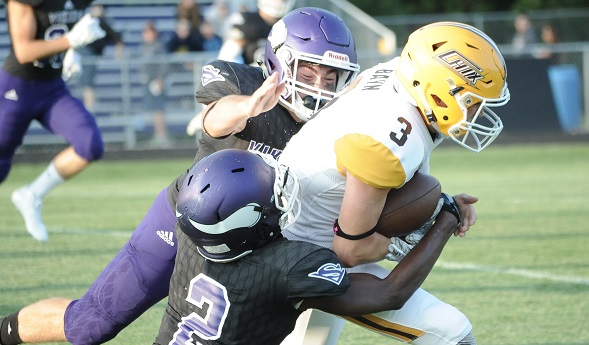
PHOTO: Zeeland East (yellow helmets) downed Saginaw Swan Valley on opening night and will face arguably its toughest opponent since in rival Zeeland West this weekend. (Click to see more from HighSchoolSportsScene.com.)