

8-Player Takes Flight in Upper Peninsula
September 28, 2017
By Dennis Grall
Special for Second Half
ESCANABA – Three yards and a cloud of dust. That was the highly successful version of football applied by veteran Ohio State coach Woody Hayes as big bruisers dominated the game.
 It certainly is not the preferred style on the fields of 8-player football. Nope, this version is much more open-field and definitely more exciting, full of big plays and a ton of scoring.
Take Powers North Central as the prime example. The Jets have won the last two 8-player MHSAA championships with back-to-back 13-0 seasons, piling up yards and points in their first two seasons in the 8-player game with a large group of skilled athletes.
Their winning streak ended at 27 games earlier this season, but the style they displayed with exceptional athleticism led by Jason Whitens and Bobby Kleiman has caught on with many other programs.
The Upper Peninsula, at the forefront of the 8-player game due largely to decreasing enrollments, has been lighting up the scoreboards this year. Teams like Pickford and Cedarville, Rapid River and Stephenson, Ontonagon and Crystal Falls Forest Park are progressing with the same formula as North Central by featuring explosive offenses.
Citing some 8-player detractors who don't think the game is real football, veteran Cedarville coach Scott Barr said, "I don't think anyone can argue that it (8-player) has not been healthy for football. It has been healthy."
The game is thriving in small schools because the 8-player version simply has allowed football to remain in the athletic program despite shrinking enrollments across the state.
"It has allowed us to keep football," said veteran coach Steve Ostrenga of Rapid River, who led the Rockets into 8-player Finals in 2011 and 2013 and into the playoffs every season since making the switch after going 1-7 in 11-player in 2010.
"We did it out of necessity. We may have waited too long," added Ostrenga, recalling that last year of 11-player football when only one sub was available at several games.
Veteran Pickford skipper Josh Rader has an idea why the 8-player game has met approval at so many small schools. "It is a high-octane game. It is a lot of fun to watch," he said. "It puts a lot of pressure on defenses because it is such a wide open game. It makes it exciting for the fans."
No longer do fans have to squint and squirm in their seats to see what is happening among the goliaths in the line. Now the football is visible in the wide open spaces as skilled athletes display dazzling moves, whether the team favors the extremely popular spread offense or uses the more familiar run-oriented approach.
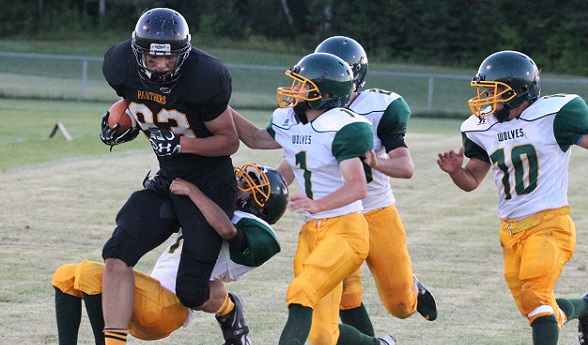 "It is more a one-on-one oriented game now," said coach Ben Mayer of Ontonagon, whose program has consolidated with neighboring Ewen-Trout Creek, which yearly battled small player turnouts just to keep the game alive. Fifteen E-TC students are playing football at Ontonagon, with six on the varsity, highlighted by 6-foot-7 receiver Jacob Witt, who caught MHSAA 8-player record 24 touchdown passes last season.
"Without 8-player, we would have gone under a while back," said Mayer, who played for U.P. Sports Hall of Fame coach Bob "Cubby" Carlson at Ontonagon. He said the Gladiators were forced to use four freshmen and had 130-pound athletes on the line in past years.
"Football has changed a lot in the last four years," he said of the time since the Gladiators moved to the 8-player game. "The ball is in the air. It is fun to watch.”
Mayer said 8-player also enables his program to offer junior varsity football to younger students, instead of having them compete against older, bigger and stronger players with the potential to increase injuries.
"There is not as much violence between the tight ends now because we don't play in those tight spaces," said Mayer.
He also recalls putting "wildly undersized kids in the line against bigger schools with monsters from legitimate programs, with kids getting stepped on and squashed on.
"You do have a lot of choices in 8-man. I can put smaller kids somewhere and they will be all right, and we can still play football."
Ostrenga said it seems injuries, especially of the serious variety, have also seemed to decrease. "We used to hit a lot more in practice. Now we do a lot of teaching and drill work and conditioning," he said, adding MHSAA officials have been in the forefront of trying to reduce injuries with new regulations.
Ostrenga said in the 11-player version, many times it came down to "men playing against boys."
He did say, however, that under the 8-player game coaches "can tend to overuse a player. You get a really good athlete and use him as a crutch in a game."
Ostrenga said it took time to support the change to 8-player football. "I was against 8-man football at first. Now it has made me more open-minded and allowed me to become more understanding." He said 8-player athletes need to have speed, strength, balance and shiftiness.
"Some big guys can't move that well," he said, indicating this version of football requires more agile and nimble athletes to cover the wide-open spaces. "The big thing is understanding you have to get your athletes on the field. You just have eight guys on the field and you are (more) exposed. In 11-man you can hide someone. In 8-man, coaches will find your weaknesses."
Rader agreed, noting, "It puts a lot of pressure on the defense because the game is so wide open. There is a little different strategy. It is a disadvantage for the defense because (the field) is so wide open and there is not a lot of help. You want to take the advantage your offense has over the defense in one-on-ones.
"We like to run the ball and throw the ball, so our athletes can utilize the open field.”
Barr said 8-player quarterbacks are more difficult to contain than typical pocket passers. "They are more elusive," he said, recalling how the 6-foot-4 Whitens could take the direct snap, survey the field and decide whether to throw or run the ball himself.
In the 2016 MHSAA title game, Whitens ran 17 times for a record 352 yards and six touchdowns as the Jets beat Deckerville 58-22. The Jets ran for 469 yards that night.
"You rarely see teams ground and pound," Barr said of the8-man game, noting he began to rely on the spread offense in 11-player football as he tried to figure out how to match up with the over-powering tailback-oriented rushing attack of perennial power Forest Park, which began playing 8-player football in 2016.
Barr said the kicking game is of vital importance now and that secondary tackling is a tough transition because of the explosive offense athletes.
He said "the hybrid player who has size and speed" is featured in 8-player "and it can eliminate the real big kids," which he said are seldom a factor for small schools anyway.
Another plus for the 8-player game comes in scheduling, where Class D schools no longer have to face larger Class C programs and can also find opponents in northern Wisconsin, which also has declining enrollments.
Bark River-Harris and Lake Linden-Hubbell are the only Class D schools still fielding 11-player football teams in the Upper Peninsula. Three other schools, Class D Wakefield-Marenisco and Bessemer and Class C Ironwood have formed a cooperative program, Gogebic Miners, for football purposes.
 Denny Grall retired in 2012 after 39 years at the Escanaba Daily Press and four at the Green Bay Press-Gazette, plus 15 months for WLST radio in Escanaba; he served as the Daily Press sports editor from 1970-80 and again from 1984-2012. Grall was inducted into the Upper Peninsula Sports Hall of Fame in 2002 and serves as its executive secretary. E-mail him at [email protected] with story ideas for the Upper Peninsula.
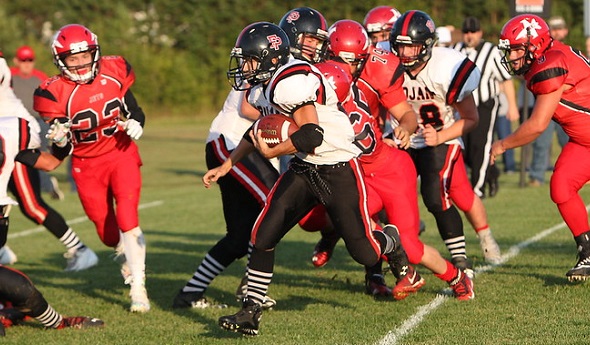
PHOTOS: (Top) Crystal Falls Forest Park downed Powers North Central 66-58 in Week 2 as the teams combined to score more than 100 points for the third time in two seasons. (Middle) Ewen-Trout Creek’s Jacob Witt, here against Carney-Nadeau last season, caught 24 touchdown passes in 2016 and is playing as part of a co-op team with Ontonagon this fall. (Photos by Paul Gerard.)
Bollman Cousins Making Plenty of Noise as 'Wrecking Balls' for Surging Big Rapids
By
Tom Kendra
Special for MHSAA.com
October 9, 2025
BIG RAPIDS – On Friday nights, the Bollman boys are always in the middle of the action, bringing the muscle and the fight and the power to the Big Rapids football team.
 But for the rest of the weekend, senior Jack Bollman and his first cousin, junior Max Bollman, are happiest when they are able to get away from it all at their family’s deer hunting ranch in nearby Canadian Lakes – appropriately named “The Sanctuary.”
“I just love being out there,” said Jack, a four-year starting running back for the Cardinals. “Our whole family works out there, and it’s just a great environment. It’s our second home, out in nature.”
The Bollmans haven’t spent much time at The Sanctuary lately, as they are laser-focused on what is becoming a special season for Big Rapids (6-0), which earned honorable mention in the latest Division 4 state rankings and heading into Friday’s game at Grant.
The Cardinals are known for their triple-option veer offense, operating out of the shotgun and often with four wideouts. But if the defense gets spread out too thin, the Bollmans will make it pay.
“Jack and I, we look at it as our job to bring the physicality on every play,” said Max, a 6-foot-1, 235-pound defensive end who also plays tight end, primarily in short-yardage and goal-line situations. “We want to be a problem for the other team. Other teams know that we can pass, but we can run over you, too.”
 The Bollmans are part of a golden era of Big Rapids football under 11th-year coach Mike Selzer. The Cardinals – who were 7-3 in 2022, 10-2 and Regional finalists in 2023 and 9-2 last season – are hoping to take a couple more steps this fall with a senior-laden roster.
“We have so much experience this year that our practices are not learning things, but just fine-tuning and adjusting,” said Selzer, who starts 10 seniors on offense and nine on defense. “That experience makes it much easier to make adjustments on the fly during games.”
Big Rapids has overwhelmed its first six opponents, with the closest game a 19-7 win at Paw Paw in the opener. The big Central States Athletic Association Red showdown against Reed City on Sept. 26 turned into a one-sided 40-13 win.
Senior quarterback Cole Haist has completed 59-of-90 passes for 947 yards and 11 touchdowns, and rushed for 249 yards and a team-high nine touchdowns. He throws the ball to a plethora of receivers on the edge, notably seniors Trenton Mossel, Owen Craven, Kurt Wilber and Wyatt Skiera.
But when it comes to short-yardage situations, Max Bollman will check in as a tight end and often lead the way for his cousin, Jack, who is the team’s leading rusher with 56 carries for 429 yards, an average of 7.7 per carry, and six touchdowns.
Big Rapids is looking forward to a big game Week 8 at perennial Division 3 playoff team Coopersville, before pursuing its ultimate goal of a Division 4 championship.
The Cardinals appear to be on a collision course with familiar rival Ludington, which is also unbeaten and features a senior-heavy team led by senior quarterback Cam Gunsell. Big Rapids nipped Ludington, 28-21, in last year’s playoff opener.
In preparation for this postseason, Selzer is working on team-building every Tuesday to try and give his a little edge. This past Tuesday, he brought in Saginaw Valley State assistant coach Jeremy Prudhomme for some trust and team bonding exercises.
“We’ve been climbing every year, and now we want to take those final steps,” said Haist, a three-sport athlete who is in his second year as the team’s starting quarterback. “We have the talent and the ability to go farther. Now we are working on that belief to know we can do it.”
 One bond that is already unbreakable is between the Bollman boys, who have grown up together and played football together since they were little kids.
The duo is especially lethal on defense, as the leaders of a group that has allowed only 33 points all season – fewer than six per game.
Max Bollman, a third-year starter as a junior who already has a Division I college offer from Central Michigan, is the leader of that unit from his edge position, with 24 tackles, five tackles for loss and three sacks. Jack Bollman (5-11, 215) has 14 tackles from his linebacker spot, including four for loss and one sack.
“Max is an off-the-charts kid in terms of strength, and he demands a lot of attention – but he has a motor unlike any kid I have ever coached,” said Selzer, a Wayland native who coached for 11 years at Potterville before taking the Big Rapids job in 2015.
Jonathan Losinski, a senior middle linebacker, is the team’s leading tackler with 26 stops, while Bryce Selzer and Austin Brandt both have 18 tackles.
But the emotional leaders of the Cardinals’ defense are the Bollmans, who are double trouble for every opponent.
“We have a bond, that’s for sure,” said Jack, who is hoping to play college football next year. “We want to be dangerous and blow up plays. Other teams have told us after the game that it’s unbearable to try and block us both on the same play.
“I would say we are like two giant wrecking balls out there, plowing things over.”
 Tom Kendra worked 23 years at The Muskegon Chronicle, including five as assistant sports editor and the final six as sports editor through 2011. E-mail him at [email protected] with story ideas for Muskegon, Oceana, Mason, Lake, Oceola, Mecosta and Newaygo counties.
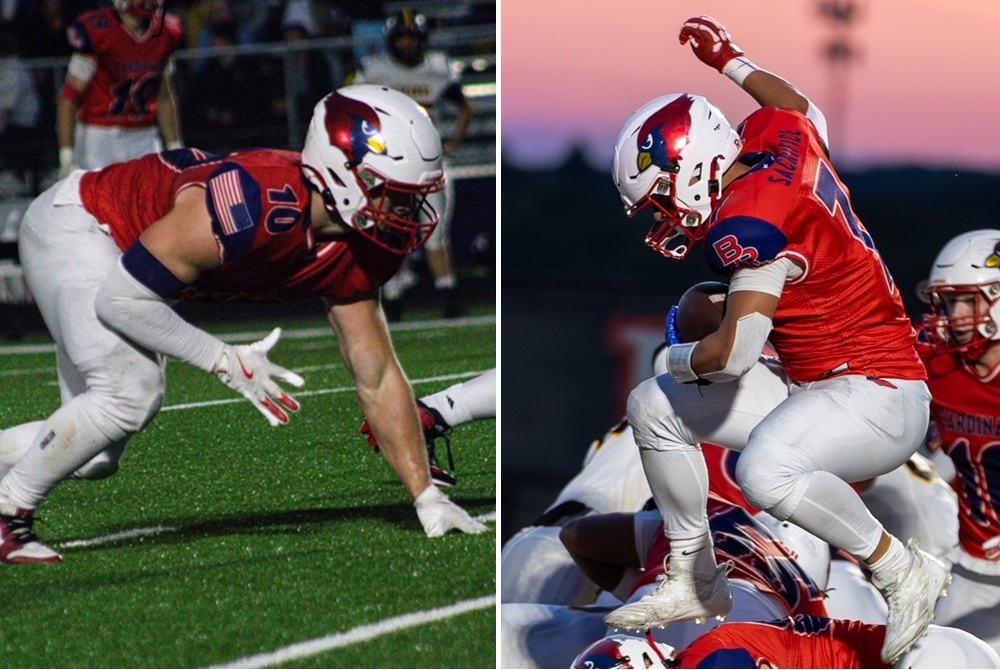
PHOTOS (Top) At left, Max Bollman lines up from at defensive end, while at right, Jack Bollman finds his way into the end zone against Howard City Tri County. (Middle) Junior Max Bollman (10) and his cousin, senior Jack Bollman (7). (Below) Mike Selzer is in his 11th year as head coach at Big Rapids. (Photos provided by the Big Rapids football program.)