

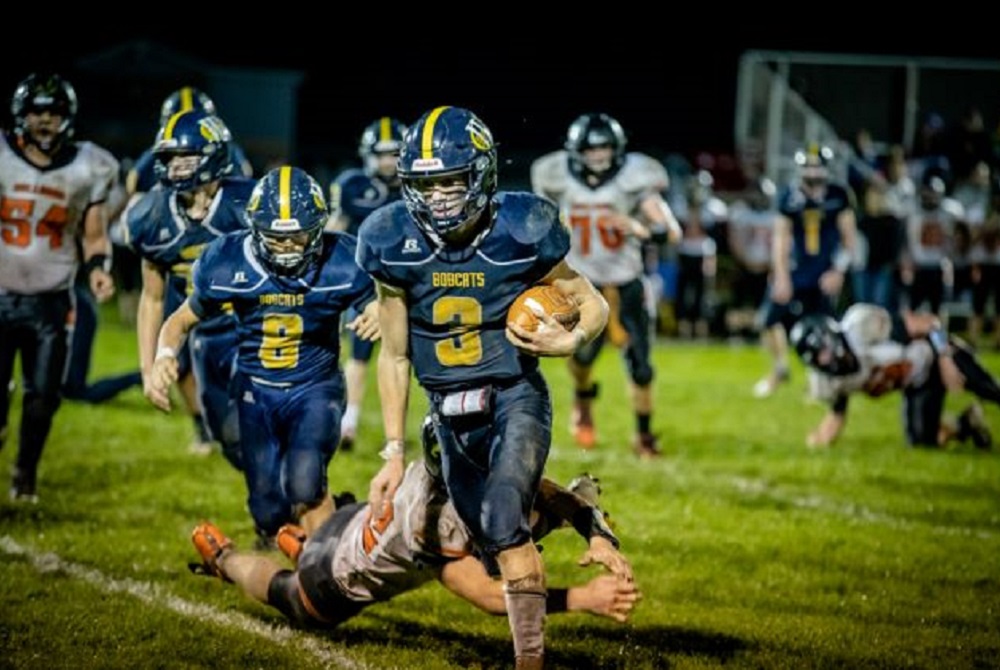
After Growing Up in Program, Giesige Earns Place Among Whiteford Greats
By
Doug Donnelly
Special for MHSAA.com
October 26, 2021
Cole Giesige had a big smile on his face when he went into the Ottawa Lake Whiteford huddle during the fourth quarter of Friday night’s win at Erie Mason.
 Giesige normally is a running back for the Bobcats, but he is also the backup quarterback for the team. When Whiteford built a big lead Friday to clinch the outright Tri-County Conference championship, Whiteford head coach Jason Mensing inserted Giesige at quarterback.
On the first play, Mensing called Giesige’s number. He then put his arm around the 6-foot-1 senior and called the play.
“He said, ‘You are two yards away from 1,000. Do you want to get it on this play?’ Giesige recalled. “I said, ‘Yeah.’ I was smiling when I went into the huddle.”
Giesige kept the ball and sliced his way through the Erie Mason defensive line for a six-yard gain. Goal accomplished. It was his final carry of the game, but it was a big one. It gave him 1,004 yards for the season.
“The line said, ‘All right, we’re going to get this for you’ and they did,” Giesige said. “I knew I had 909 coming into the game, but I didn’t know where I was at that point. When coach told me, I just started to smile.”
Reaching 1,000 yards has been a goal for Giesige since he was summoned to the varsity his sophomore season.
“That was one thing I set out to do,” Giesige said. “When I was a sophomore and I knew I was going to be on the varsity, I put goals on my walls, and one of them was 1,000 yards in a season. I’m glad I was finally able to accomplish that.”
Mensing said that after a big JV season as a freshman, Giesige was destined to be a big part of the Whiteford football team for the next three seasons.
“He’s a great kid,” Mensing said. “We knew when he was a sophomore and we brought him up that we were going to be relying on him to make big plays. He’s done a nice job.”
On Friday, Whiteford finished the regular season with an 8-1 record and No. 2 in playoff points in Division 8. The Bobcats are among favorites to make a deep run in the playoffs.
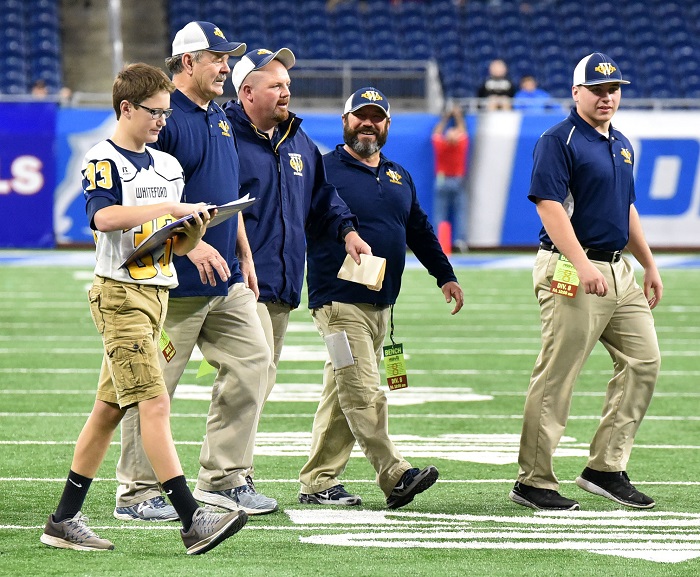 Giesige was in eighth grade when the Bobcats made its best-ever playoff run – winning the 2017 Division 8 championship. Giesige played middle school football for the Bobcats that season, but served a role for the varsity as well – he was on the Whiteford sideline for the Final at Ford Field, charting defensive plays for the coaching staff.
“He’s been a part of the program for a long time,” Mensing said.
The son of Troy and Kim Giesige is also an accomplished baseball and basketball player at Whiteford. He was an all-state pitcher last year for the Bobcats baseball team that reached the Quarterfinals, and he is fielding offers to play the sport after high school. He led the Whiteford basketball team in scoring last winter.
“He is a competitor that has a passion to improve at his craft daily,” Mensing said. “He has high expectations for himself and those around him.”
It’s been an outstanding football season for Giesige. He has done a little bit of everything for the Bobcats.
Heading into Friday’s playoff opener, he has scored 25 touchdowns and converted nine two-point conversions for 168 points. He’s rushed for 18 touchdowns, caught four touchdown passes, returned two kickoffs for scores, and went 100 yards on an interception return in Week 8 against Petersburg Summerfield.
He now holds the record for longest kickoff return (95 yards) and longest interception return (100 yards) in school history. He’s moving up the charts in season and career touchdowns. He averages 9.3 yards per carry and nearly 23 yards per reception. His kickoff return average is 40 yards per attempt.
Mensing said scoring touchdowns isn’t all that he does.
“He is a solid blocker, a good ball catcher and obviously a back with good vision and ability to cut,” the 10th-year Whiteford coach said.
Whiteford has been on a roll of late. The Bobcats enter the postseason on a five-game winning streak and are averaging 52 points per game. During the win streak, they have scored 58, 54, 76, 46 and 62 points.
Giesige is one of just five seniors on the team, but they all play important roles. Two-way tackle Noah Bauman is a two-time all-stater and makes an impact on both sides of the ball. Jack Andrews was a center as a sophomore but was converted to tight end and he has caught four touchdowns this season. Ty Ruddy is a team leader and two-way starter, and linebacker Levi Hillard is among the team’s top tacklers.
Thanks to that core group, the Bobcats are primed and ready to make noise in the playoffs.
“I’m not really certain how it compares to years past as each team and journey is so unique,” Mensing said. “I do know we have a great group of guys that I think want to keep competing together a little longer.”
 Doug Donnelly has served as a sports and news reporter and city editor over 25 years, writing for the Daily Chief-Union in Upper Sandusky, Ohio from 1992-1995, the Monroe Evening News from 1995-2012 and the Adrian Daily Telegram since 2013. He's also written a book on high school basketball in Monroe County and compiles record books for various schools in southeast Michigan. E-mail him at [email protected] with story ideas for Jackson, Washtenaw, Hillsdale, Lenawee and Monroe counties.
PHOTOS (Top) Ottawa Lake Whiteford’s Cole Giesige runs the ball during a win over Petersburg Summerfield this season. (Middle) Giesige (far left) walks with the coaching staff during halftime of Whiteford’s 2017 Division 8 Final at Ford Field. (Top photo by Natalie McCormack; middle photo by Cari Hayes.)
Growing Gobles Preparing for Future with Return to 11-Player Football
By
Pam Shebest
Special for MHSAA.com
August 25, 2026
GOBLES — For the last five years, Gobles saw success competing in 8-player football, making the MHSAA Playoffs four of those seasons.
 This year, coach Greg Eichler hopes to transition that success into 11-player in spite of grumbling from some fans.
“We’re pretty doubted by the town right now,” sophomore tailback/free safety Case Lord said. “But I see what goes on at practice and in the weight room, and I see our work ethic and how strong we are. I think we can do something great.”
Eichler said numbers-wise, the Tigers could compete in 8-player, but “our district is growing, which is good, so when you look at the projected enrollments a couple years down the line, we’re going to be over that playoff limit for 8-player.
“We have a younger team, but we’ve got a diverse group from sophomores up to seniors in terms of their talents and abilities, and I think they can put together some good success right now and also build for the future.”
Gobles finished a combined 31-10 in 8-player over the last four seasons.
Moving back to 11-player, more athletes will have the opportunity to play big roles in the experience.
“It’s been good to have a JV and varsity consistently with no issue, but at the same time, we have a lot of extra kids on the sideline playing 8-player,” Eichler said. “With 11-player there are more opportunities for the kids.”
Discussing the move, the coach added, "When you’ve got three extra guys on the field, it changes how much space on the field you’ve got to cover and who you’re looking at, who you’re covering, who you’re keying on.”
Another change this fall will be playing several less familiar opponents as part of a combined league. Gobles is among a handful of Southwestern Athletic Conference schools playing football as part of the Southwest 10 Conference this fall.
"We’re playing a majority Southwest 10 schedule but will play Galesburg and Saugatuck from the SAC and everyone else is Southwest (10),” Eichler said. "Traditionally the SAC has been our league. You had to give that up, but you want to make sure you’re putting the kids in the best position.”
Eichler said the Southwest 10 has some great traditions and some solid football programs that will give the Tigers a run.
 “We love a new challenge, and we feel that’s what this is. It’s a new step in our program that’s going to challenge everybody, coaches and players alike,” he noted. “Southwest 10 teams are a little bit more our size. They’re still mostly bigger than us, but I think competitively they’re probably the better teams to put on our schedule.”
Senior outside linebacker/wing back Hunter Piper said playing in both conferences is a plus “because we’re playing more schools that I know. We go to those schools for other sports, so it’s nice to play new competition.”
Eichler said one advantage for the Division 8 Tigers this year is that in 11-player “you get bonuses for playing bigger schools and most of the time, we’re the smaller school.
“We have several Division 7 schools on our schedule, so those are like little bonus incentives. That’s win or lose.”
They got their first taste of 11-player in a while last Thursday in a scrimmage against Coloma. Gobles will kick off the “real” season at home Thursday against Niles Brandywine.
“We had a competitive scrimmage, and a lot of our young players got some really good experience,” Eichler said. “I would say the following day’s film session was even more important, as our team learned a lot in order to prepare for our Week 1 matchup versus Niles Brandywine.”
Their second game is a big one for the town: The Tiger Tribute game versus Hartford on Sept. 3.
“It’s the military and first responder appreciation game (which will feature) flyovers, vehicles,” Eichler said.
Honorary captain this year is Navy Lieutenant Commander Ian Weston, a 2010 Gobles alum. The tribute will include a parade and the school choir singing the national anthem.
Sophomore & senior expectations
Eichler said Lord was the first freshman he moved up to varsity over his six years coaching.
“He took some lumps early but really grew as the year went on,” the coach said. “He’s going to bring some varsity experience even as a sophomore.
"I think that’s really good for that sophomore group. He understands what varsity football looks like, even though it was 8-player. We played some really good teams.”
Lord said playing varsity as a freshman was eye-opening.
“Out of the gate I wasn’t prepared for the speed, but I learned very fast that’s a big thing with a varsity game,” he said. “Now I understand what that is, and I can compete with others.
 “I’ve been looking forward to this year since last season ended.”
Lord is no stranger to 11-player football, starting the sport 12 years ago on a club team.
“My brother (Adam Vosburg), and my grandpa (Gerald Gravatt) both played football,” Lord said. “My brother had D-I (college) offers everywhere but went to Olivet to stay close to home after my grandpa passed. My brother basically lived through him, and I live through my brother.”
Eichler counts on seniors such as Piper in leadership roles.
“Hunter brings experience, some really good leadership and stability,” the coach said. “I think that’s going to be important because our bigger group right now is our sophomores. We have him and a handful of other seniors to help stabilize them.”
Part of Piper’s experience is from the 2024 team that went undefeated in the regular season before losing its Division 1 8-Player Regional Semifinal to Martin.
Jumping to 11-player is “a little funky with a couple more players, and the field is definitely a little bigger, but it’s still the same game,” Piper said. “I love the game, and I like to bring a lot of leadership. I like to help out the younger kids.”
Piper, who is also on the wrestling team, said that helps him in football.
“I like the testosterone sports,” he said. “I like to go out there and fly around and hit. The energy is beautiful.”
In spite of hearing some of the town’s naysayers, Piper said, “There’s moments in practice where I think this is a great team. People don’t see what we see, and they’re definitely underestimating us.
“Our strength is the bond we have. We have a very strong connection between all of us.”
 Pam Shebest served as a sportswriter at the Kalamazoo Gazette from 1985-2009 after 11 years part-time with the Gazette while teaching French and English at White Pigeon High School. She can be reached at [email protected] with story ideas for Calhoun, Kalamazoo and Van Buren counties.
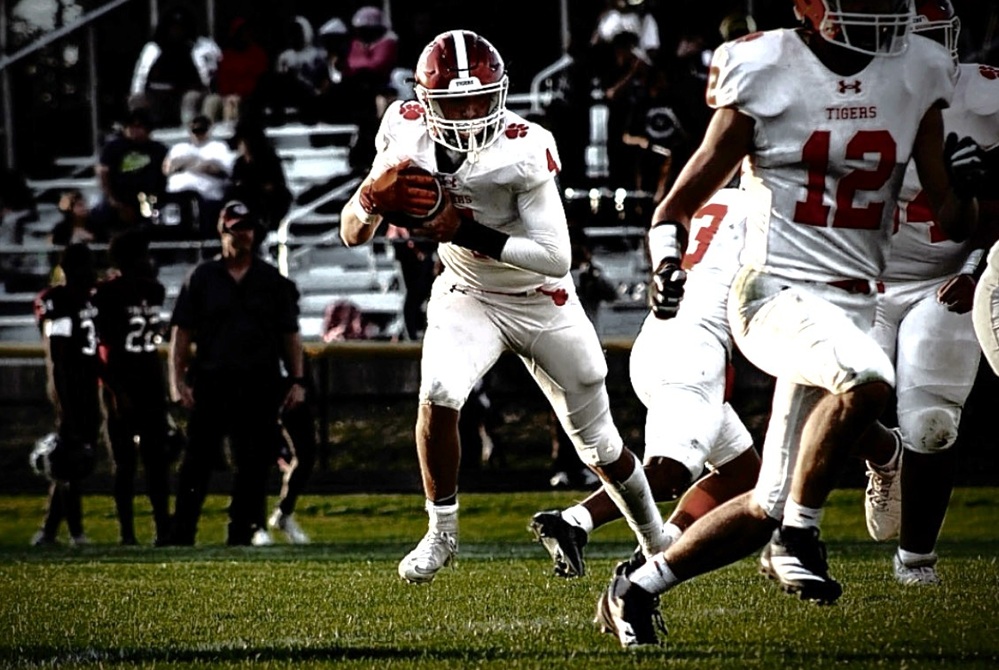
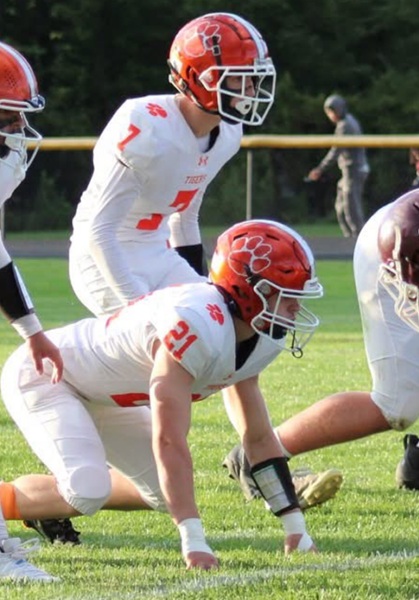
PHOTOS (Top) Gobles’ Case Lord follows his blockers during a carry last season. (Middle) From left: Tigers coach Greg Eichler, Hunter Piper and Case Lord. (Below) Piper (7) lines up on defense last fall. (Action photos courtesy of the Gobles football program. Head shots by Pam Shebest.)