


To Assist and Honor Those Who Served
By
Geoff Kimmerly
MHSAA.com senior editor
September 7, 2012
Born into a multiple-generation U.S. Military family, Eddie Ostipow understood early the honor in serving one’s country.
His father, Mike, did so in Vietnam. Grandfather Alex Ostipow – now 90 – was part of the D-Day Invasion of France during World War II, then taken as a prisoner of war during the Battle of the Bulge in Belgium, and earned three purple hearts while deployed from 1942-46.
Tonight, as the Orioles’ football coach leads his team against Eaton Rapids, both will take the field with him – symbolically at first, and then down from the stands with a larger group of veterans and active-duty soldiers who will be honored for their contributions to this country.
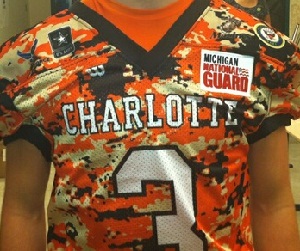 Mike and Alex Ostipow's names are among those that will be worn on both teams’ jerseys as part of their “Victory for Veterans” game to benefit the Veterans of Foreign Wars National Home for Children based in Eaton Rapids.
Funds raised from the purchase of those jerseys and other donations all will benefit the National Home, which was built in 1925 and provides a variety of services to military members and their families, including housing when a family member is deployed. Total, the schools raised roughly $6,300 for the home, which receives all of its funding through donations.
“The kids don’t always understand what those people sacrificed for the freedom we have to even play football on Friday nights,” Ostipow said. “It’s close to me. (And) for me, selfishly, I’ll be able to honor my grandfather.”
Kickoff is 7 p.m. Both teams will wear camouflage jerseys featuring the names of military personnel that were purchased with donations of $100. Charlotte players were given the opportunity to wear the names of family members. For those who did not have names to wear, jerseys were sponsored by teachers and other members of the community.
Charlotte 2002 graduates Nick Cantin and Matt Lamoreaux will serve as honorary captains – Cantin is in the Air Force and Lamoreaux serves in the Navy. After the game, players from both teams will present their jerseys to the service members or their families who they honored.
This cause was a natural for the Orioles. On the Friday before Memorial Day each spring, Charlotte hosts a school-wide round table of veterans, who speak candidly with students about their war experiences. And this opportunity allowed both communities to donate to an effort close to home – both schools are in Eaton County, and Eaton Rapids is only 11 miles from Charlotte.
Ostipow had heard of the home previously – in fact, his grandmother had visited the facility while his grandfather was deployed. But until he began researching for tonight’s event, he didn’t realize the variety of services it provides.
His student teacher, former Eaton Rapids quarterback Matt Marriott, is the son of one of the home’s facility managers. After a series of meetings with Marriott's dad, representatives from the home and Eaton Rapids’ administration and coaches, the plan was hatched.
The Orioles received a bonus when their local National Guard recruiter heard about the effort, and the Guard paid for $2,500 of the $2,800 it would have cost to print the Orioles’ jerseys. That meant $2,500 more that Charlotte could donate to the home.
Click to learn more about the VFW National Home for Children.
1st & Goal: 2021 Week 2 Preview
By
Geoff Kimmerly
MHSAA.com senior editor
September 1, 2021
Last week's return to "normal" football was as good as anticipated, if not better. And the good news is we're just getting started.
As we cruise into Labor Day weekend, the great majority of Week 2 games will again be played Thursday. Additionally, more than 150 games will be viewable live on MHSAA.tv, with Bally Sports Detroit broadcasting Friday's Detroit Cass Tech at Muskegon game on its PLUS cable channel and State Champs! Sports Network streaming live Saturday's Grand Rapids Catholic Central game against Merrillville (Ind.) Andrean. See the full schedule from the MHSAA Score Center.
In addition to our weekly glance at some of the games to watch in every corner of our state, we're also introducing a new feature for this season -- an "Unforgettable 5ive" of highlights from MHSAA.tv and media partner broadcasts. See below for our Week 1 5ive, which includes the following:
► Marquette's Jordan Demay with the Pick 6 in Marquette's 49-14 win over Alpena.
► Clinton Township Chippewa Valley's Cephus Harris with the 60-yard TD run in a 45-20 win over Detroit Catholic Central.
► Dearborn Fordson's Alex Osman connecting with Antonio Gates Jr. for a 37-yard TD in Fordson's 38-23 win over Canton.
► DeWitt's Tyler Holtz throwing a 30-yard touchdown pass to Bryce Kurncz in DeWitt's 47-27 win over Traverse City Central.
► Grand Blanc's Elijah Jackson-Anderson sealing a 40-34 win over East Lansing with a 40-yard TD run.
Bay & Thumb
Elkton-Pigeon-Bay Port Laker (1-0) at Ubly (1-0), Thursday
Both got off to solid starts last week, Laker downing Flint Beecher and Ubly upending Unionville-Sebewaing. By October, both could be contending for league championships as well. Ubly was third in the Greater Thumb Conference East last season, while Laker came in third in the GTC West.
Keep an eye on these: THURSDAY Saginaw Swan Valley (0-1) at Frankenmuth (1-0), Saginaw Nouvel (1-0) at Millington (1-0). FRIDAY North Branch (1-0) at Croswell-Lexington (0-1), Lapeer (0-1) at Midland (0-1).
Greater Detroit
Muskegon Mona Shores (1-0) at Detroit Martin Luther King (0-1), Friday
Mona Shores began its drive last week for a third-straight Division 2 championship with a 42-point win over Lowell, and they’ve lined up 2019 Finals foe King for a second-straight regular-season meeting. The Sailors have won both of those last two matchups, and the Crusaders also have plenty driving them from last week’s 42-40 loss to Indiana power Carmel – decided on a 35-yard touchdown catch on the game’s final play.
Keep an eye on these: FRIDAY Davison (0-1) at Detroit Catholic Central (0-1), West Bloomfield (0-1) at Oak Park (0-1), River Rouge (1-0) at Warren De La Salle Collegiate (1-0), Dearborn (1-0) at Belleville (1-0).
Mid-Michigan
Lansing Catholic (1-0) at Williamston (1-0), Thursday
Formerly league rivals until 2018, both again have league title aspirations after the Capital Area Activities Conference didn’t award championships last season due to the shortened schedule. Williamston, from the CAAC Red, set the tone coming off last year’s Division 4 Semifinal trip by doubling up Croswell-Lexington on the road last week. Lansing Catholic, in the CAAC White, made the Division 5 Semifinals last season and doubled up Lansing Waverly in its opener.
Keep an eye on these: THURSDAY Lansing Everett (1-0) at Lansing Eastern (1-0), DeWitt (1-0) at Portland (1-0), Pewamo-Westphalia (1-0) at Laingsburg (1-0), Jackson (1-0) at Grand Ledge (1-0).
Northern Lower Peninsula
Maple City Glen Lake (1-0) at Kingsley (1-0), Thursday
These are two more who could emerge as league champions over the next eight weeks. Kingsley – from the Northern Michigan Football Conference Legends division – has made the best of last year’s unfortunate circumstance, when the undefeated Stags were unable to take the field for their District Final. Kingsley opened with a 54-8 win over McBain, last season’s Highland Conference champion. Glen Lake was second in the NMFC Leaders last fall, ending a four-year league title streak, but opened last week with a 35-6 win over 2020 Highland co-runner-up Houghton Lake.
Keep an eye on these: THURSDAY Marquette (1-0) at Traverse City Central (0-1). FRIDAY Grand Haven (1-0) at Traverse City West (1-0), Escanaba (1-0) at Petoskey (1-0), Grayling (1-0) at Traverse City St. Francis (1-0).
Southeast & Border
Erie Mason (1-0) at Hudson (1-0), Thursday
The Eagles were one of the best stories of the 2020 season, breaking a string of 15 straight sub-.500 finishes to win the Tri-County Conference in their first season in the league. If this fall’s Week 1 is an indication, former Lenawee County Athletic Association foe Hudson could be a candidate for a similar 2021. The Tigers earned some statewide attention with a 59-14 opening win over annual power Ithaca.
Keep an eye on these: THURSDAY Jonesville (1-0) at Homer (0-1), Ida (1-0) at Ottawa Lake Whiteford (1-0), Michigan Center (1-0) at Hanover-Horton (1-0), Harper Woods (1-0) at Pinckney (1-0).
Southwest Corridor
Three Rivers (1-0) at Edwardsburg (1-0), Thursday
Even with reigning Division 6 champion Montague undergoing a bit of a fresh start, few results jumped off the page more last week than the Eddies’ 38-0 win in their opening matchup. A little more undercover but intriguing also was Three Rivers’ 36-34 overtime win over Paw Paw, the most frequent runner-up of late to Edwardsburg’s Wolverine Conference dominance. Three Rivers’ victory also gave it as many wins as it totaled all last season, and this week will be another opportunity to show what’s possible.
Keep an eye on these: THURSDAY Niles Brandywine (1-0) at Cassopolis (1-0), Schoolcraft (0-1) at Centreville (0-1), Battle Creek Pennfield (1-0) at Marshall (1-0), Kalamazoo Hackett Prep (0-1) at Stevensville Lakeshore (1-0).
Upper Peninsula
Ishpeming Westwood (1-0) at Iron Mountain (1-0), Thursday
The Mountaineers have a chance to stake a pretty serious claim as Western Peninsula Athletic Conference Copper favorites if they can add a win over Westwood to last week’s two-pointer over Negaunee. The Patriots similarly would enjoy a major boost with another Copper contender, Calumet, up next. Iron Mountain and Westwood have split their last four meetings on the field.
Keep an eye on these: THURSDAY Calumet (0-1) at Negaunee (1-0), Bark River-Harris (1-0) at West Iron County (0-0). FRIDAY Gladstone (1-0) at Kingsford (1-0), Marinette, Wis. (0-2) at Menominee (1-0).
West Michigan
Detroit Cass Tech at Muskegon, Friday
This was another anticipated matchup that couldn’t be played last fall because of the late start, but this would be a massive draw any season. Both are coming off big wins, and as in years past both feature plenty of future college players. The Technicians are riding a 10-game regular-season winning streak – but Muskegon has lost only twice at home over the last six seasons.
Keep an eye on these: THURSDAY Cedar Springs (1-0) at Rockford (1-0), Muskegon Oakridge (1-0) at Whitehall (1-0). FRIDAY Grand Blanc (1-0) at Grand Rapids Forest Hills Central (1-0), East Grand Rapids (0-1) at Grand Rapids South Christian (1-0).
8-Player
Hale (1-0) at Pellston (1-0), Friday
Pellston is a combined 15-3 over the last two seasons, and Hale is 12-6 over the same span of time – and Pellston won their league matchups in 2018 and 2019 before both moved into different conferences and didn’t play each other last season. This return of the series could feature strength on strength. Hale hasn’t given up more than 20 points in a game since last season’s opener, while Pellston’s 64 points last week followed the 45+ they scored six times a year ago.
Keep an eye on these: THURSDAY Marion (1-0) at Brethren (0-1), Mount Pleasant Sacred Heart (1-0) at Deckerville (0-0). FRIDAY Rapid River (0-1) at Lake Linden-Hubbell (1-0), Ironwood (1-0) at Ontonagon (1-0).
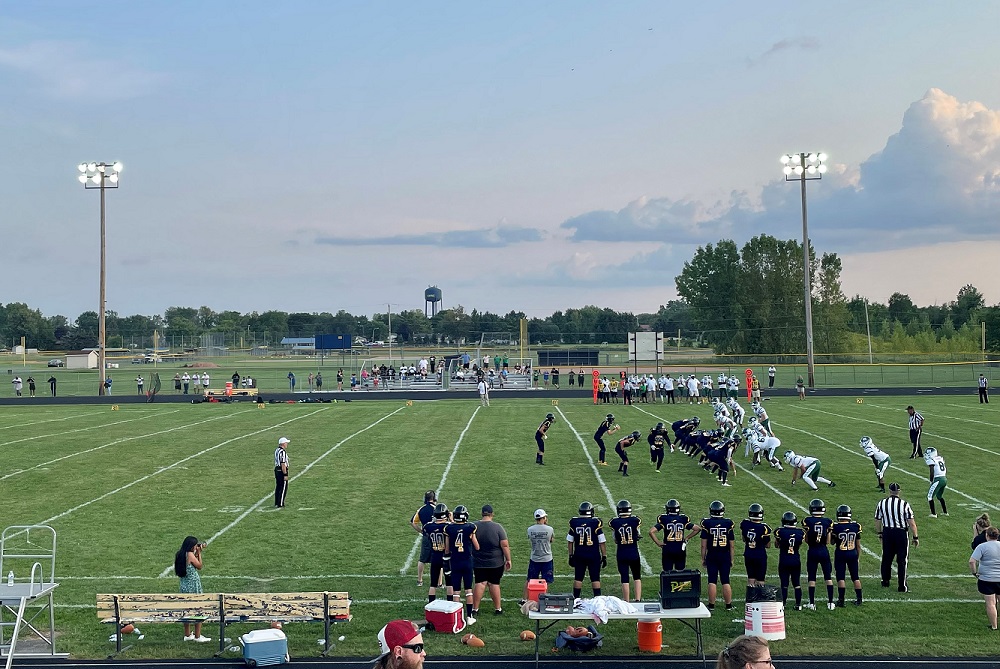
PHOTO: Capac and New Haven kicked off their season last week. Capac, returning after playing only one game a year ago, won 22-0. (Photo by Robert Batzloff.)