


Attending to Football
November 29, 2013
The interscholastic football season comes to an end this weekend with the MHSAA Finals at Ford Field, but the most talked about sport in high schools today will continue to make headlines for many months into the future.
Some of the headlines will introduce topics that are merely footnotes compared to what is really most important, that being the efforts to keep school-sponsored football the safest and sanest brand of football in America.
At the center of these efforts has been a task force appointed by the MHSAA to work throughout 2013 to advance these two objectives: “To promote the value of interscholastic football and to probe for ways to make the sport safer in Michigan.”
The tangible results of the task force’s four meetings are these:
-
- A proposal to the MHSAA Representative Council to revise football practice policies to improve acclimatization of players and to reduce head trauma. The proposal goes to the Representative Council Dec. 6 for discussion, then to the Michigan High School Football Coaches Association and MHSAA Football Committee in January and to the MHSAA League/Conference meeting in February, before returning to the Representative Council for action on March 22.
-
Three proposals to the NFHS Football Rules Committee to modify playing rules to promote player safety.
- A variety of print, online and broadcast promotions on behalf of the value of interscholastic football and its safety record and to encourage healthier out-of-season activities by students in all sports.
MHSAA research informs us that participation in 11- or 8-player football in member high schools this fall was down 3.0 percent compared to 2012, and down 7.63 percent since the 2008 season. The biggest reasons cited by those surveyed are, in declining order, safety issues, declining enrollment, athletes playing other school or non-school sports, cultural changes and pay-to-participate.
It is important to note that participation is not declining everywhere, not even everywhere where enrollments are down and participation fees are up. It is important to note also that some other sports are in much greater decline than football in terms of high school participation.
It is difficult for me to imagine my life without football as a part of it. It’s difficult to imagine schools and communities without football. I very much doubt that the absence of football would have improved my life or the schools and communities I’ve been a part of. It’s a sport that needs our attention, not its extinction.
Moment: The Final Thrill
December 16, 2020
By John Johnson
MHSAA Director of Broadcast Properties
Over the course of nearly 34 years on this job, you often get asked what single championship game you would rank at the top of your list. You could ask that question to 100 people and get 100 answers – and guess what? They’d all be right. Such is the beauty of high school sports.
Which is why, after all these years, my game for the ages is one that has stood the test of time in my mind for over 30 years. It had everything you would want in a high school game – fantastic competition – great plays – and when it was over, some of the best sportsmanship I’ve ever seen – NO – make that THE best sportsmanship I’ve ever seen. To be on the field, you’d have a hard time telling who won and who lost by the way the players from both teams hugged and shook hands and sincerely congratulated each other. Which is how it should be after every – single – game.
And what topped it all off after that was the winning team making a trip to a pep assembly at the other team’s gym the following week to thank them for a great game, and present a banner signed by every member of the team.
That game was the 1989 Class B Football Playoff Final. The last year that four divisions were conducted in that postseason tournament. The last game played in that format.
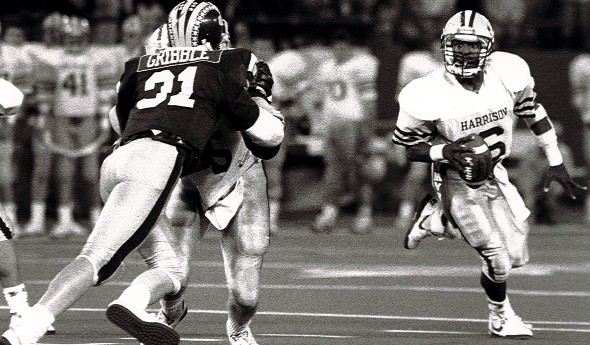
Farmington Hills Harrison and DeWitt. The powerful, dominant Hawks and even legendary at that time coach John Herrington – and the All-America quarterback in Mill “The Thrill” Coleman; against the pride of the Ingham County League, the Panthers of DeWitt, from what was an old farming bedroom community north of Lansing transforming into a new money suburb of the Capitol City.
The Hawks, the reigning Class B champs after winning the third of their state-record 13 titles against St. Joseph the previous November, were heavy favorites. DeWitt was making its fourth Playoff appearance and moving up in class after reaching the Semifinals in 1988, only to lose to powerhouse Detroit St. Martin dePorres.
The underdogs used an efficient running attack to take a 21-14 halftime lead on Harrison. John Telford, who rushed for 153 yards in the game, had two of the scores. Harrison tied the game early in the final period on the first of two scoring runs by Coleman, this one from 19 yards out.
DeWitt then put together a grinding drive, culminated by quarterback Chris Berkimer sneaking it from one yard out. Harrison blocked the extra point and DeWitt led 27-21 with 2:20 on the clock.
That left way too much time for Coleman. He engineered a 67-yard, five-play drive to tie the game. It didn’t even take a minute off the clock.
“When they scored I looked at the clock and knew we had enough time and all three of our time outs,” Coleman told the Detroit Free Press after the game. “I kept thinking back to that drive John Elway had against the Browns a couple of years ago in the playoffs when he had to go 98 yards.”
Three straight passes to Mike Saputo, Steve Hill and Greg Piscopink got Harrison down to the DeWitt 16; and Coleman then rolled out on a Student Body Right for another seven yards.
At the DeWitt 9, Coleman dropped back for what appeared to be another pass, but the Panthers' pressure forced The Thrill to run. Coleman eluded five tacklers along the way, finally diving into the end zone to score.
“We knew he (Coleman) was good, and we just tried to contain him,” DeWitt coach Gail Thornton told the Lansing State Journal after the game. “But every once in a while he would get loose for a big one.”
Steve Hill kicked the extra point and Harrison was back in the lead, 28-27. Hill would then intercept Berkimer on DeWitt’s first play after the ensuing kickoff to seal the deal.
PHOTO: Farmington Hills Harrison's Mill Coleman rolls left at the start of what would be the game-winning run for his team in the 1989 Class B Football Final. (Photo by Gary Shook).