


Attending to Football
November 29, 2013
The interscholastic football season comes to an end this weekend with the MHSAA Finals at Ford Field, but the most talked about sport in high schools today will continue to make headlines for many months into the future.
Some of the headlines will introduce topics that are merely footnotes compared to what is really most important, that being the efforts to keep school-sponsored football the safest and sanest brand of football in America.
At the center of these efforts has been a task force appointed by the MHSAA to work throughout 2013 to advance these two objectives: “To promote the value of interscholastic football and to probe for ways to make the sport safer in Michigan.”
The tangible results of the task force’s four meetings are these:
-
- A proposal to the MHSAA Representative Council to revise football practice policies to improve acclimatization of players and to reduce head trauma. The proposal goes to the Representative Council Dec. 6 for discussion, then to the Michigan High School Football Coaches Association and MHSAA Football Committee in January and to the MHSAA League/Conference meeting in February, before returning to the Representative Council for action on March 22.
-
Three proposals to the NFHS Football Rules Committee to modify playing rules to promote player safety.
- A variety of print, online and broadcast promotions on behalf of the value of interscholastic football and its safety record and to encourage healthier out-of-season activities by students in all sports.
MHSAA research informs us that participation in 11- or 8-player football in member high schools this fall was down 3.0 percent compared to 2012, and down 7.63 percent since the 2008 season. The biggest reasons cited by those surveyed are, in declining order, safety issues, declining enrollment, athletes playing other school or non-school sports, cultural changes and pay-to-participate.
It is important to note that participation is not declining everywhere, not even everywhere where enrollments are down and participation fees are up. It is important to note also that some other sports are in much greater decline than football in terms of high school participation.
It is difficult for me to imagine my life without football as a part of it. It’s difficult to imagine schools and communities without football. I very much doubt that the absence of football would have improved my life or the schools and communities I’ve been a part of. It’s a sport that needs our attention, not its extinction.
Drive for Detroit: Playoff Week 2 Preview
November 2, 2017
By Geoff Kimmerly
Second Half editor
 The first week of the 2017 MHSAA Football Playoffs was one of the most memorable in recent memory with a collection of twists and turns, late-game heroics and bracket-shaking upsets.
Welcome to the encore.
This week, we’ve got one of the state’s most heated rivalries, two meetings of undefeated teams, and plenty of matchups fans have been anticipating to decide District titles in 11-player and Regional championships in the 8-player divisions.
We’d love for you to check out one (or more) of the 72 games being played across the state this weekend. We also have eight being broadcast either on Prep Zone by FOX Sports Detroit or MHSAA.tv. The MHSAA playoff scoreboard page is home to results and next week’s games as they’re determined. The MHSAA Playoffs are sponsored by the Michigan Army National Guard, and “Drive for Detroit” is sponsored by MI Student Aid.
11-Player Division 1
Canton (9-1) at Belleville (10-0), Friday
The Chiefs eliminated one popular championship contender last week in downing Saline 42-12, and now get an opportunity against another of similar regard in the undefeated Tigers. Belleville has tied its most wins ever, with 10 for the first time since 1995, giving up 8.3 points per game. Canton will counter with an offense averaging 42 points per game; the Chiefs haven’t scored fewer than 35 since losing to Muskegon Mona Shores on opening night.
Others that caught my eye: FRIDAY Rochester Adams (9-1) at Utica Eisenhower (10-0), West Bloomfield (8-2) at Waterford Mott (9-1), Rockford (7-3) at Holland West Ottawa (9-1), SATURDAY Clarkston (8-2) at Davison (9-1).
11-Player Division 2
Traverse City Central (7-3) vs. Traverse City West (9-1) at Thirlby Field, Friday
One of the state’s best rivalries will write another chapter on the home field they share. West defeated Central 29-27 in their first meeting this season, in Week 3. Central won both of last year’s meetings, by two during the regular season and one in the playoffs as the teams met in the postseason for the first time. Central’s record doesn’t lend it enough credit; since falling to West the first time the Trojans have taken nonleague losses to playoff teams Portage Central and Birmingham Brother Rice, and then stunned Midland 21-13 on the road last week. West has kept churning too, downing Benton Harbor and bouncing back from a Week 9 loss to Coldwater (both opponents also playoff bound) to beat Midland Dow by 30 in their playoff opener.
Others that caught my eye: FRIDAY Muskegon Mona Shores (9-1) at Grand Rapids Forest Hills Central (10-0), Livonia Franklin (8-2) at Livonia Churchill (8-2), Flushing (8-2) at Fenton (9-1), Detroit East English (9-1) at Detroit Martin Luther King (9-1).
11-Player Division 3
Cedar Springs (7-3) at DeWitt (9-1), Friday
Cedar Springs opened the playoffs last week with arguably the biggest upset win in the state, downing undefeated East Grand Rapids at EGR. The Red Hawks won’t sneak up on anyone else. They’ve set a record with 401 points this season and even put up 44 in a loss to Grand Rapids Christian, but will be challenged by a DeWitt defense giving up only 10.3 points per game. The Panthers also lost to Grand Rapids Christian this year, in Week 1, but avenged that loss with a 42-10 victory over the Eagles in their playoff opener. No opponent has gotten within 24 points of DeWitt since Division 1 playoff qualifier Grand Ledge in Week 2.
Others that caught my eye: FRIDAY Stevensville Lakeshore (9-1) at Battle Creek Harper Creek (10-0), Riverview (9-1) at Gibraltar Carlson (9-1), Haslett (8-2) at East Lansing (8-2), Farmington Hills Harrison (7-3) at Warren Woods-Tower (8-2).
11-Player Division 4
Grand Rapids Catholic Central (10-0) at Wyoming Kelloggsville (10-0), Friday
These teams both are averaging nearly 42 points per game behind two of the state’s most powerful rushing attacks. That would seem to point to the other side of the ball; both defenses are giving up a little more than two touchdowns per game. But GRCC’s biggest wins (over Comstock Park and Grand Rapids West Catholic) were in close games where the scores got big, and it could be that kind of back-and-forth offensive display in this one as well with both offenses so loaded.
Others that caught my eye: FRIDAY Three Rivers (8-2) at Edwardsburg (9-1), River Rouge (8-2) at Chelsea (9-1), Alma (8-2) at Escanaba (8-2), SATURDAY Detroit Mumford (7-3) at Bloomfield Hills Cranbrook Kingswood (9-1).
11-Player Division 5
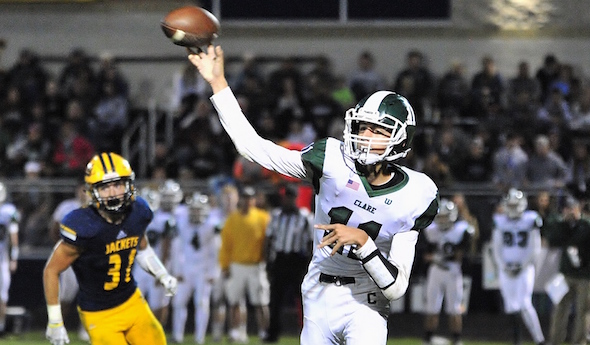
Clare (9-1) at Reed City (9-1), Friday
Reed City quietly has one of the most consistently successful programs in Michigan. One more win and the Coyotes will have 10 for the sixth time in seven seasons, and even as their 18-game regular-season winning streak ended on opening night against Montague – Reed City hasn’t lost since. Clare is similarly consistent, especially in Jack Pine Conference play, and also hasn’t lost since opening night (to Ithaca) to reach nine wins for the first time since 2012. Both have similarly sizable wins against playoff qualifier Remus Chippewa Hills – Clare’s last week to avenge a 2016 playoff loss – indicating this might be a tightly contested matchup.
Others that caught my eye: FRIDAY Menominee (7-3) at Kingsford (8-1), Carrollton (7-3) at Saginaw Swan Valley (9-1), Lansing Catholic (8-2) at Portland (9-1), Marine City (8-2) at Frankenmuth (10-0).
11-Player Division 6
Kent City (10-0) at Montague (10-0), Friday
Few teams this season have as impressive a resume as Montague, which in addition to handing the lone losses to Reed City and Muskegon Catholic Central has six shutouts over its 10 games. The Wildcats now also have a chance to avenge last year’s one-point playoff opener loss to Kent City, which has built a likewise impressive body of work this fall. The 10 wins are a program record, and a District title would be the Eagles’ first in this sport.
Others that caught my eye: FRIDAY Michigan City (9-1) at Jackson Lumen Christi (8-1), Detroit Central (8-2) at Warren Michigan Collegiate (10-0), Houghton Lake (7-3) at Millington (9-1), SATURDAY Maple City Glen Lake (7-2) vs. Traverse City St. Francis (9-1).
11-Player Division 7
Pewamo-Westphalia (9-1) at New Lothrop (10-0), Friday
The Hornets are hoping their annual regular-season success pays off this fall with a first MHSAA Finals trip since 2006. The Hornets are a combined 86-6 since the start of 2010 and only one of those losses came during the regular season – they’ve reached the Semifinals three times this decade but just missed taking that next step again. A game like the Week 1 win over Lake Fenton surely was meant to prepare the Hornets for matchups like this one with the reigning Division 7 champion Pirates, who despite graduating the second-leading rusher in MHSAA history is riding a nine-game winning streak and scoring 43 points per game versus last year’s 46.
Others that caught my eye: FRIDAY Reading (8-2) at Cassopolis (9-1), Riverview Gabriel Richard (9-1) at Madison Heights Madison (10-0), Elkton-Pigeon-Bay Port Laker (9-1) at Cass City (9-1), SATURDAY Ishpeming Westwood (9-1) at Lake City (10-0).
11-Player Division 8
Muskegon Catholic Central (8-1) at Mendon (10-0), Saturday
This might be the most anticipated small-school matchup in Michigan so far this season – the reigning four-time Division 8 champion against an 11-time MHSAA title winner now revived. The Hornets ran for 415 yards in last week’s 28-12 win over St. Joseph Lake Michigan Catholic, and that ability to hold onto the ball will be necessary against a Crusaders attack led by dynamic dual threat quarterback Cameron Martinez (see 2H feature Tuesday).
Others that caught my eye: FRIDAY Norway (9-1) at Iron River West Iron County (9-1), Harbor Beach (9-1) at Saginaw Nouvel (10-0), Climax-Scotts (8-2) at Pittsford (9-1), SATURDAY Frankfort (7-2) at Gaylord St. Mary (10-0).
8-Player Division 1
Morrice (9-1) at Deckerville (9-1), Friday
Morrice broke Deckerville’s 16-game regular-season winning streak with a 33-32 Week 5 win that announced the Orioles as MHSAA championship contenders – even though they were then beaten by Kingsford a week later. Morrice avenged that loss last week and now must avoid falling by the same fate to the reigning Finals runner-up Eagles, who have amped up the offense by scoring 250 of their 496 points this season over the last four weeks.
Other Regional Finals: FRIDAY Cedarville (8-2) at Stephenson (8-2), Suttons Bay (7-3) at Central Lake (10-0), Lawrence (5-5) at Bellevue (9-1).
8-Player Division 2
Onekama (9-1) at Pickford (10-0), Saturday
Perhaps the most impressive part of Pickford’s dominance this season has come on the defensive side of the ball. The Panthers are giving up only 9.6 points per game, which just doesn’t happen much in the wide-open 8-player game – and is half as many points as they gave up while reaching the Semifinals a year ago. Enter Onekama, averaging 51 points per game – only a few behind Pickford’s 56 and against a similarly competitive slate.
Other Regional Finals: FRIDAY Engadine (8-2) at Crystal Falls Forest Park (7-2), Bay City All Saints (7-3) at Kinde-North Huron (9-1), SATURDAY Flint International Academy (8-2) at Portland St. Patrick (9-1).
Second Half’s weekly “Drive for Detroit” previews and reviews are powered by MI Student Aid, a part of the Student Financial Services Bureau located within the Michigan Department of Treasury. MI Student Aid encourages students to pursue postsecondary education by providing access to student financial resources and information, including various student financial assistance programs to help make college more affordable for Michigan students. MI Student Aid administers the state’s 529 savings programs (MET/MESP) and eight additional aid programs within its Student Scholarships and Grants division. Click for more information and connect with MI Student Aid on Facebook and Twitter @mistudentaid.
PHOTO: Clare, here against Ithaca in Week 1, will play for a District title tonight against Reed City. (Click to see more from HighSchoolSportsScene.com.)