

Back from Brink, Concord Surges On
By
Chip Mundy
Special for Second Half
September 9, 2016
By Chip Mundy
Special for Second Half
CONCORD – Two years ago this week, Concord head football coach Max Clark and the school district faced a difficult decision.
 Clark pushed for the school to forfeit varsity games until it had enough healthy players to fill a team. Concord had started the season with 16 players, but injuries had the Yellow Jackets down to nine by Week 3, and pulling up kids from the junior varsity wasn't an option for Clark.
“We had the same argument almost every year,” Clark said. “Do we shut down a couple of varsity games? We even talked about trying to play some 8-man varsity games so we could keep a JV intact.
“In 2014, I got backing from the superintendent and my administration, and I said we just have to do this. If we bring up JV kids, we're just doing the same old stuff. They are going to get hurt, they are going to get discouraged, and we're going to lose kids.
“We took a beating and took our lumps, but we wanted to make sure to keep that JV team intact, which is this year's seniors. They needed to develop that mentality on how to win and be a team, and if we would have just stripped them, we would have been right back where we had been.”
Concord forfeited two games before it was able to field a team for Week 5, and it finished the season 1-8 for the second year in a row and third time in four years.
Since then, it has been a rags-to-riches story. That junior varsity team is now the senior class on the varsity – a varsity that went 7-2 during the regular season last year, lost in a MHSAA Division 7 Pre-District game, and has started the season 2-0 this year.
Already, Concord is gaining attention. The Jackson Citizen Patriot ranked Concord No. 1 in its area “Power Poll,” ahead of No. 2 Grass Lake, No. 3 Jackson Lumen Christi and No. 4 Jackson.
It is uncharted territory for Concord, which has had just two winning seasons since 2001.
“It's a whole new challenge,” Clark said. “Everyone is loving up this No. 1 power-ranking thing, which I don't think I've ever seen before at Concord, but it's just press.
“I tell the team, 'If you are focused on the little things, bad things happen when they're big.' One of their biggest strengths is their confidence, and as long as they continue to work hard, they can relish in that No. 1 and enjoy it. They've never had it here before, and the community is treating them in a phenomenal way. We had an amazing crowd last week at Homer.”
Turning it around
Clark is one of those “glass half-full” kind of guys, although, in reality, he might just feel the glass is always filled to the brim. He grew up in Concord and played on the 2001 team that advanced to the Division 7 Semifinals before losing to Detroit St. Martin dePorres.
To him, coaching is more than a job. It is who he is in a lot of ways.
“I'm 32 years old, and for 17 of my 32 years, I've been a part of this program, whether as a player or a coach or in some capacity,” he said. “A big part of who I am as a person is from what I learned from Coach (Clint) Alexander and the guys that taught us what we know back in the late 1990s and early 2000s.
“I just try to carry that on and bring a lot of that tradition back. I know how important it was to me and helping me become a teacher and a coach and be a good father and a good husband. That's the mentality we're trying to bring to these buys here so they can carry on that legacy.”
 Clark is in his fourth season as the head coach, and for the first two of those years, he was not a teacher at the school. It certainly did not help him recruit the hallways for players, and even though he was a local guy, that identity might not have been strong with the younger players.
He landed a teaching job last year. He teaches history and social studies, and it has strengthened his connection with the student body. He also preached a positive attitude, not only to his players, but to the community.
“Maybe it's my personality or my mentality, but I try really hard to be positive all the time,” he said. “I remember my first year. It didn't matter if I was at the hardware store downtown or wherever, if somebody asked me about our numbers, I always told them, 'We're going to have the biggest team we've ever had.'
“Maybe that was the greatest lie I ever told, but the point was that it was about marketing and creating a positive aura around our program, rather than in the past, how there had always been that negativity surrounding the program. We wanted to change that mentality. It's changing, but it's still in the beginning.”
Clark said the first big step was the season finale in 2014 – the season during which the two games were forfeited. Concord blasted Bellevue 62-20 to avoid a winless season. Those tied the most points Concord had scored in a game dating back to 1950 and were more than the combined point total from 2005 and 2006.
“Bellevue had beat us two years before, and I think that made our players believe in our new offense,” Clark said. “That one win really carried us into the offseason.”
Last year, Concord defeated Union City in Week 2 to end a 27-game losing streak against the Chargers. It was the springboard for the turnaround season.
“That was a big deal for the community and the kids, and I think that really tripped the trigger and made them believe,” Clark said.
Senior running back Tony Brooks, Jr., said the victory was a huge confidence boost.
“It made everyone know that we could win,” he said.
History of futility
Concord football has a resume filled with futility. Since 1950, it has a record of 216-363-13.
It has never won a Big Eight Conference title, and the league has been in existence since 1973.
It has an all-time losing record against every member of the Big Eight, and most of those records aren't even close.
It went three consecutive seasons without a win twice and endured losing streaks of 35 and 30 games.
Yet, the school has enjoyed much athletic success in sports like basketball, golf, volleyball and track & field. The boys basketball team won 10 consecutive District titles under coach Bob Urschalitz during the 1980s. But at least one person thinks that might have hindered the football program.
The last time Concord won a conference championship in football was 1964 as a member of the Cascades Conference. Kilbourn Snow was a member of that team, and he has stayed in the community and followed all the teams throughout the years.
 “He told his basketball players that if they wanted to play basketball, they couldn't play football,” Snow said. “I remember coming to games back then and all of the basketball players were out for golf, and he was the golf coach, too. We had a golf team that could have probably been a good football team, and they were all sitting on the sidelines. From there, it all went downhill.”
Snow has a lot of praise for Clark and said Clark reminds him of his old coach from the 1960s, Van Green.
“He has the same rapport with his players and the same kind of determination,” Snow said. “He is very focused on the legacy of Concord football. They are getting the young kids involved, and on the night the little kids are playing, they run through the varsity and JV players, and the players all stop and clap for them.
“Max has re-instilled that football culture back in the school.”
Another win to build upon
Brooks, who rushed for 129 yards, gained 71 as a receiver and scored three touchdowns last week in an exciting overtime victory against rival Homer, was on the junior varsity two years ago when the varsity had to forfeit two games.
“We would go against them in practice, and we would keep up with them,” he said. “It was frustrating because they only had 13 or 14 guys, and if one person gets hurt, it's going to hurt you.”
The Homer game, much like the Union City game last year, might be a springboard to success, and it gave the Yellow Jackets possession of the Little Brown Jug – the prize in the rivalry.
“It was phenomenal, it felt really good and I was pretty emotional afterwards, I'm not going to lie,” Clark said. “We needed to get over that hump, so I think this momentum will carry us a little bit. That's the goal, anyway.
“We don't want to get lackadaisical at practice because we won. Great teams practice harder after they win.”
This year's team faced a big challenge from the start. Last year's quarterback, Chase Hinkle, was a senior and was named the Most Valuable Player of the Big Eight Conference. Jacob Randall is the new starter, and Austin Hoxie is the backup.
“Chase was a great quarterback, and he did great things for us,” Clark said. “He worked hard in the offseason, so we had designed a lot of stuff that we did around him and his abilities, and we've done the same thing with our new guys.
“Jacob is a good runner and has a lot of ability. He has an amazing arm, and he throws a 90 mph fastball in baseball. But we have depth there. In our first game, Jacob had an asthma attack and had to go out, and Austin went in and goes 5-for-9 and throws a touchdown pass.”
Concord runs a spread-power no-huddle offense with Clark calling all the plays from the sidelines.
“I've never seen anyone use my system; I just holler out plays,” he said. “We have the ability to change the numbers and letter that we use to call the same stuff. It works for us.
“We've been pretty run-heavy the first two weeks. We have phenomenal running backs. We have great receivers, and we can pass when we need to, but I guess if we don't need to pass, we won't. There is that old-school mentality that three things can happen when you pass, and two of them are bad. So I like to keep it on the ground.”
Concord connection
The players say a brotherhood has developed on the team. That often is seen on winning teams, and Concord does not appear to be an exception to the rule.
“This has been great because the team has such a strong connection,” senior Bradley Hawkins said.
 One of the players who can attest to the connection is senior strong safety Montez Brewer, who came to Concord two years ago when Albion closed its high school. All the Albion students were spilled into nearby schools such as Concord, Marshall, Homer, Springport and Parma Western.
“It wasn't a fast connection when I came over, but sports helped a lot,” Brewer said. “Sports helps everyone get closer.
“It's hard that Albion doesn't have a school, but this is a positive thing because we can still do what we love to do – play football. At Albion, there was a point in time when we couldn't even play football because everyone was moving, but now we can play, and we still stay in contact.”
That Concord connection is one of the backbones of the football program.
“I think the biggest mentality is that it's an attitude, and me bringing it every day and keeping the intensity up,” Clark said. “You can't ever have days when you just stop when it's hot. You have to go hard every single day, but at the same time it's making sure the kids love being here.
“You're taking care of them. It's not the old school anymore where the kids show up and work hard because they're afraid. They show up and work hard because they love their coaches and we love them. Love is a lot more powerful, and that's what I learned as a player. We loved each other like brothers as a team, we loved our coaches and they loved us, and then you're willing to work a lot harder.”
Clark knows the job isn't done, but he is changing the football culture. He said last year he learned a hard lesson himself in the playoffs – a game Concord lost at Dansville 28-6.
“I learned something about myself,” he said. “I didn't do a good enough job of re-evaluating our goals after we made the playoffs because all year we talked about just making the playoffs. I think overall there was a little bit of an exhale and excitement that we made it. It was almost like we lost our hunger, and as a coach I learned a lot from that situation. I had never been in that situation as a coach.
“Now, I preach that it's our expectation. Never again will Concord football be happy just to make the playoffs. Our goals this year were one, to win our rivalry games, and we got that do that in Week 1 and Week 2. Now, we have to make the playoffs and win the first Big Eight Conference championship for Concord.
“We want to be the best team to ever play here.”
While that might be a lofty goal, there is another that Clark plans to accomplish and will have more control in doing so.
“If you look at the history of the football program, we've had good coaches come and go,” he said. “Go all the way back to the 70s and Coach (Glen) Stevenson, and they won. In the 60s, they won a lot. In the 80s, they had a couple of years when they won games, and then Coach Alexander came in the 1990s and early 2000s and left.
“I am not going to sit here and say that I'm at the level that they were at – someday, hopefully, I can be compared to those guys – but there a difference between me and those other guys: I'm not going anywhere. My kids go here, I live a block from the school. I love it here. There's nowhere for me to go.”
 Chip Mundy served as sports editor at the Brooklyn Exponent and Albion Recorder from 1980-86, and then as a reporter and later copy editor at the Jackson Citizen-Patriot from 1986-2011. He also co-authored Michigan Sports Trivia. E-mail him at [email protected] with story ideas for Jackson, Washtenaw, Hillsdale, Lenawee and Monroe counties.
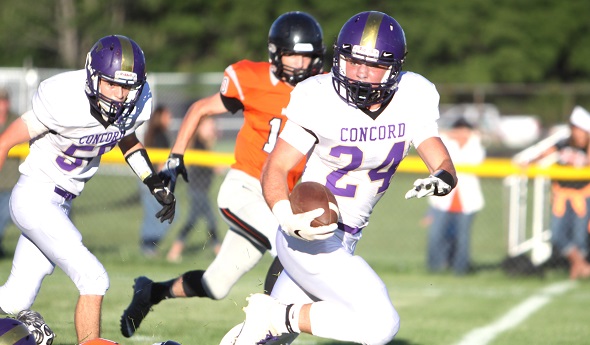
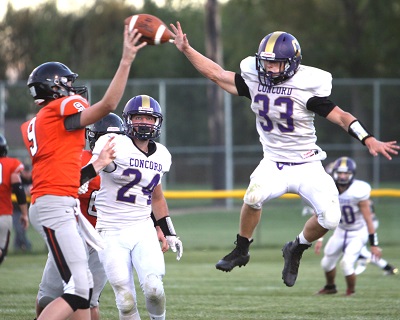
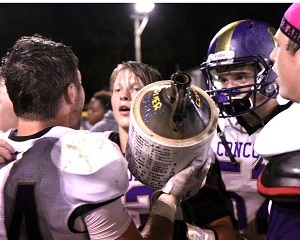
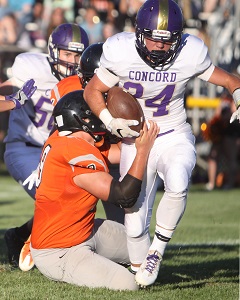
PHOTOS: (Top) Tony Brooks, Jr., runs for some of his 166 yards against Homer during Concord's victory last week. (Middle top) Nick Stump jumps to block off a potential pass. (Middle below) Concord players celebrate earning the Big Brown Jug awarded annually to the winner of the Concord/Homer game. (Below) Brooks works to break free; his grandfather Gary also was a standout for the school. (Photos by Kilbourn Snow.)
Football Kicks Off Again, 129 Years Later
By
Ron Pesch
MHSAA historian
August 25, 2017
Buried in the text on the fourth page of the Saturday, October 27, 1888, Detroit Free Press is a single, concise sentence bearing a minimum amount of detail.
“The Windsor foot ball team will play the Detroit High School team this afternoon at 3.”
To date, this is the earliest account of a Michigan high school playing the game of “foot ball.”
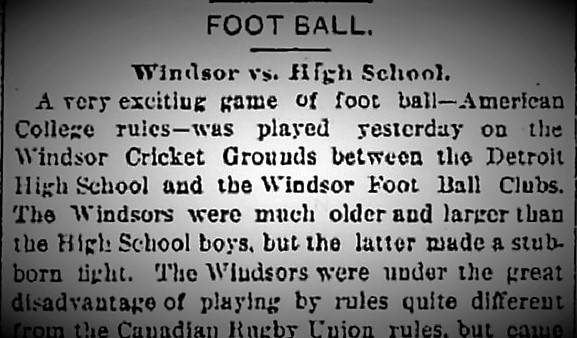
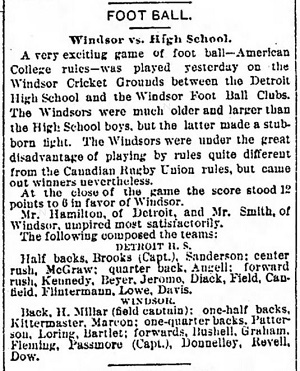
The following day’s paper provides only a few more details. The game was played on the Windsor Cricket Grounds. Despite the great disadvantage of playing under “American Football rules … quite different from the Canadian Rugby Union rules …” the “older and larger” Windsors won the contest, 12-6. Rosters for each squad were provided.
 Under American rules of the time, a touchdown was worth four points, with a conversion kick following a touchdown worth two additional points. At the time, a field goal counted for five points and a safety was worth two. The teams, however, may have agreed to a different scoring system before the contest.
Was this the first football game for a Michigan high school? That’s unlikely, but it is certainly among the earliest published accounts involving a prep game in the state.
It’s a fair assumption that foot ball, or some version of the game, was being played in neighborhoods before that time, at least based on the following statement found in the Jackson Citizen Patriot, dated June 18, 1867. Only days before, Dorrance & Goodwin’s, a store on Main Street in Jackson, had placed advertisements in the newspaper’s classifieds noting the pending arrival of this new product.
“Foot Ball – The pastime was inaugurated on our streets yesterday. Three or four balls were kept in motion all day on Main street alone. It affords no little amusement to the little boys, and is certainly a healthy exercise for the larger ones. It’s all right as long as no windows are broken or horses scared. Both calamities were barely escaped scores of times during the day.”
Rutgers and Princeton are credited with playing the first college football game in 1869. A decade later, in 1879, the University of Michigan established a football team.
Detroit High School played a number of games in 1888, besides the Windsor match, including a contest with the Tappen School from the Corktown area of Detroit. Played at the Detroit Athletic Club grounds on the afternoon of Thursday November 15, a final score was not mentioned in the following day’s Free Press.
For those unfamiliar with the sport, an account of the University of Michigan versus Detroit Athletic Club contest that appeared in the November 18 Free Press served as a fine introduction to the game, and the determination behind securing “possession of a leather-covered foot ball.”
“It was very interesting to see one speedy young man, after a desperate struggle in which the spectators fully expected to see him lose an arm or a leg, get away from his captors and start like a deer, with eight or ten of the opposite side in full pursuit. He is overtaken and the leader of the pursuing party springs upon the back of the man with the inflated trophy, bearing him to the ground with a dull thud … It is also an inspiring sight to see a fleet-footed player seize the ball and run at full speed in the direction of the goal of his opponents. Then a wing-footed opponent cuts across to intercept him, makes a flying leap, grasps the fugitive around the neck or waist and both go to grass with a suddenness and velocity that transforms them into human wheels …
 “While one unaccustomed to foot ball will naturally be startled by some of the acrobatic feats, still it is impossible to watch the game for any length of time without a tingling of the blood and holding of the breath. It is most intensely exciting, continuous in action and replete with fine points of play.
“It may be explained that the goals in a foot ball game are set at a distance of 330 feet from each other. The goal is made by placing two pieces of scantling twenty feet long upright in the ground, eighteen and one-half feet apart. Another piece runs midway horizontally between the uprights, and the ball must go over the horizontal piece and between the uprights to count a goal. There are eleven men on each side and the object is, of course, to get the ball through the goal of the other. The time of game is an hour and a half each side playing forty-five minutes from each goal, with an intermission of ten minutes between halves.”
A player who ran over an opponent’s goal line, “with the ball and touched it down” was then entitled to “bring the ball in front of the goal and attempt to kick it through”…
Among those playing for the Athletic Club squad that day was “little Hugh Brooks (captain) of the high school team.” Eligibility rules for players would evolve over time.
On Saturday, November 24, Detroit High School squared off for the first of two contests with Ann Arbor High School, this one at the Detroit Athletic Club grounds. Admission to the 2:45 p.m. contests was 25 cents. A crowd of around 300 watched “an exciting illustration of how Rugby foot ball is played. The exhibition by the Ann Arbor boys was considerably better than that of the Detroiters,” noted the Free Press, “the result of that being that Detroit’s banners have been kicked into the dust.”
Ann Arbor returned home with a 12-0 victory.
A second game with Ann Arbor was quickly scheduled.
In between, on Thursday, November 29, the Detroit High School squad played the Athletic Club before a crowd of about 200.
 “While the Athletics won by 12 to 0, still their playing was very loose, probably the result of over confidence. The Athletics will have to rid themselves of this by Saturday or the Albions will make short work of them.”
A large crowd gathered in the drizzling rain in Ann Arbor on Saturday, December 8, for what appears to be the final contest of the 1888 season for the high school teams of Detroit and Ann Arbor.
“It was a fine game. (Captain) Brooks, McGraw and Wisner, for Detroit, and Jewett, Diggert, Dupont, and Rathbone for Ann Arbor, made fine plays for their respective sides.” The result was an 8 to 2 win, and redemption, for the Detroit squad.
Today, 129 years later, “football” has seen wild expansion, numerous rule changes, and huge advancement in equipment worn when compared to those pioneer days of the sport. In 2017, more than 1 million individuals will suit up for high school teams across the United States. In Michigan alone, more than 36,000 participate in prep football.
And our state’s original programs live on. On Friday, Detroit Central opened its season with a win over Detroit Loyola. Ann Arbor High School, renamed Ann Arbor Pioneer in the late 1960s, fell in its Friday opener to Muskegon.
Welcome to another season of America’s favorite pastime.
 Ron Pesch has taken an active role in researching the history of MHSAA events since 1985 and began writing for MHSAA Finals programs in 1986, adding additional features and "flashbacks" in 1992. He inherited the title of MHSAA historian from the late Dick Kishpaugh following the 1993-94 school year, and resides in Muskegon. Contact him at [email protected] with ideas for historical articles.
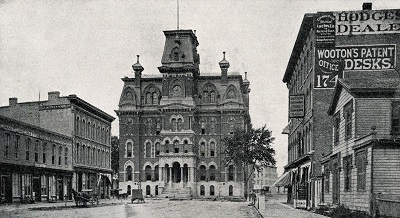
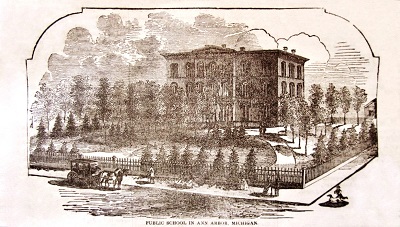
PHOTOS: (Top) The Detroit Free Press included brief coverage of the first "reported" game on Oct. 28, 1888. (Middle) When Michigan’s state government moved from Detroit to Lansing in 1847, the old Capitol building was re-opened as the Detroit’s first city high school in 1863. To better accommodate Detroit’s growing population, the old two-story structure was remodeled into a four-story building, unrecognizable to most. The school served the city well until January 1893, when it burned to the ground. (Below) Erected in 1856 at the cost of $27,000, Ann Arbor High School at State and Huron (now site of the North Quad of the University of Michigan) was destroyed by fire in 1904. (Photos courtesy of Ron Pesch.)