

'Battle for the Bell' Rings for 110th Tilt
October 5, 2016
By Tom Kendra
Special for Second Half
The Whitehall vs. Montague football game actually begins on Thursday night far away from any football field, with a huge crowd from each town, bands, cheerleaders, players, coaches and school officials.
 For the coin toss.
In a scene reminiscent of a Revolutionary War battle, the aforementioned delegations marched toward each other on the evening of Thursday, Sept. 22, and met – Whitehall in red and Montague in blue – on the bridge over the White River, which separates the two northern Muskegon County towns.
No shots were fired or punches thrown, but simply a coin was tossed high in the air by veteran MHSAA official Chuck Hulce (who, by the way, coached Montague from 1969 to 1977 and then Whitehall from 1979 to 1981) and the 110th edition of the “The Battle for the Bell” was underway.
“This is something I’ve been dreaming about my whole life – playing Whitehall, the cross-town rival where I know everyone, my senior year,” said Montague senior wide receiver Josh Weesies. “It’s huge for me. We’ve been grinding all summer just thinking about this game.”
Montague, with a population of 2,361 and covering 3.27 square miles, boasts the World’s Largest Working Weathervane and 1961 Miss America Nancy Fleming – and boasted a 59-48-2 edge in the all-time series over Whitehall heading into this year’s game.
Whitehall, with a population of 2,706 and covering 3.79 square miles, counters with the historic Howmet Playhouse and 11-year Major League Baseball player and Gold Glove winner Nate McLouth, who quarterbacked the Vikings to back-to-back wins in the series in 1998 and 1999.
The game has always been about bragging rights, but this year’s clash was much more. For the first time since 1985, both teams came into the game undefeated and both were state-ranked. Whitehall was 4-0 and ranked eighth in the Associated Press Division 4 poll, while Montague was also 4-0 and ranked sixth in Division 5.
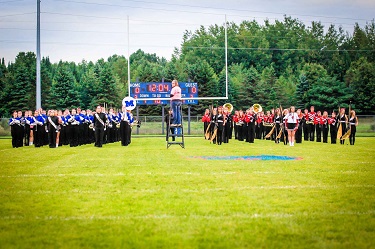
 The pre-game festivities on Sept. 22 were all about White Lake area unity as the two communities came together for a “Pink Out” event to raise money for St. Jude’s Hospital and the fight against cancer – and the marching bands even performed together on the field before the game.
Then it was time to take sides.
“This rivalry is very special for me,” said Whitehall senior quarterback Casey Huizenga. “I know all the Montague kids. We’re friends, but during this game we’re going all out.”
Huizenga and Whitehall actually struck first in the game, which was played on a perfect early fall night in front of 5,000 fans at Montague.
Whitehall junior Tylor Russell returned the opening kickoff deep into Montague territory, setting up a 1-yard plunge by Huizenga for a quick 6-0 Vikings’ lead.
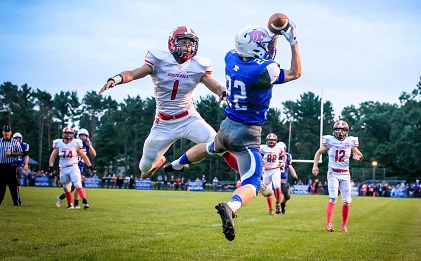
But it didn’t take long for Montague’s myriad offensive weapons to come out. On the ensuing possession, Montague senior quarterback Dylan Stever (good friends with Huizenga, incidentally) connected with junior Jake Jancek on a 16-yard touchdown pass to tie the score.
Jancek was the first of six Wildcats to score touchdowns in the game, which featured 40 points in the first quarter alone, with Montague holding a 27-13 edge. Also scoring for the Wildcats were junior Eddie Caviedes, sophomore Bryce Stark, Weesies, sophomore Kenyon Johnston and Stever.
The difference in the game was Montague’s defense completely shutting down the Whitehall offense after the first quarter.
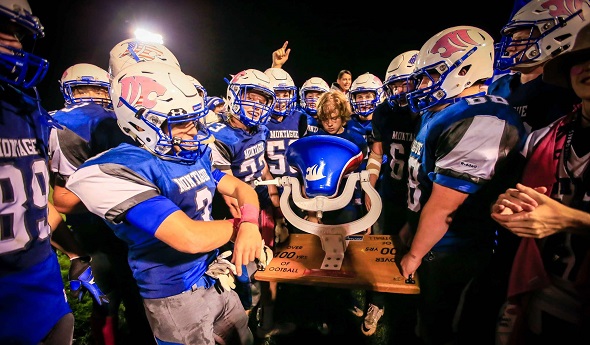
Whitehall’s only score after the first 12 minutes was a 90-yard interception return by junior Justin Brown in the fourth quarter, which completed the scoring in a decisive 41-20 Montague victory. The night ended with fans heading for their cars and the Wildcats ringing the red, white and blue victory bell for the ninth time in the last 11 years.
“It’s fun to be here with the whole community at one game,” said 13th-year Montague coach Pat Collins, who played quarterback and led the Wildcats to the 1992 Class CC championship game at the Pontiac Silverdome, where they lost to Detroit dePorres, 12-7. “It’s a real special moment every year up here.”
 Collins has turned Montague into a state football powerhouse, as it’s made the MHSAA Playoffs in 11 of his first 12 seasons as head coach. What is more impressive is what his teams have done once they get there. Montague made it at least to the third round of the playoffs eight straight years from 2004 to 2011, at least to the Semifinals five straight years from 2005 to 2009 and won back-to-back Division 6 championships in 2008 and 2009.
Montague (5-1), which was upset by North Muskegon in the rain on Sept. 30, is heavily favored at Hart this week, which would set up a showdown at Muskegon Oakridge (5-1) on Oct. 14 for the West Michigan Conference title. For the playoffs, Montague’s enrollment has increased to 414 and the Wildcats are now considered a “bubble team” which could end up in either Division 5 or Division 6.
Whitehall (4-2), a larger school with 654 students, could clinch its third-straight Division 4 playoff berth with two wins over its final three games, starting with this week’s showdown at Ravenna (4-2).
While Montague has been a model of stability with just two head football coaches during the past 31 years (Ken Diamond from 1986 to 2003 and Collins from 2004 to present), Whitehall has been just the opposite.
The Vikings have had five different head coaches since 2002, but it appears they have found their man in Dewitt native Tony Sigmon, who has a 19-9 record over the past three seasons after a 1-8 start in his first season in 2013.
For Sigmon, the first step to competing for West Michigan Conference titles and MHSAA playoff victories is being able to consistently go toe-to-toe with rival Montague.
“This game, this rivalry is what high school football is all about,” Sigmon said. “It’s a game that has become a huge community event, and it drives both teams to keep getting better.”
 Tom Kendra worked 23 years at The Muskegon Chronicle, including five as assistant sports editor and the final six as sports editor through 2011. E-mail him at [email protected] with story ideas for Muskegon, Oceana, Mason, Lake, Oceola, Mecosta and Newaygo counties.
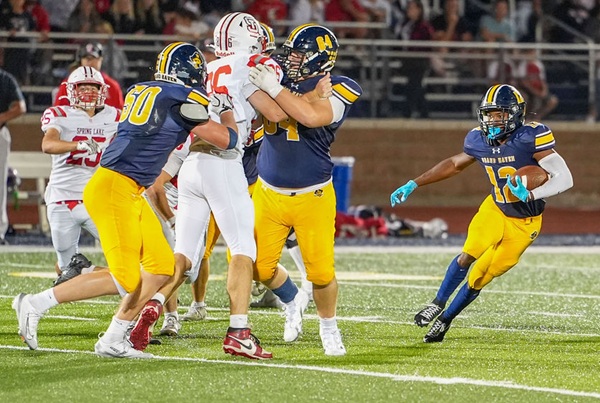
PHOTOS: (Top) Montague players gather to ring the trophy bell after Montague defeated Whitehall, 41-20, in the "The Battle for the Bell." (Middle) Montague junior Jake Jancek elevates to grab this 16-yard touchdown pass from Dylan Stever in the first quarter, while Whitehall's JoJo Dowdell defends. (Below) The Whitehall and Montague bands performed together before the big game between the two northern Muskegon County schools. (Photos by Tim Reilly.)
Grand Haven Playmakers Rising to Challenge After Loss of Senior Standout
By
Tom Kendra
Special for MHSAA.com
September 9, 2026
Grand Haven was expected to have one of the state’s best backfield duos this season in seniors Andrew Willemsen and KV Korenstra.
 That duo became singular in July, when Willemsen tore his ACL for the second-consecutive year, a gut-punch both for him and the Buccaneers’ coaching staff – which was planning on handing the ball to Willemsen 20-plus times per game.
Despite that emotional setback, Haven is off to its first 2-0 start since 2018, as the team’s many other offensive standouts – notably Korenstra and senior quarterback Easton Hintz – have stepped up their games.
“We all feel so bad for Andrew, and it just makes us appreciate things so much more,” said Korenstra, a Ferris State commit who rushed for 519 yards and caught 26 passes for 291 yards last fall.
“It’s good for our morale to be 2-0, but we all know that we can play so much better and that we have to play so much better, especially on offense.”
Grand Haven (2-0) heads into the gauntlet of its schedule the next three weeks, starting with Friday night’s Ottawa-Kent Conference Red opener at defending league champion Hudsonville, followed by East Kentwood at home and at Rockford.
The Bucs have found a way to win two tight games, a 35-34, triple-overtime thriller over visiting Spring Lake in the opener and then a hard-fought, 17-14 road win at Muskegon Reeths-Puffer last week.
“It hasn’t always been pretty, but we have been able to finish games out, which hasn’t been the case in the past,” said fourth-year Grand Haven coach Andrew Biedenbender, a Mount Pleasant native who played offensive line at Grand Valley State. “We can’t puff our chests out. We understand what’s ahead of us, but going into it with the confidence we now have is big.”
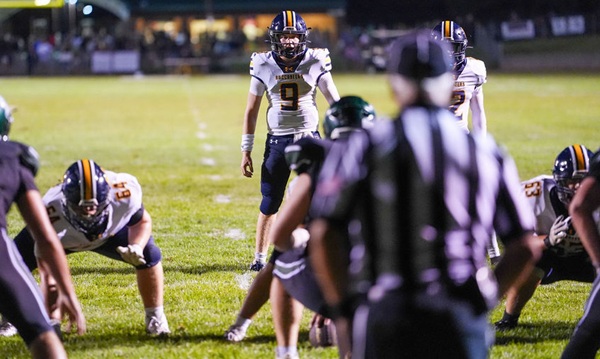
 Senior quarterback Easton Hintz has been the catalyst, completing 28-of-42 passes (67 percent) for 359 yards and four touchdowns, with no interceptions. The dual-threat playmaker also has rushed for 168 yards and a score.
Hintz employs a variety of receiving options, starting with 6-foot-2 wideout Amani Frierson, another Ferris State commit, who has 11 catches for 151 yards and a touchdown.
An emerging weapon for the Bucs is junior tight end Grayam Beyer (6-6, 225), who had a breakout game against Spring Lake with four catches for 43 yards, including two TDs. Beyer already has five Division I college offers and visited Ohio State last Saturday.
If those weapons draw excessive attention, Hintz often hooks up with shifty junior slot receivers Lennon Jorgensen and Drew Hammerle.
Korenstra has been solid, if not spectacular, with 157 rushing yards and two TDs through two games. Korenstra, who finished third at the Lower Peninsula Division 1 Finals in the 100-meter dash last spring (10.79), has been slowed by a sprained ankle which he suffered early in the opening game.
“If you saw him early last week, you would have never thought he could play a football game,” said Biedenbender of the senior speedster, who was clocked at 4.28 seconds in the 40-yard dash this summer.
“So he has been fighting that ankle but still has hit a couple of 15- or 20-yard runs, but we’re waiting for him to break off a couple of 40- or 50-yarders.”
While he waits for Korenstra to get back up to full speed, Biedenbender occasionally allows himself to imagine what might have been this fall if Willemsen had stayed healthy.
The three-sport standout and athletic freak burst onto the scene as a sophomore with 1,321 yards and 11 TDs. He missed his entire junior year after tearing his ACL during summer workouts but came all the way back and was part of two school-record sprint relay teams in track this spring.
 His recovery was so impressive (running a 4.3 40-yard dash and squatting almost 500 pounds early this summer) that he was offered a scholarship at Grand Valley. Willemsen was working out at GVSU in July when the unthinkable happened – a full tear of his other ACL.
“It’s like having a sports car in your garage that you never had a chance to drive,” said Biedenbender, whose main assistants are Matt Naber (offensive coordinator) and Eric Rozema (defensive coordinator). “He’s one of the best athletes ever at Grand Haven that no one’s going to know about. He has some great football ahead of him but, unfortunately, it won’t be for us.”
The Buccaneers still possess a variety of weapons that other teams would love to have, with an experienced senior quarterback in Hintz directing the show. Hintz (6-0, 185) threw for 975 yards last fall despite missing about one-third of the season with an injury, but is now on pace to easily eclipse the 1,000-yard passing plateau.
Haven’s 2-0 start also has put the team in position to make some noise in the conference race and compete for five wins and the school’s first playoff berth since 2019.
The quick start is a continuation of success at Grand Haven, which won the Division 1 boys volleyball title in the spring, to go along with a Finals appearance in softball and a fifth-place team finish in boys track.
“So much of it comes down to belief,” said Hintz, a crafty left-hander who is just as comfortable throwing on the run as he is in the pocket. “Our aiming point is making it to the playoffs and then winning a playoff game, which is something that hasn’t been done at this school in a long time. I believe we have the team to do it.”
 Tom Kendra worked 23 years at The Muskegon Chronicle, including five as assistant sports editor and the final six as sports editor through 2011. E-mail him at [email protected] with story ideas for Muskegon, Oceana, Mason, Lake, Oceola, Mecosta and Newaygo counties.
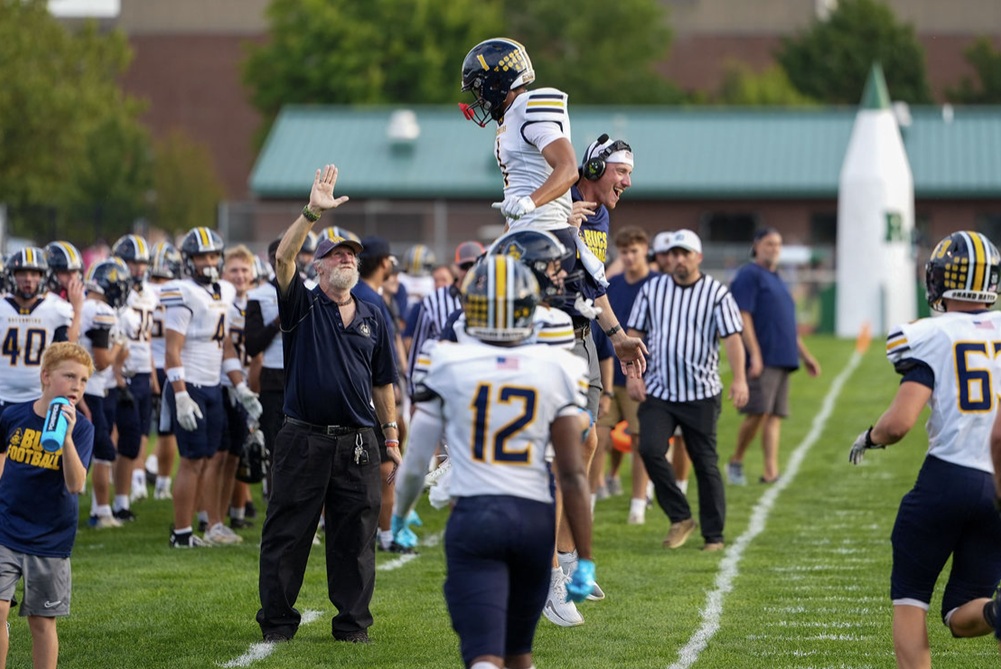
PHOTOS (Top) Fourth-year Grand Haven coach Andrew Biedenbender celebrates with wideout Amani Frierson (1) during last week’s victory over Muskegon Reeths-Puffer. (Middle) KV Korenstra (12) follows his blockers against Spring Lake. (Below) Senior quarterback Easton Hintz (9) prepares to take a snap against Reeths-Puffer. (Photos by Josh Walters/JWaltVisuals.)