

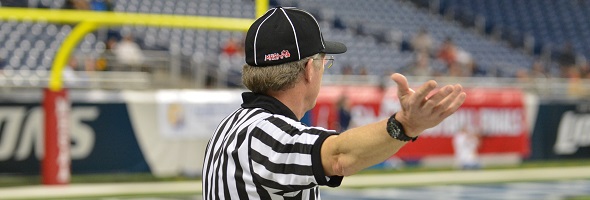
Be the Referee: 40-Second Play Clock
August 29, 2019
This week, MHSAA Assistant Director Brent Rice explains the change in football to a 40-second play clock.
Be The Referee is a series of short messages designed to help educate people on the rules of different sports, to help them better understand the art of officiating, and to recruit officials.
Below is this week's segment - 40-Second Play Clock - Listen
One of the rules changes in high school football this year involves timing between downs.
All varsity games will be played with a 40-second play clock that begins after the conclusion of the previous play, with exceptions for things like timeouts, penalties, measurements and at the start of a period – when a 25-second count will be used.
In experiments in Michigan over the past few seasons, the 40-second play clock proved to improve the pace of play and consistency between plays because it is not dependent on the referee’s subjective signal. And while some schools may choose to purchase visible play clocks for their fields, it is not required. The Back Judge, who has the primary responsibility for the play clock, will signal at 10 seconds and count the last five seconds.

Back to Building Boys Into Men, Munger Bringing Newfound Success to Newaygo
By
Tom Kendra
Special for MHSAA.com
November 6, 2024
NEWAYGO – After a long, physical practice Tuesday, as the light rain started to intensify, Newaygo coach Ralph Munger decided to squeeze in a quick game of “Simon Says.”
 Within a few minutes, players were laughing, making fun of each other for clapping their hands when Munger didn’t say the magic words (and doing five push-ups as punishment) – and learning mental focus in the process.
“He’s an old-style coach,” said Newaygo senior Henry Wood, a senior captain and two-way starter. “But he has a crazy passion for the sport, and his football IQ is insane.”
Simon Says is just one of proven techniques the longtime coach is using to teach and motivate his players at Newaygo, which is 8-2 and hosting Central Montcalm on Friday for a Division 6 District championship in just his second year as coach.
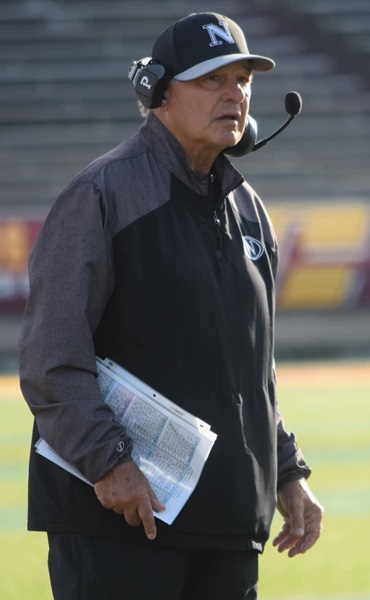
Munger, 72, is having a ball at his latest coaching stop and is up to 11 wins over his two years at Newaygo, a small, rural school northwest of Grand Rapids – after winning 80 games in 11 years at Frankenmuth and 255 games over 28 years at Rockford, the latter tenure including five Finals appearances and three titles. He entered this season the sixth-winningest coach in state football history, and heading into this weekend his career record is 343-117.
“We’re making strides, and things are starting to click,” said Munger, who was an all-state football player in his own right at Frankenmuth in the late 1960s. “I feel pretty good, and I thank God every day that he has allowed me to coach again.”
 Newaygo knocked off traditional Division 6 power Montague, 30-17, last week for the school’s first playoff win since 2018.
The Lions are doing it with Munger’s beloved power game, led by senior quarterback Blake Kerr (55-of-99 passing for 805 yards and 10 TDs), junior running back Porter Slominski (130 rushes for 934 yards and 13 TDs) and senior running back Ethan Reyburn (104 rushes for 673 yards and 8 TDs).
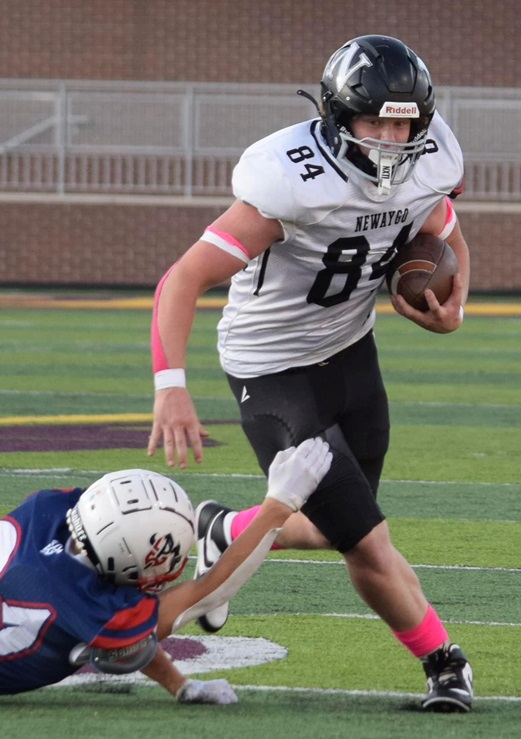
Kerr, who has good size at 6-foot-2 and 200 pounds, has thrown primarily to his two fellow senior captains in split end Hunter Yearsovich (18 catches for 255 yards and 3 TDs) and Wood (9 catches for 140 yards and 3 TDs).
Luis Ceja Alvarez (5-10, 155), is a crafty, undersized linebacker who leads the defense with 34 solo tackles and 52 assists. Fellow linebacker Xavier Stroud has 17 solos and 32 assists.
Yearsovich, a team leader and two-way starter with a 4.4 GPA, said he and his senior teammates had an immediate connection with their Hall of Fame coach.
“I’ll never forget when we met him in the gym last year because he talked to us like we were men,” said Yearsovich. “With him, we don’t ever have the mentality that we’re going to lose, no matter who we’re playing. It hasn’t always been like that around here.”
As the Lions broke into groups in the middle of Tuesday’s practice, Munger headed off with the defensive backs.
The joy of hands-on coaching was apparent as he schooled them on back-pedaling and cutting on what could be a muddy playing surface Friday night, and then concentrating and catching a wet ball.
Munger, who had quadruple-bypass, open-heart surgery in the summer of 2019 and has undergone three separate spine surgeries, is thankful to still be able to stalk the sidelines with a whistle around his neck. He endured one long autumn away from coaching, during the COVID year of 2020, which is when he knew he wasn’t done.
“I was going stir crazy,” said Munger with a grin. “I needed my football fix, anywhere.”
 That led him to tiny Mancelona High School, which is near his cabin in northern Michigan, where he helped coach the offensive and defensive lines in 2021 and 2022. He then in 2023 pursued and landed the Newaygo head coaching job, which is a 30-minute drive from his home in Rockford.
He led Newaygo to a fairly typical 3-6 record last year. But with a full year of his coaching under their belts, the Lions are enjoying a breakthrough fall.
Newaygo finished the regular season 7-2, with the only losses coming against Reed City and Big Rapids, who are both still alive in the playoffs. One of the wins came against this week’s playoff opponent, Central Montcalm, 21-12, in Week 2.
Another victory over CM would earn the Lions yet another home game, against the winner of Ovid-Elsie at Lansing Catholic, this time for a Regional championship. Newaygo has never won a football Regional title, and 2012 was the only year it won more than one playoff game, losing to Grand Rapids West Catholic in a Division 5 Regional Final.
Munger said, at this point in his life, his only goals are to bring some positive energy to Newaygo and help his players make the transition from boys to men – the same thing he has been doing for almost 50 years.
“I am enjoying myself, very much so,” said Munger, who is a member of six Halls of Fame for his coaching achievements. “I find it fun getting after all the challenges out here. That’s what drives me.
“That’s the calling that the Good Lord has given me.”
 Tom Kendra worked 23 years at The Muskegon Chronicle, including five as assistant sports editor and the final six as sports editor through 2011. E-mail him at [email protected] with story ideas for Muskegon, Oceana, Mason, Lake, Oceola, Mecosta and Newaygo counties.
PHOTOS (Top) Newaygo varsity football coach Ralph Munger, right, talks things over with his senior quarterback Blake Kerr during a 53-26 win over Lake Odessa Lakewood on Oct. 18 at Central Michigan’s Kelly-Shorts Stadium. (Middle) Senior tight end Henry Wood (84) works to get past an outstretched defender. (Below) Munger, play sheet in hand, has led the Lions to an 8-2 record. (Photos by Tashina Kerr.)