


Be the Referee: 40-Second Play Clock
August 29, 2019
This week, MHSAA Assistant Director Brent Rice explains the change in football to a 40-second play clock.
Be The Referee is a series of short messages designed to help educate people on the rules of different sports, to help them better understand the art of officiating, and to recruit officials.
Below is this week's segment - 40-Second Play Clock - Listen
One of the rules changes in high school football this year involves timing between downs.
All varsity games will be played with a 40-second play clock that begins after the conclusion of the previous play, with exceptions for things like timeouts, penalties, measurements and at the start of a period – when a 25-second count will be used.
In experiments in Michigan over the past few seasons, the 40-second play clock proved to improve the pace of play and consistency between plays because it is not dependent on the referee’s subjective signal. And while some schools may choose to purchase visible play clocks for their fields, it is not required. The Back Judge, who has the primary responsibility for the play clock, will signal at 10 seconds and count the last five seconds.
1st & Goal: 2023 Playoff Week 3 Preview
By
Geoff Kimmerly
MHSAA.com senior editor
November 10, 2023
By Saturday night, the first two MHSAA Football Finals matchups will be decided.
 Four 8-Player Semifinals earlier that day will determine which teams advance to play one more time Nov. 18 at Northern Michigan University’s Superior Dome, and we detail this weekend’s matchups below.
We’re also down to the final eight teams in all eight 11-player divisions as Regional championships will determine the 32 that will take another step closer to spending Thanksgiving weekend at Ford Field.
Of 40 games played this weekend, 36 will be broadcast on MHSAA.tv, and continue to monitor the Football Playoff Scoreboard including for 11-Player Semifinal times and locations as those are determined.
8-Player Division 1
Indian River Inland Lakes (10-1) at Pickford (10-1), Saturday - WATCH
Pickford is playing in its first Semifinal since the Division 2 championship season of 2019, and bounced back nicely after losing its Week 9 game 42-10 to St. Ignace with a pair of rematch wins over Rudyard and Norway. Junior Tommy Storey tells it, rushing for 1,851 yards and 31 touchdowns and throwing for 794 and 12, respectively. Inland Lakes, however, edged St. Ignace 40-36 last week to advance – avenging a Week 4 loss to the Saints – and also is paced by a standout junior run/pass threat. Aidan Fenstermaker has run for 1,567 yards and 23 scores and thrown for 996 yards and 14 touchdowns.
Martin (9-2) at Kingston (9-2), Saturday - WATCH
Martin graduated 11 seniors, including an all-state quarterback, from last season’s Division 1 championship team. But the Clippers are again one step from playing for the title, led by another standout signal-caller. Junior Gavin Meyers has rushed for 1,144 yards and 11 touchdowns and thrown for 787 yards and eight more scores, and Martin is coming off avenging a 37-point Week 4 loss to Gobles with a 28-6 District Final win. Kingston is back in the Semifinals for the first time since 2019, and also having avenged an early defeat (by 18) with a 26-0 District Final win over Brown City. Senior Owen Corlis has piled up 1,412 yards and 23 touchdowns on the ground and connected on 56 percent of his passes with 10 – nearly half of those completions – going for scores. He also has three return TDs.
8-Player Division 2
Lake Linden-Hubbell (8-3) at Marion (10-0), Saturday - WATCH
Marion ran into eventual Division 2 champion Powers North Central in Semifinals the last three seasons, including while also undefeated a year ago, and will attempt to take the next step with a defense that has given up only 40 points over eight games on the field (two wins were by forfeit). Senior Gavin Prielipp is the leading rusher and scored 11 touchdowns rushing, eight receiving, three off interceptions and one apiece on kickoff and punt returns. Lake Linden-Hubbell is making its first Semifinal appearance since 1997 in 11-player and likely will try to break through the Eagles’ wall with senior quarterback Danny Marcotte (1,234 yards/20 TDs rushing ) and senior running back Sam Roberts (1,165/15).
Deckerville (9-2) at Adrian Lenawee Christian (11-0), Saturday - WATCH
Lenawee Christian has topped 60 points for the second time in three seasons, scoring more than 50 in seven games, with a variety of playmakers but quarterback Sam Lutz setting the pace. The senior has thrown for 1,727 yards and 29 touchdowns, rushed for 868 and 24, respectively, and also scored off interception and kickoff returns. Deckerville is one of the original 8-player powers and back in the Semifinals for the first time since 2017 after one-score playoff wins over Morrice and Portland St. Patrick. Junior Hunter Garza quarterbacks an attack that’s run for more than 3,000 yards, while he’s passed for 1,341 and 24 touchdowns.
11-Player Division 1
Davison (11-0) at Rockford (11-0), Saturday - WATCH
It’s difficult to not look ahead, knowing that one of these undefeated teams could next week face two-time reigning Division 1 champion Belleville in a Semifinal – if the Tigers defeat Northville on the other side of the bracket. But Davison and Rockford surely aren’t looking past anything; they last faced off in a 2020 Semifinal, won by the Cardinals, and both are seeking a first Regional title since that season. Both teams are keyed by standout offensive playmakers, and Rockford’s defense has been one of its best over the last decade giving up only 10 points per game despite facing Muskegon, Mona Shores and Caledonia among six playoff teams total during the regular season. The deciding matchup could be the Rams trying to slow down a Davison attack that has scored 44 or more points seven times.
Other Regional Finals FRIDAY Clarkston (6-5) at Western Bloomfield (9-2) - WATCH, Southfield Arts & Technology (10-1) at Clinton Township Chippewa Valley (9-2) - WATCH. SATURDAY Northville (10-1) at Belleville (11-0) - WATCH.
11-Player Division 2
Saturday Heritage (9-2) at Muskegon (9-2), Saturday
Muskegon is as close to a regular at this stage of the playoffs as any program in Michigan; the Big Reds will be playing in a Regional Final for the 11th time over the last 12 seasons as they continue to pursue a return trip to Ford Field. Heritage is much newer to the experience after winning its first District title since 2001 – but that just sets up an opportunity to add another incredible chapter to an already memorable run. The Hawks boast the state’s all-time leader in receiving touchdowns in Braylon Isom, who caught his 49th and 50th to tie and break the record in the District Final win. But Heritage also lost standout running back Ty Robertson to injury two weeks ago and now must stop or keep up with a Muskegon offense that’s reached 40 points in five of its last six games.
Other Regional Finals FRIDAY Byron Center (10-1) at East Lansing (9-2) - WATCH, Roseville (8-3) at Warren De La Salle Collegiate (9-2) - WATCH, Waterford Mott (9-2) at Gibraltar Carlson (10-1) - WATCH.
11-Player Division 3
Mason (11-0) at Walled Lake Western (10-1), Friday - WATCH
The setup for this rematch includes a rare mathematical oddity of the playoff system in that Mason went to Western in Week 8 and won 30-7, and now must return for this Regional Final. Western, with a schedule of mostly Division 2 opponents, has the home game after holding onto the top spot in Division 2 playoff-point average while Mason – playing a Division 3-heavy schedule – finished third on that list. The good news for the Bulldogs, however, is they know they can win this on the road – and the offense is continuing to churn with that first Western matchup the only game over the last six in which Mason didn’t score at least 41 points. That said, we’ve once again seen these playoffs a number of rematches flip, with multiple postseason winners coming back after losing big the first time around.
Other Regional Finals FRIDAY Gaylord (11-0) at Grand Rapids Forest Hills Central (10-1) - WATCH, Detroit Martin Luther King (6-5) at River Rouge (7-4) - WATCH. SATURDAY Zeeland West (8-3) at Parma Western (10-1).
11-Player Division 4
Portland (11-0) at Niles (10-1), Friday - WATCH
On the surface, this appears to be an undefeated Portland team with seven double-digit win seasons over the last nine, hitting the road seeking to return to the Semifinals after most recently making them in 2021 and 2018, on the way to face an up-and-coming Niles program that just won its first District title. But while all true, Niles is led by coach Scot Shaw, formerly of nearly two decades at Three Rivers and leader of its Division 4 championship team in 2003. He has the Vikings learning this playoff thing fast, but there will be some unfamiliarity regardless because Niles’ first two postseason wins were Wolverine Conference rematches. Portland, under another longtime leader in John Novara, has traveled this path and will be playing in its third-straight Regional Final.
Other Regional Finals FRIDAY Big Rapids (10-1) at Grand Rapids South Christian (8-3) - WATCH, Haslett (8-3) at Goodrich (10-1) - WATCH. SATURDAY Carleton Airport (10-1) at Harper Woods (8-3).
11-Player Division 5
Grand Rapids Catholic Central (10-1) at Grand Rapids West Catholic (11-0), Friday - WATCH
After playing last season in different divisions, these two are matched up again, and both enter this meeting undefeated against in-state opponents – GRCC’s lone loss came in Week 1 against Chicago Loyola. The challenges otherwise for both have been few. The Cougars defeated reigning Division 4 champion Grand Rapids South Christian 21-12 in Week 8, but have won all of their remaining games by at least 32 points. West Catholic’s 17-14 win over Division 3 Coopersville in Week 3 was its only game closer than 26 points, and the Falcons have given up a combined 13 points over their last five games with two shutouts to start the postseason.
Other Regional Finals FRIDAY Macomb Lutheran North (9-2) at Corunna (11-0) - WATCH, Flat Rock (8-3) at Detroit Southeastern (8-3). SATURDAY Kingsford (10-1) at Frankenmuth (10-1) - WATCH.
11-Player Division 6
Gladstone (9-2) at Kingsley (9-2), Friday - WATCH
Only eight teams remain in all of these 11-player divisions, and perhaps no division seems wider open than Division 6, with these two on the same side of the bracket with two more that have lost three games this fall. Kingsley won a Regional title as recently as 2019 and is playing in its fourth Regional Final over the last six seasons. Gladstone is playing in a Regional Final for the second straight after losing last year to Negaunee, the eventual Division 6 runner-up. The Braves defeated Negaunee last week, and another win would send them to the Semifinals for the first time since 1985.
Other Regional Finals FRIDAY Midland Bullock Creek (8-3) at Reed City (8-3) - WATCH, Detroit Edison (8-3) at Almont (10-1) - WATCH. SATURDAY Ovid-Elsie (7-4) at Constantine (10-1) - WATCH.
11-Player Division 7
Pewamo-Westphalia (10-1) vs. North Muskegon (11-0) at Muskegon Oakridge, Saturday - WATCH
A 17-14 opening-weekend win over annual Finals contender Pewamo-Westphalia announced statewide that North Muskegon might be set up for a special season. And so it’s been, with last week’s 27-24 District clincher over Lawton the Norsemen’s first single-digit victory since that Week 1 defeat of the Pirates. P-W hasn’t lost again, or had another game decided by fewer than 13 points. The defense especially has resembled the group that helped drive Division 7 titles in 2019 and 2021, giving up 8.6 points per game and double digits only three times. North Muskegon has been held to fewer than 27 only one other game this fall, an 18-7 win over rival Ravenna.
Other Regional Finals FRIDAY Montrose (8-3) at Millington (11-0) - WATCH, Clinton (10-1) at Jackson Lumen Christi (10-1) - WATCH. SATURDAY McBain (7-4) at Menominee (9-2) - WATCH.
11-Player Division 8
Ithaca (11-0) at Ubly (11-0), Saturday - WATCH
This is the level of showdown that immediately came to mind when Ithaca slotted as one of the two largest schools in Division 8 after playoff runs in Divisions 5, 6 and 7 over the last decade. After another dominant regular season, Ithaca has navigated one-point wins over Fowler and New Lothrop to start the playoffs. The Yellowjackets feature their most potent offensive attack since 2017 and still have given up only 9.2 points per game after allowing a combined 55 over the last two weeks. Ubly’s last three seasons have ended at Ford Field twice and the Semifinals in 2021, and this team has performed similarly keeping pace with last season’s record-setting offense and allowing only 9.5 points per game.
Other Regional Finals FRIDAY Iron Mountain (11-0) at Beal City (10-1) - WATCH, White Pigeon (11-0) at Ottawa Lake Whiteford (11-0) - WATCH. SATURDAY Riverview Gabriel Richard (7-4) at Clarkston Everest Collegiate (9-2) - WATCH.
MHSAA.com's weekly “1st & Goal” previews and reviews are powered by MI Student Aid, a part of the Office of Postsecondary Financial Planning located within the Michigan Department of Treasury. MI Student Aid encourages students to pursue postsecondary education by providing access to student financial resources and information. MI Student Aid administers the state’s 529 college savings programs (MET/MESP), as well as scholarship and grant programs that help make college Accessible, Affordable and Attainable for you. Connect with MI Student Aid at www.michigan.gov/mistudentaid and find more information on Facebook and X (Twitter) @mistudentaid.
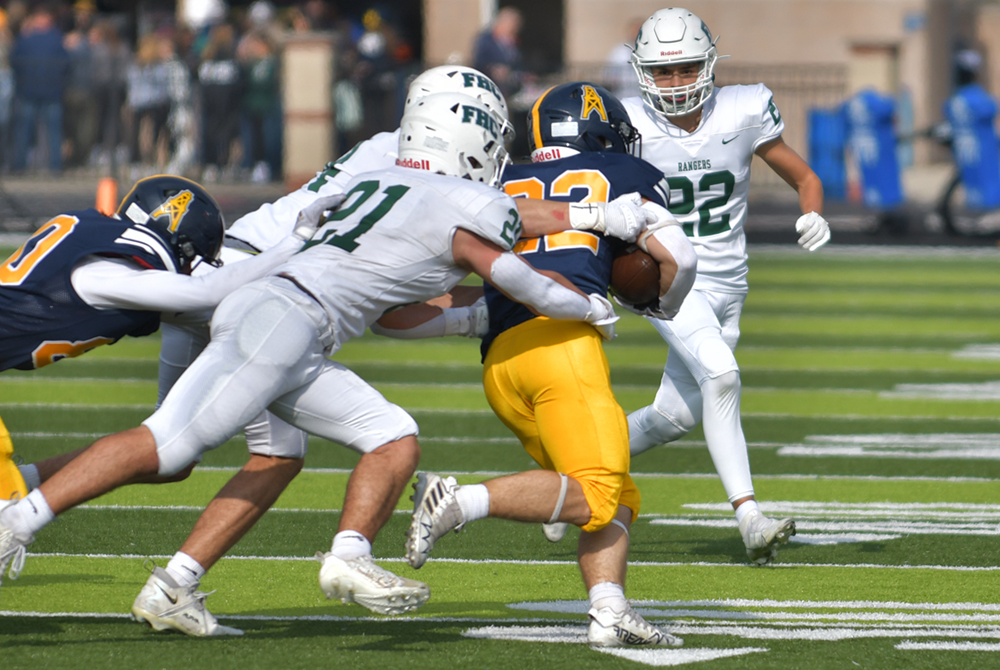
PHOTO Grand Rapids Forest Hills Central defenders converge during a Division 3 District Final win over Mount Pleasant. (Click for more from High School Sports Scene.)