


Be the Referee: 40-Second Play Clock
August 29, 2019
This week, MHSAA Assistant Director Brent Rice explains the change in football to a 40-second play clock.
Be The Referee is a series of short messages designed to help educate people on the rules of different sports, to help them better understand the art of officiating, and to recruit officials.
Below is this week's segment - 40-Second Play Clock - Listen
One of the rules changes in high school football this year involves timing between downs.
All varsity games will be played with a 40-second play clock that begins after the conclusion of the previous play, with exceptions for things like timeouts, penalties, measurements and at the start of a period – when a 25-second count will be used.
In experiments in Michigan over the past few seasons, the 40-second play clock proved to improve the pace of play and consistency between plays because it is not dependent on the referee’s subjective signal. And while some schools may choose to purchase visible play clocks for their fields, it is not required. The Back Judge, who has the primary responsibility for the play clock, will signal at 10 seconds and count the last five seconds.
Performance of the Week: Birmingham Seaholm's Colton Kinnie
November 3, 2023
 Colton Kinnie ♦ Birmingham Seaholm
Senior ♦ Football
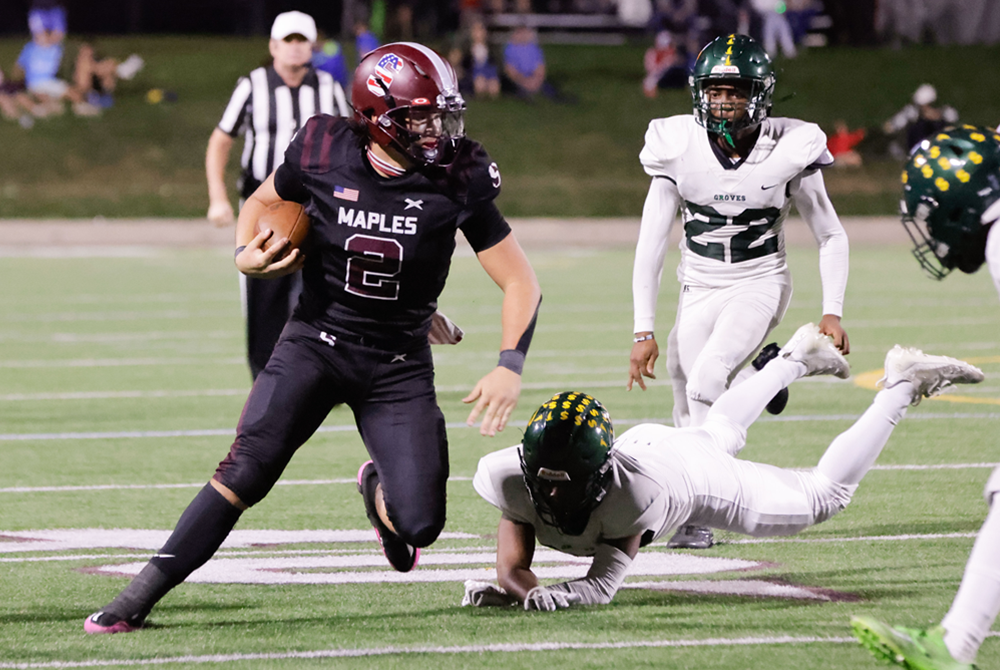
The Maples’ third-year starting quarterback led Seaholm to a 56-49 win over rival Birmingham Groves in a Division 2 District Semifinal on Friday after Seaholm also had defeated Groves 21-14 in the regular-season finale the week before. Kinnie ran for four touchdowns and threw for two more as his team improved to 9-1 this fall.
Seaholm earlier repeated as Oakland Activities Association Blue champion and is a combined 17-4 over the last two seasons after finishing just 1-8 in 2021. The 6-foot-2, 220-pound Kinnie has been a major contributor to the turnaround, and he’s joined by an experienced cast of seasoned starters including twin brother Granden. Both also joined the Seaholm baseball varsity as sophomores and helped that team to a District title in the spring.
@mhsaasports 🏈POW: Colton Kinnie #football #touchdown #seaholm #letsgo #part1 #highschoolsports #tiktalk #interview #performanceoftheweek #mistudentaid #fyp #MHSAA ♬ original sound - MHSAA
@mhsaasports 🏈POW: Colton Kinnie #tiktalk #questiontime #part2 #suits #chipotle #nighttime #kitkat #reeses #phone #family #performanceoftheweek #mistudentaid #fyp #MHSAA ♬ original sound - MHSAA
Follow the MHSAA on TikTok.
MHSAA.com's "Performance of the Week" features are powered by MI Student Aid, a part of the Office of Postsecondary Financial Planning located within the Michigan Department of Treasury. MI Student Aid encourages students to pursue postsecondary education by providing access to student financial resources and information. MI Student Aid administers the state’s 529 college savings programs (MET/MESP), as well as scholarship and grant programs that help make college Accessible, Affordable and Attainable for you. Connect with MI Student Aid at www.michigan.gov/mistudentaid and find more information on Facebook and Twitter @mistudentaid.
Past 2023-24 Honorees
Oct. 27: Lauren Timpf, Macomb Lutheran North golf - Report
Oct. 20: Alena Li, Okemos golf - Report
Oct. 13: Seth Norder, Grand Haven cross country - Report
Oct. 5: Paige Anderson, Muskegon Reeths-Puffer golf - Report
Sept. 29: MacKenzie Bisballe, Lake City volleyball - Report
Sept. 22: Jhace Massey, Gladwin football - Report
Sept. 15: Kaylee Draper, Sturgis swimming - Report
Sept. 8: Owen Jackson, Traverse City St. Francis tennis - Report
Sept. 1: Rachel Forsyth, Ann Arbor Pioneer cross country - Report
PHOTO Seaholm quarterback Colton Kinnie eludes a Groves defender during their Division 2 playoff matchup. (Photos courtesy of the Birmingham Seaholm athletic department.)