

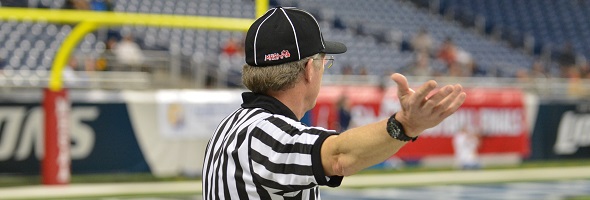
Be the Referee: 40-Second Play Clock
August 29, 2019
This week, MHSAA Assistant Director Brent Rice explains the change in football to a 40-second play clock.
Be The Referee is a series of short messages designed to help educate people on the rules of different sports, to help them better understand the art of officiating, and to recruit officials.
Below is this week's segment - 40-Second Play Clock - Listen
One of the rules changes in high school football this year involves timing between downs.
All varsity games will be played with a 40-second play clock that begins after the conclusion of the previous play, with exceptions for things like timeouts, penalties, measurements and at the start of a period – when a 25-second count will be used.
In experiments in Michigan over the past few seasons, the 40-second play clock proved to improve the pace of play and consistency between plays because it is not dependent on the referee’s subjective signal. And while some schools may choose to purchase visible play clocks for their fields, it is not required. The Back Judge, who has the primary responsibility for the play clock, will signal at 10 seconds and count the last five seconds.
Growing Gobles Preparing for Future with Return to 11-Player Football
By
Pam Shebest
Special for MHSAA.com
August 25, 2026
GOBLES — For the last five years, Gobles saw success competing in 8-player football, making the MHSAA Playoffs four of those seasons.
 This year, coach Greg Eichler hopes to transition that success into 11-player in spite of grumbling from some fans.
“We’re pretty doubted by the town right now,” sophomore tailback/free safety Case Lord said. “But I see what goes on at practice and in the weight room, and I see our work ethic and how strong we are. I think we can do something great.”
Eichler said numbers-wise, the Tigers could compete in 8-player, but “our district is growing, which is good, so when you look at the projected enrollments a couple years down the line, we’re going to be over that playoff limit for 8-player.
“We have a younger team, but we’ve got a diverse group from sophomores up to seniors in terms of their talents and abilities, and I think they can put together some good success right now and also build for the future.”
Gobles finished a combined 31-10 in 8-player over the last four seasons.
Moving back to 11-player, more athletes will have the opportunity to play big roles in the experience.
“It’s been good to have a JV and varsity consistently with no issue, but at the same time, we have a lot of extra kids on the sideline playing 8-player,” Eichler said. “With 11-player there are more opportunities for the kids.”
Discussing the move, the coach added, "When you’ve got three extra guys on the field, it changes how much space on the field you’ve got to cover and who you’re looking at, who you’re covering, who you’re keying on.”
Another change this fall will be playing several less familiar opponents as part of a combined league. Gobles is among a handful of Southwestern Athletic Conference schools playing football as part of the Southwest 10 Conference this fall.
"We’re playing a majority Southwest 10 schedule but will play Galesburg and Saugatuck from the SAC and everyone else is Southwest (10),” Eichler said. "Traditionally the SAC has been our league. You had to give that up, but you want to make sure you’re putting the kids in the best position.”
Eichler said the Southwest 10 has some great traditions and some solid football programs that will give the Tigers a run.
 “We love a new challenge, and we feel that’s what this is. It’s a new step in our program that’s going to challenge everybody, coaches and players alike,” he noted. “Southwest 10 teams are a little bit more our size. They’re still mostly bigger than us, but I think competitively they’re probably the better teams to put on our schedule.”
Senior outside linebacker/wing back Hunter Piper said playing in both conferences is a plus “because we’re playing more schools that I know. We go to those schools for other sports, so it’s nice to play new competition.”
Eichler said one advantage for the Division 8 Tigers this year is that in 11-player “you get bonuses for playing bigger schools and most of the time, we’re the smaller school.
“We have several Division 7 schools on our schedule, so those are like little bonus incentives. That’s win or lose.”
They got their first taste of 11-player in a while last Thursday in a scrimmage against Coloma. Gobles will kick off the “real” season at home Thursday against Niles Brandywine.
“We had a competitive scrimmage, and a lot of our young players got some really good experience,” Eichler said. “I would say the following day’s film session was even more important, as our team learned a lot in order to prepare for our Week 1 matchup versus Niles Brandywine.”
Their second game is a big one for the town: The Tiger Tribute game versus Hartford on Sept. 3.
“It’s the military and first responder appreciation game (which will feature) flyovers, vehicles,” Eichler said.
Honorary captain this year is Navy Lieutenant Commander Ian Weston, a 2010 Gobles alum. The tribute will include a parade and the school choir singing the national anthem.
Sophomore & senior expectations
Eichler said Lord was the first freshman he moved up to varsity over his six years coaching.
“He took some lumps early but really grew as the year went on,” the coach said. “He’s going to bring some varsity experience even as a sophomore.
"I think that’s really good for that sophomore group. He understands what varsity football looks like, even though it was 8-player. We played some really good teams.”
Lord said playing varsity as a freshman was eye-opening.
“Out of the gate I wasn’t prepared for the speed, but I learned very fast that’s a big thing with a varsity game,” he said. “Now I understand what that is, and I can compete with others.
 “I’ve been looking forward to this year since last season ended.”
Lord is no stranger to 11-player football, starting the sport 12 years ago on a club team.
“My brother (Adam Vosburg), and my grandpa (Gerald Gravatt) both played football,” Lord said. “My brother had D-I (college) offers everywhere but went to Olivet to stay close to home after my grandpa passed. My brother basically lived through him, and I live through my brother.”
Eichler counts on seniors such as Piper in leadership roles.
“Hunter brings experience, some really good leadership and stability,” the coach said. “I think that’s going to be important because our bigger group right now is our sophomores. We have him and a handful of other seniors to help stabilize them.”
Part of Piper’s experience is from the 2024 team that went undefeated in the regular season before losing its Division 1 8-Player Regional Semifinal to Martin.
Jumping to 11-player is “a little funky with a couple more players, and the field is definitely a little bigger, but it’s still the same game,” Piper said. “I love the game, and I like to bring a lot of leadership. I like to help out the younger kids.”
Piper, who is also on the wrestling team, said that helps him in football.
“I like the testosterone sports,” he said. “I like to go out there and fly around and hit. The energy is beautiful.”
In spite of hearing some of the town’s naysayers, Piper said, “There’s moments in practice where I think this is a great team. People don’t see what we see, and they’re definitely underestimating us.
“Our strength is the bond we have. We have a very strong connection between all of us.”
 Pam Shebest served as a sportswriter at the Kalamazoo Gazette from 1985-2009 after 11 years part-time with the Gazette while teaching French and English at White Pigeon High School. She can be reached at [email protected] with story ideas for Calhoun, Kalamazoo and Van Buren counties.
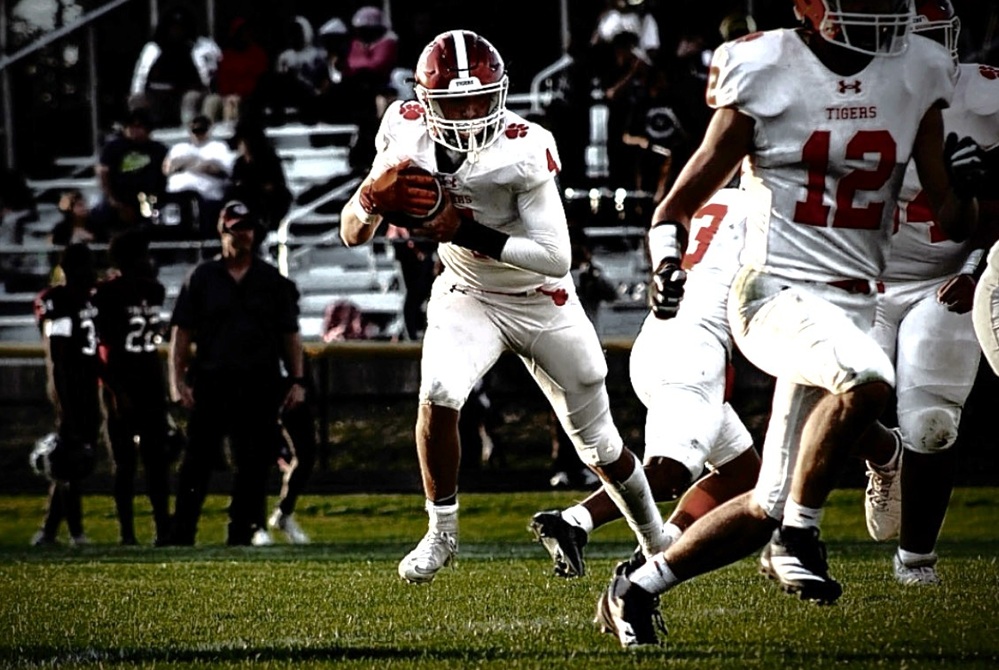
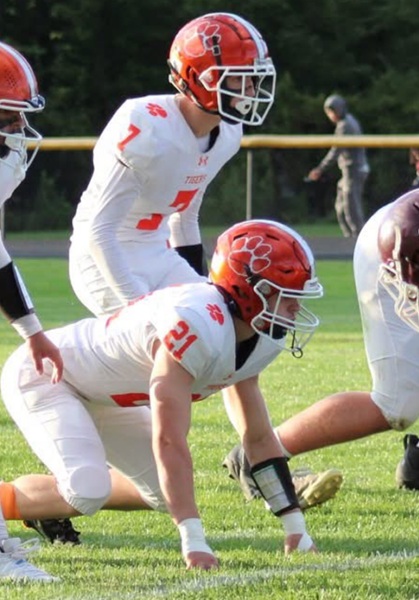
PHOTOS (Top) Gobles’ Case Lord follows his blockers during a carry last season. (Middle) From left: Tigers coach Greg Eichler, Hunter Piper and Case Lord. (Below) Piper (7) lines up on defense last fall. (Action photos courtesy of the Gobles football program. Head shots by Pam Shebest.)