

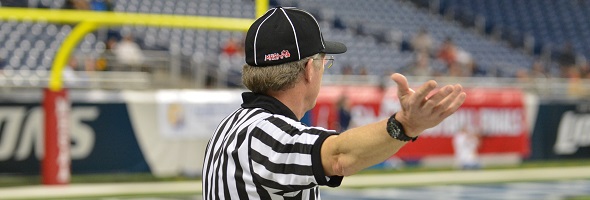
Be the Referee: 40-Second Play Clock
August 29, 2019
This week, MHSAA Assistant Director Brent Rice explains the change in football to a 40-second play clock.
Be The Referee is a series of short messages designed to help educate people on the rules of different sports, to help them better understand the art of officiating, and to recruit officials.
Below is this week's segment - 40-Second Play Clock - Listen
One of the rules changes in high school football this year involves timing between downs.
All varsity games will be played with a 40-second play clock that begins after the conclusion of the previous play, with exceptions for things like timeouts, penalties, measurements and at the start of a period – when a 25-second count will be used.
In experiments in Michigan over the past few seasons, the 40-second play clock proved to improve the pace of play and consistency between plays because it is not dependent on the referee’s subjective signal. And while some schools may choose to purchase visible play clocks for their fields, it is not required. The Back Judge, who has the primary responsibility for the play clock, will signal at 10 seconds and count the last five seconds.
What's My Why: Official Brady Driver
June 12, 2026
Brady Driver, Sturgis
Driver just completed his 20th year as an MHSAA-registered official. He has worked football, wrestling and boys lacrosse all 20 years, and also officiated basketball for six seasons and volleyball and girls lacrosse for one apiece.
One, the opportunity to continue interacting with athletics, and school districts, and sports, and being part of educational athletics.
Two, the thousands of student-athletes that I get to see grow up in and through sports and then go on to great things in their lives.
And then three, for me, to also be able to have the joy of building lifelong friendships with multiple officials across these three sports, and the opportunities to have been able to travel, in some cases across the United States to officiate, and also meeting some pretty incredible people through the circles of football, wrestling and lacrosse.
I would highly encourage, if you have a desire to stay involved and get the best seat in the house every time, every game, every night, to be an official. It’s one of the best things you’ll ever do.
“What’s My Why” is a weekly feature telling the stories of MHSAA-registered officials in their own words. If you’re an MHSAA official and would like to share your reason why, please submit a 15 to 45-second video, taken horizontally, to director of officials Sam Davis at [email protected].
Don't miss Officiate Michigan Day 2026, July 25 in Grand Rapids! Check out MHSAA.com/OMD to register and learn more.
What's My Why
June 8: Cindy Tyzo, West Bloomfield - Watch
June 3: Jeff Spedoske, DeWitt - Watch
June 1: Mike Carrier, Commerce Township - Watch
May 27: Stan Wright, Warren - Watch
May 26: Murray Rose, Zeeland - Watch
May 22: Mike VanLaan, Alto - Watch
May 18: Clint Abbott, Newaygo - Watch