

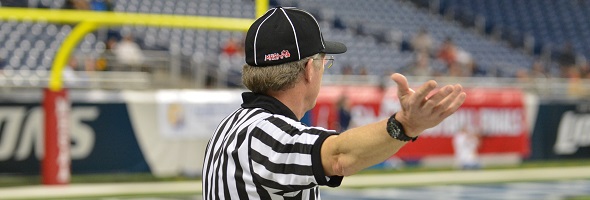
Be the Referee: 40-Second Play Clock
August 29, 2019
This week, MHSAA Assistant Director Brent Rice explains the change in football to a 40-second play clock.
Be The Referee is a series of short messages designed to help educate people on the rules of different sports, to help them better understand the art of officiating, and to recruit officials.
Below is this week's segment - 40-Second Play Clock - Listen
One of the rules changes in high school football this year involves timing between downs.
All varsity games will be played with a 40-second play clock that begins after the conclusion of the previous play, with exceptions for things like timeouts, penalties, measurements and at the start of a period – when a 25-second count will be used.
In experiments in Michigan over the past few seasons, the 40-second play clock proved to improve the pace of play and consistency between plays because it is not dependent on the referee’s subjective signal. And while some schools may choose to purchase visible play clocks for their fields, it is not required. The Back Judge, who has the primary responsibility for the play clock, will signal at 10 seconds and count the last five seconds.
Officiate Michigan Day 2026 - Register to Join Us!
By
Geoff Kimmerly
MHSAA.com senior editor
May 19, 2026
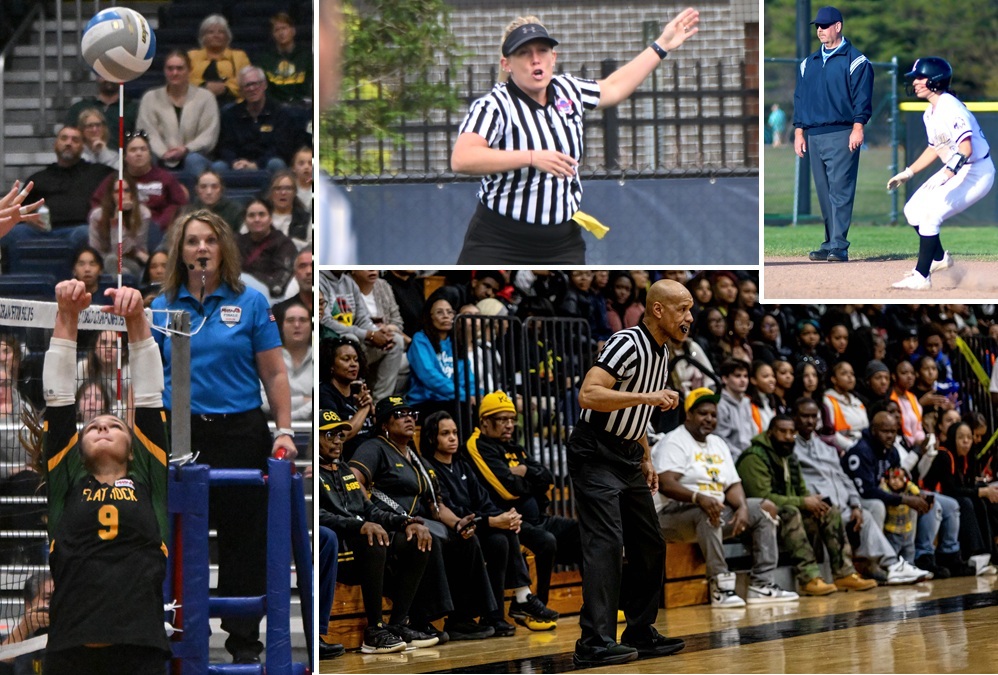
Officiate Michigan Day 2026 will welcome 2,000 MHSAA-registered game officials to Grand Rapids on July 25 – and registration is available now for this historic gathering expected to draw participants from all over the state.
 Doors open at 7:30 a.m., with the first session at 9 a.m. at DeVos Place. The day-long event will feature dynamic speakers and presenters providing knowledge in several sports and all levels including collegiate and professional. We will be highlighting several of those speakers over the next many weeks on MHSAA.com and social media as part of the lead-up to the event.
Cost is $45 if officials register by the end of June, and $50 beginning July 1. More information is on the way; keep posted at MHSAA.com/OMD.
This will be the third Officiate Michigan Day, joining events in 2013 and 2018.
OMD will accompany the annual National Association of Sports Officials (NASO) Summit that will take place July 26-28, also at DeVos Place.