


Be the Referee: Automatic 1st Downs
October 29, 2020
This week, MHSAA assistant director Brent Rice explains how high school football rules differ from those at the collegiate and professional levels when it comes to awarding automatic first downs.
Be The Referee is a series of short messages designed to help educate people on the rules of different sports, to help them better understand the art of officiating, and to recruit officials.
Below is this week's segment - Automatic 1st Downs - Listen
Today we are going to talk about one of the biggest rule difference areas in high school football from those rules used in college and pro games, and that deals with automatic first downs.
When watching that college game on Saturday or the pro game on Sunday, all of us know there are several defensive fouls that give the offense an automatic first down. However, under high school rules, the opposite is true most of the time.
The only high school fouls that result in an automatic first down for the offense are the roughing fouls – roughing the passer, the kicker, the holder and the long snapper. Fouls such as defensive pass interference or any other personal foul do not bring an automatic first down under high school rules.
Past editions
10/22: You Make the Call: Illegal Kick - Listen
10/15: Toe the Line on Penalty Kicks - Listen
10/8: Disconcerting Acts - Listen
10/1: Ball Hits Soccer Referee - Listen
9/24: Clocking the Ball from the Shotgun - Listen
Sailors Eye 'Their Turn' after QB Moves On
August 25, 2015
By Dean Holzwarth
Special for Second Half
CUTLERVILLE – With the 2015 season opener against Grand Rapids Christian a few days away, South Christian football coach Mark Tamminga said quarterback isn’t a position that's stressing him out.
That statement might be a bit surprising considering Tamminga graduated this spring one of the most prolific passers in Michigan High School Athletic Association history.
 Jon Wassink capped a banner high school career last fall by guiding the Sailors to a Division 4 championship with a dramatic 28-27 win over Lansing Sexton.
Wassink, a three-year starter, took his talents to Western Michigan University, but not before finishing second all-time in the MHSAA record book for career passing yards with 8,124.
In fact, Wassink’s name appears in the MHSAA record book 17 times despite playing only three varsity seasons. He’s third in career passing attempts (884), second in completions (584) and fifth in touchdown passes (76).
“We’re never going to replace a Jon Wassink; there’s no doubt about that,” Tamminga said after practice last week. “But I have two kids right now fighting for the quarterback position, and whichever one gets the job is going to be a very good high school quarterback. Maybe an all-conference quarterback, I’m not sure, but the quarterback position right now is pretty far down on my worry list.
“We have other things to worry about. Our line, our receivers, but we’re going to be fine with our quarterback. We’re going to score some points.”
Besides Wassink, the Sailors graduated a bevy of talent from a senior class that won 12 straight games after an 0-2 start to win their second MHSAA Final in three seasons.
Eighteen starters are gone, leaving behind a young team stacked with juniors and sophomores.
The only remaining starters are seniors Ezinga, Niewiek, John Masselink (TE/S) and Dylan Brink (RB/LB).
“We lost a great senior class, all the way down,” Tamminga said. “They were such great leaders, and the kids rallied around them. I told this year’s group that it’s their turn. They have to step up. You can win games with underclassmen, but to win consistently you have to have senior leadership, and that’s what I need from those guys. So far they have shown that, and we’re pretty proud of them.”
The person attempting to fill the void left by Wassink was yet to be determined at the start of this week. Junior Eric Dykstra and sophomore Andrew Haan are vying for the starting position.
Dykstra is the frontrunner, but recently suffered a wrist injury. That allowed Haan to take a majority of reps in practice and during the Sailors’ preseason scrimmage.
Tamminga said both have the potential to step in and lead this year’s squad.
“I would say Eric has the upper hand if healthy, but it is so close,” he said. “We don’t lose a beat with Andrew in there either. Both of them realize they have big shoes to fill, but what is so great is they don’t feel they have to be the next Jonny Wassink. They are going to be them, and they are going to be very good high school quarterbacks.”
 South Christian also will miss Wassink’s ability to run the ball. He rushed for 3,252 yards and 50 touchdowns in three seasons.
“He definitely made big plays with his arm and his legs, which I think is going to hurt us the most,” Sailors’ right guard Josh Ezinga said. “He was such a two-dimensional player that defenses had to either prepare for him running-wise or passing-wise.
“And even though as a lineman you try not to miss a block, it happens once in a while, and he would just make a play and make you look like you’re the best in the world because he would make people miss.”
The absence of Wassink will be felt from a leadership standpoint as well. He wasn’t only a playmaker, he was there to help the younger players improve.
“Obviously Jon was a great player, but he also was a great leader,” senior wide receiver Jake Niewiek said. “He helped me a lot when I was getting started with the offense. Being a receiver in the system was a little complicated, but he really took us under his wing and showed us what we had to do.”
But Tamminga said adjustments have been made to atone for Wassink not being on the field in 2015.
“We basically had it pretty easy when he was here, and now we have to step up and coach to our strengths,” he said. “You have to coach differently because Jonny was like having another coach on the field. These kids are not going to be able to do the things that Jonny did. We have to adjust as coaches to compensate for that.”
The key losses by the Sailors have other teams chomping at the bit to dethrone the two-time Ottawa-Kent Gold champions.
But while others may deem this a down year, South Christian hopes to maintain the same tradition of winning to which it has become accustomed.
“I think there are different expectations for us from the public and the media, but I think all the pieces of the puzzle are there and we can still be a great team this year,” Ezinga said. “I definitely think we can win with sophomores and juniors, and they realize they have to go hard every single play.”
Niewiek agreed that this year’s team can still be a formidable challenger.
“Practices have been great and everyone has been working their butts off,” he said. “We obviously have lower expectations than last year, but we hope to surprise some people. We want to keep the bar set high.”
Tamminga said the first goal is to get to six wins, which won’t be easy with three straight playoff teams on the schedule to open the season.
“We want to make the playoffs,” he said. “Just make the playoffs, but what worries me is if we don’t have three good games and go 0-3. I still believe we can go 6-3 and make the playoffs. They have to believe it, and that’s the challenge ahead of us right now.”
 Dean Holzwarth covered primarily high school sports for the Grand Rapids Press and MLive for 16 years and more recently served as sports editor of the Ionia Sentinel and as a sports photojournalist for WZZM. Contact him at [email protected] with story ideas for Allegan, Kent and Ottawa counties.
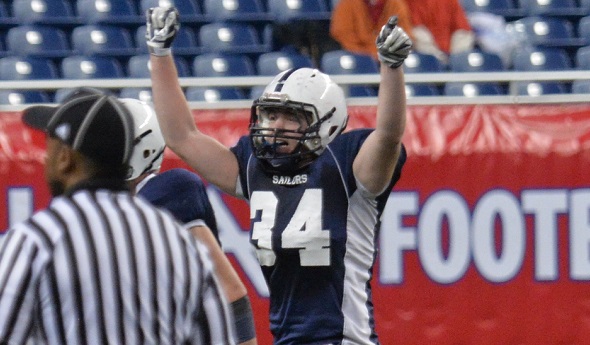
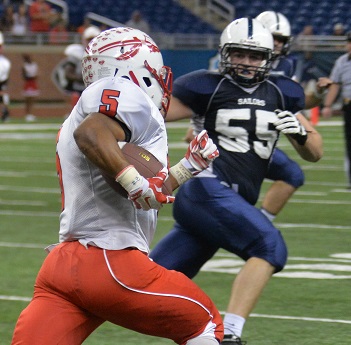
PHOTOS: (Top) South Christian’s Jake Niewiek celebrates a turnover during last season’s Division 4 Final at Ford Field. (Middle) The Sailors’ Jake Elzinga works to stay in front of a Sexton ball carrier; both he and Niewiek return this fall.