


Be The Referee: Catch Momentum
October 17, 2019
This week, MHSAA assistant director Brent Rice offers a "You Make the Call" regarding catch momentum after an interception near the goal line.
Be The Referee is a series of short messages designed to help educate people on the rules of different sports, to help them better understand the art of officiating, and to recruit officials.
Below is this week's segment - Catch Momentum - Listen
Here’s another edition of a football You Make The Call. On a passing play, a defender intercepts the ball at the 2-yard line, and the momentum of the catch carries him across the goal line.
The defender is allowed to come out of the end zone on this play. But while breaking free from the grasp of an opponent, the ball is fumbled out of the back of the end zone. What’s the call?
Since it was the momentum of catch that carried the defender into the end zone to begin with and the ball remained in the end zone and was declared dead there, a rules exception places the ball 1st-and-10 at the 2-yard line.
Past editions
Oct. 10: Golf Rules Changes - Listen
Oct. 3: No Tackle Box - Listen
Sept. 26: You Make the Overtime Call - Listen
Sept. 19: Swimming Finishing Touch - Listen
Sept. 12: Curbing Gamesmanship By Substitution - Listen
Sept. 5: Football Safety Rules Changes - Listen
Aug. 29: 40-Second Play Clock - Listen
A Game for Every Fan: Week 7
October 7, 2015
By Geoff Kimmerly
Second Half editor
We're at the point every football season when conference champions begin to be crowned. But for the Week 7's schedule to fall together like this is nearly inconceivable.
Fifteen leagues statewide will feature matchups of teams tied for first place, with five more conferences bracing for tilts between first and second-place teams that could have immediate title implications.
Many of those games are discussed in detail below; all are tonight unless noted. Check MHSAA Score Center for results as they come in, updated standings and playoff-point averages.
Bay & Thumb
Almont (6-0) at Algonac (6-0)
What gives this matchup the slight edge in intrigue over undefeated teams facing off in the Saginaw Valley League (see below)? This is shaping up as arguably the most meaningful game in Algonac football history. The Muskrats’ perfect start is earning attention statewide and is a great story after the team went 1-8 a year ago and last had a winning record in 2005. But a league title, clinched tonight, would be the team’s first since 1972 – and standing in the way is reigning champion Almont, which hasn’t lost in the Blue Water Area Conference since Week 4 of 2013.
Others that caught my eye: Lapeer (6-0) at Midland (6-0), Vassar (5-1) at Unionville-Sebewaing (5-1), Detroit Cesar Chavez (4-2) at Mayville (4-2), Sterling Heights (5-1) at Marysville (4-2).
Greater Detroit
Canton (5-1) at Plymouth (5-1)
Plymouth’s championship-contending golfers this fall could land a ball at Canton in two strokes, these schools are so near to each other. And their last seven football meetings have been about that close too, all decided by 12 points or fewer. The Wildcats own a share of the Kensington Lakes Activities Association South title by way of Canton’s loss last week to Livonia Churchill – but the reigning champion Chiefs can grab a share as well by extending a current winning streak against Plymouth to three.
Others that caught my eye: Berkley (5-1) at Birmingham Groves (6-0), Farmington Hills Harrison (5-1) at Farmington (4-2), River Rouge (6-0) at Pontiac Notre Dame Prep (5-1), Warren Mott (5-1) at Sterling Heights Stevenson (5-1).
Mid-Michigan
St. Johns (5-1) at DeWitt (6-0)
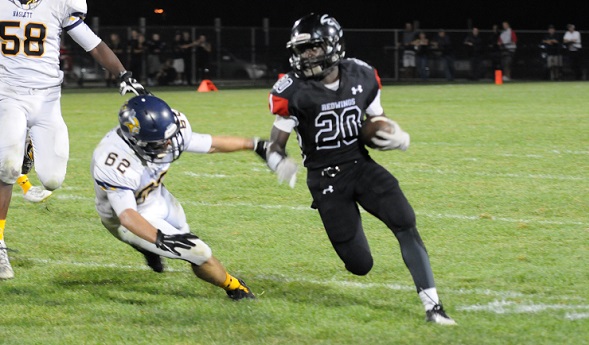
These neighbors are meeting to decide the Capital Area Activities Conference Red title for the second straight season, with DeWitt the reigning champion thanks to last year’s 16-10 victory. The Panthers have won five straight against the Redwings and won’t have trouble drumming up enthusiasm despite coming off facing its other rival, Haslett, last week. The Redwings have lost only to one-loss Grand Rapids Catholic Central, in Week 2, and feature speedy MHSAA track champion Steven Linton in the backfield and a defense that could slow this game down substantially.
Others that caught my eye: Sanford Meridian (6-0) at Harrison (5-1), Howell (5-1) at Brighton (5-1), Vestaburg (5-1) at Mount Pleasant Sacred Heart (3-3), Pewamo-Westphalia (6-0) at Laingsburg (5-1).
Nothern Lower Peninsula
Harbor Springs (4-2) at Frankfort (5-1)
Most of the best up north this weekend are nonleague matchups, but Harbor Springs could make some noise in the Northern Michigan Football League Legends division as it seeks to guarantee its best finish since 2000. The Rams earned an impressive victory last week over 4-2 Indian River Inland Lakes and have won two of the last three against Frankfort – which is first in the Legends and undefeated since opening night. The Panthers have given up 35 points total.
Others that caught my eye: Lincoln Alcona (5-1) at Johannesburg-Lewiston (5-1), Oscoda (4-2) at Hillman (5-1), Gaylord (5-1) at Petoskey (4-2), Maple City Glen Lake (4-2) at Traverse City St. Francis (6-0).
Southeast & Border
Monroe St. Mary Catholic Central (6-0) at Milan (5-1)
St. Mary hasn’t given up more than seven points in a game since Week 3 as it’s cruised during the first two-thirds of its Huron League repeat pursuit. But Milan arguably has been more impressive; the Big Reds, who won the league in 2012 and 2013, are a one-point loss to 5-1 Marshall on opening night from a perfect record this fall – and after losing to the Falcons 43-0 last year, would love to break St. Mary's 11-game winning streak.
Others that caught my eye: Ottawa Lake-Whiteford (5-1) at Morenci (5-1), Ann Arbor Skyline (3-3) at Ann Arbor Pioneer (5-1), Hudson (3-3) at Ida (6-0), Chelsea (6-0) at Ypsilanti Community (3-3).
Southwest Corridor
Watervliet (5-1) at Delton Kellogg (5-1)
This is the product of the reconfigured Southwestern Athletic Conference, which added teams – including Delton Kellogg – from the former Kalamazoo Valley Association this fall and split into three divisions. The SAC Lakeshore division has provided an extra boost to a Delton program that hasn’t made the playoffs since 2001 but has upped its win total three seasons running. Watervliet is a little more used to this with three 10-win seasons over the last four, but this fall both teams are in similar position – both one-point losses from perfection.
Others that caught my eye: Mattawan (3-3) at Battle Creek Central (3-3), Parchment (4-2) at Berrien Springs (6-0), Plainwell (4-2) at Edwardsburg (6-0), Portage Northern (3-3) at Portage Central (6-0).
Upper Peninsula
Negaunee (6-0) at Ishpeming (5-0)
Ishpeming has won 37 of its last 38 regular-season games. The only team to beat the Hematites? Negaunee, back in 2012, but the Miners came close in 2013 and remain Ishpeming’s toughest annual obstacle despite being shut out 28-0 a year ago. Ishpeming is coming off an open week and has had a little extra time to prepare, although a defense that has given up 33 points in five games has looked plenty ready to match a Negaunee offense scoring 41 points per contest.
Others that caught my eye: Calumet (4-2) at L'Anse (4-2), Bark River-Harris (5-1) at Munising (5-1), Iron Mountain (4-2) at Kingsford (4-2), Houghton (3-3) at Lake Linden-Hubbell (6-0) (Sat.).
West Michigan
Grand Rapids West Catholic (4-2) at Comstock Park (5-1)
Most teams would be fine with a 6-5 blip like Comstock Park experienced in 2014 after three seasons with a combined record of 33-6. But the Panthers look like themselves again, with a win over Ottawa-Kent Bronze co-leader Cedar Springs and the only loss to O-K Green co-leader Zeeland West by 10. West Catholic, which won the O-K Green last season thanks to a 47-33 win over Comstock Park, looked like it might be in for an off season after a 1-2 start. But the two-time reigning Division 5 champion has found a source of offense the last three weeks and looks good to make the playoffs for the 13th straight season regardless of what happens tonight. (This game can be viewed live with subscription on MHSAA.tv.)
Others that caught my eye: Byron Center (5-1) at Zeeland West (6-0), Wyoming Godwin Heights (4-2) at Grand Rapids NorthPointe Christian (6-0), Big Rapids (4-2) at Remus Chippewa Hills (5-1), East Kentwood (4-2) at Rockford (4-2).
8-Player
Waldron (6-0) at Battle Creek St. Philip (6-0), Saturday
This has been a history-making season for Waldron, off to its first 6-0 start since 1978 and approaching at least eight wins for the first time since 1984 (its final two opponents, Litchfield and Carsonville-Port Sanilac, are winless). Beating St. Philip would put the Spartans’ run into another echelon. The Tigers’ only losses the last two seasons were three times to reigning 8-player champion Lawrence – and they have a 49-0 win over 4-2 Webberville and a 65-32 win over 5-1 Morrice this fall.
Others that caught my eye: Portland St. Patrick (5-1) at Webberville (4-2), Lawrence (6-0) vs. Prairie Farm, Wis. (7-0) at Madison Middleton, Wis. (Sat.).
PHOTO: St. Johns' Steven Linton (20) turns the corner during a two-point win over Haslett in Week 4. (Click for more from HighSchoolSportsScene.com.)