

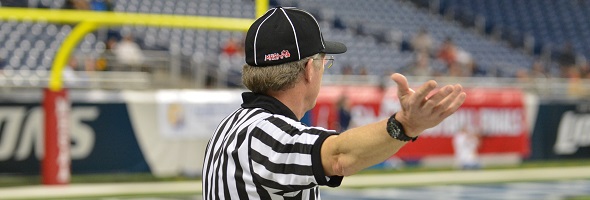
Be The Referee: Catch Momentum
October 17, 2019
This week, MHSAA assistant director Brent Rice offers a "You Make the Call" regarding catch momentum after an interception near the goal line.
Be The Referee is a series of short messages designed to help educate people on the rules of different sports, to help them better understand the art of officiating, and to recruit officials.
Below is this week's segment - Catch Momentum - Listen
Here’s another edition of a football You Make The Call. On a passing play, a defender intercepts the ball at the 2-yard line, and the momentum of the catch carries him across the goal line.
The defender is allowed to come out of the end zone on this play. But while breaking free from the grasp of an opponent, the ball is fumbled out of the back of the end zone. What’s the call?
Since it was the momentum of catch that carried the defender into the end zone to begin with and the ball remained in the end zone and was declared dead there, a rules exception places the ball 1st-and-10 at the 2-yard line.
Past editions
Oct. 10: Golf Rules Changes - Listen
Oct. 3: No Tackle Box - Listen
Sept. 26: You Make the Overtime Call - Listen
Sept. 19: Swimming Finishing Touch - Listen
Sept. 12: Curbing Gamesmanship By Substitution - Listen
Sept. 5: Football Safety Rules Changes - Listen
Aug. 29: 40-Second Play Clock - Listen
What's My Why: Official Will Godfrey
June 24, 2026
Will Godfrey, Jackson
Godfrey just completed his 30th year as an MHSAA-registered official, and he has officiated basketball and softball every season of those three decades. He also has officiated 24 seasons of volleyball, 24 of football and 18 of baseball.
Basically, to stay involved in sports, supplement my income, and just to really stay active.
I would encourage anyone who wants to stay involved in sports to do it. It’s fun and very rewarding. You meet a lot of good people, and it’s a good time.
“What’s My Why” is a weekly feature telling the stories of MHSAA-registered officials in their own words. If you’re an MHSAA official and would like to share your reason why, please submit a 15 to 45-second video, taken horizontally, to director of officials Sam Davis at [email protected].
Don't miss Officiate Michigan Day 2026, July 25 in Grand Rapids! Check out MHSAA.com/OMD to register and learn more.
What's My Why
June 19: Jarrett Skorup, Midland - Watch
June 12: Brady Driver, Sturgis - Watch
June 8: Cindy Tyzo, West Bloomfield - Watch
June 3: Jeff Spedoske, DeWitt - Watch
June 1: Mike Carrier, Commerce Township - Watch
May 27: Stan Wright, Warren - Watch
May 26: Murray Rose, Zeeland - Watch
May 22: Mike VanLaan, Alto - Watch
May 18: Clint Abbott, Newaygo - Watch