

Be the Referee: Disconcerting Acts
October 8, 2020
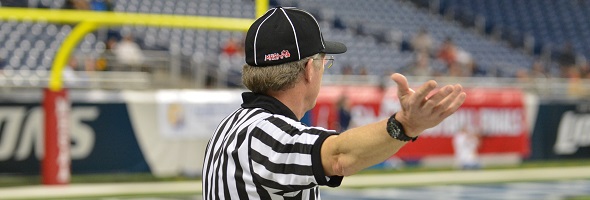
This week, MHSAA officials coordinator Sam Davis explains a change in football meant to reduce a form of gamesmanship at the line of scrimmage.
Be The Referee is a series of short messages designed to help educate people on the rules of different sports, to help them better understand the art of officiating, and to recruit officials.
Below is this week's segment - Disconcerting Acts - Listen
Among the rules changes in high school football for the 2020-21 school year is an adjustment in the penalty assessed to the defense for disconcerting acts and sounds.
Among the gamesmanship that sometimes takes place near the line of scrimmage at the start of the play, defensive players have been known to make sounds or act in a manner which otherwise might distract an offensive player waiting for the snap signal. Previously, the most egregious of these actions would be penalized 15 yards for unsportsmanlike conduct.
But beginning this year, the disconcerting act foul is a five-yard penalty. The change in the rule actually makes it more likely that this kind of behavior will be flagged, and may eventually lead to a reduction is this type of activity.
Past editions
10/1: Ball Hits Soccer Referee - Listen
9/24: Clocking the Ball from the Shotgun - Listen
1st & Goal: 2021 8-Player Finals Preview
By
Geoff Kimmerly
MHSAA.com senior editor
November 17, 2021
Saturday’s 8-Player Football Finals would struggle to feel more familiar.

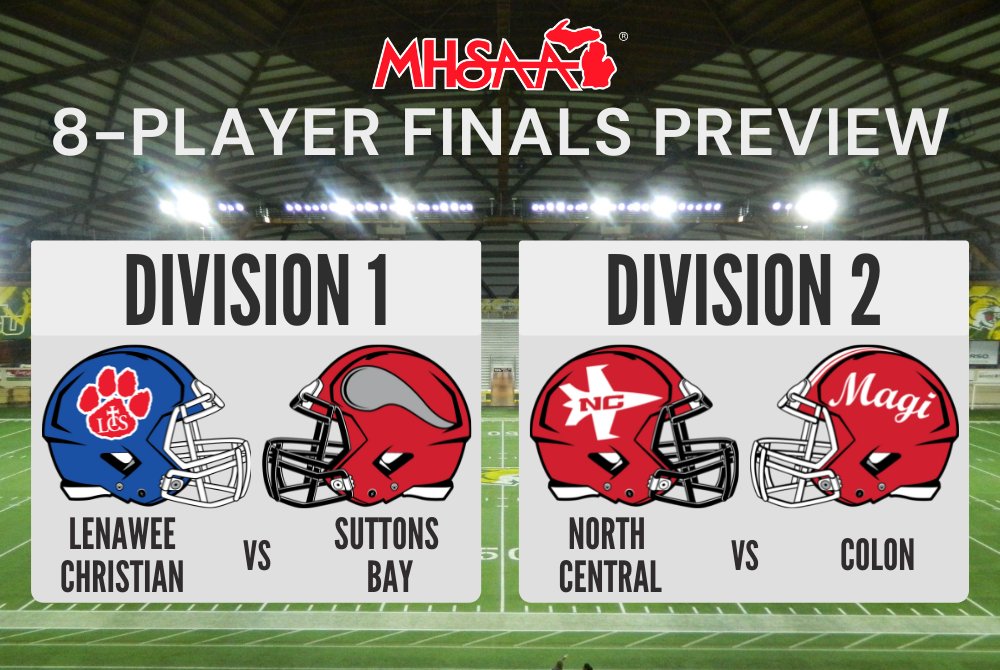
After a year away, the Division 1 and 2 championship games will be returning to Superior Dome at Northern Michigan University. Three of four finalists will be playing for titles for the second-straight season – Adrian Lenawee Christian and Powers North Central are returning champions, and Suttons Bay a returning runner-up – while Colon also will play again on the final day after making the Finals in 2019.
Lenawee Christian (12-0) and Suttons Bay (12-0) will kick off the day in Division 1 at 11 a.m., followed by North Central (12-0) and Colon (11-1) approximately 2 p.m. Both games will be broadcast live on MHSAA.tv, and replayed on Bally Sports Detroit’s primary channel Nov. 25 beginning at 7 p.m. Audio of both games will be streamed live on MHSAANetwork.com.
Below is a look at all four finalists. Team “rankings” are based on their playoff-point averages heading into the postseason. Statistics are through Semifinals unless noted.
Division 1
ADRIAN LENAWEE CHRISTIAN
Record/rank: 12-0, No. 1
Coach: Bill Wilharms, ninth season (69-24)
League finish: First in Southern Central Athletic Association A
Championship history: 8-Player Division 1 champion 2020.
Best wins: 36-14 over No. 3 Martin in Semifinals, 41-0 (Regional Final) and 41-20 over No. 6 Britton Deerfield, 47-21 over Division 2 No. 7 Colon.
Players to watch: QB/CB Ashur Bryja, 5-8/150 sr. (1,862 yards/27 TDs passing, 681 yards/15 TDs rushing); RB/DB/K/P Clay Ayers, 5-10/170, sr. (816 yards/16 TDs rushing, 395 yards/5 TDs receiving); WR/LB Elliott Addleman, 6-5/195, sr. (777 yards/12 TDs receiving). OG/DL Jacobus Kegerreis, 5-9/185, sr.
Outlook: Lenawee Christian has yet to lose an 8-player game since switching from 11-player, building a combined 23-0 record over the last two seasons that includes a 47-0 win over Suttons Bay in last season’s Division 1 Final. The closest an opponent has come over those two seasons is 16 points. The Cougars graduated last season’s standout running back and quarterback and haven’t missed a beat, outscoring their opponents by an average score of 51-8. The offense is easy to praise and understandably so, but the defense deserves substantial credit – through the Regional Final, Lenawee Christian was allowing 2.6 yards per rush and teams to complete only 31 percent of their pass attempts. Kegerreis and Ayers were all-state first team selections as juniors, Ayers as a kicker.
SUTTONS BAY
Record/rank: 12-0, No. 2
Coach: Garrick Opie, fourth season (43-4)
League finish: Does not play in a league.
Championship history: 8-player Division 1 runner-up 2019 and 2020, 11-player Division 6 runner-up 2004.
Best wins: 42-36 (OT) over No. 12 Rudyard in Semifinal, 53-18 over No. 4 Indian River Inland Lakes in Regional Final, 49-8 (Regional Semifinal) and 48-18 over No. 16 Mesick, 46-0 over No. 7 Munising, 45-0 over Division 2 No. 3 Marion.
Players to watch: RB/DB Hugh Periard, 6-0/175, sr. (1,028 yards/19 TDs rushing); RB/DB Shawn Bramer, 6-2/200, jr. (1,725 yards/24 TDs rushing, 892 yards/8 TDs receiving); QB/DB Dylan Barnowski, 6-0/155, jr. (1,570 yards/24 TDs passing); OL/DL Cameron Alberts, 6-1/290, sr.
Outlook: Suttons Bay will be playing in the Division 1 championship game for the third-consecutive season, and its only losses over the last two seasons have been in those previous two Finals. The Norseman are coming off their closest game over the last two years, with a late hook-and-ladder play helping to save the day in last week’s overtime win over Rudyard. But even counting the 36 points scored by the Bulldogs, Suttons Bay’s defense is again imposing giving up 12 points per game and no more than 18 to any other opponent. The Norseman had intercepted 12 passes this season heading into the Semifinal; meanwhile, Suttons Bay has thrown for 26 touchdowns with only one interception. Senior tight end Brayden Opie is the most sizable target at 6-3 and has caught seven touchdown passes.
Division 2
COLON
Record/rank: 11-1, No. 7
Coach: Robbie Hattan, sixth season (48-17)
League finish: Second in Southern Central Athletic Association A
Championship history: 8-player Division 1 champion 2019.
Best wins: 42-6 over No. 4 Au Gres-Sims in Semifinal, 29-22 over No. 1 Morrice in Regional Final, 35-13 over No. 6 Portland St. Patrick in Regional Semifinal, 44-24 over No. 12 Climax-Scotts.
Players to watch: QB/DB Simon Vinson, 6-3/185, jr. (1,212 yards/24 TDs rushing, 2,253 yards/37 TDs passing); RB/LB Kaleb Johnson, 5-8/160, sr. (727 yards/10 TDs rushing, 377 yards/3 TDs receiving); WR/DB Justin Wickey, 5-11/160, jr. (1,454 yards/21 TDs receiving).
Outlook: Colon’s first three playoff wins have doubled as the lone losses this season for those opponents, and the Magi face one more opportunity against an undefeated foe Saturday. Their only loss was to Division 1 unbeaten Lenawee Christian, and otherwise only Morrice has come closer than 12 points. Vinson earned an all-state honorable mention last season and has put up passing numbers that rank among the best in MHSAA 8-player history – his 2,253 yards and 37 touchdowns both rank fourth for a single season in their respective categories. Senior Kody Dovey joins Vinson, Johnson and Wickey among two-way starters and has 544 yards and eight touchdowns receiving.
POWERS NORTH CENTRAL
Record/rank: 12-0, No. 2
Coach: Leo Gorzinski, fourth season (41-3)
League finish: First in Great Lakes Eight Conference West
Championship history: Three MHSAA titles (most recent 2020).
Best wins: 73-8 over No. 3 Marion in Semifinal, 65-8 (Regional Final) and 42-0 over T-No. 9 Crystal Falls Forest Park, 64-14 over No. 11 Pellston in Regional Semifinal, 65-0 over T-No. 9 Lake Linden-Hubbell.
Players to watch: QB/LB Luke Gorzinski, 5-9/175, jr. (1,009 yards/17 TDs rushing, 926 yards/12 TDs passing); RB/DT Wyatt Raab, 5-7/170, sr. (925 yards/23 TDs rushing, 3 TDs receiving); RB/LB Alex Naser, 5-8/155, sr. (159 yards, 3 TDs receiving); OT/DE Lane Nehring, 6-0/280, sr.
Outlook: North Central dominated Division 2 in winning the championship last season, and has been even better this fall. Last week’s Semifinal win over Marion pushed the Jets’ average score this season to 62-4, and only Pellston three weeks ago has put up more than eight points on a defense that starts six seniors. The playmakers will be plenty familiar to anyone who watched last season’s championship games. Luke Gorzinski made the all-state first team last season and set a record for total offense in an 8-Player Final with 455 yards passing and rushing combined – also running for four touchdowns and throwing for three more – and Raab scored four times as the Jets set an 8-Player Finals record for scoring in the 70-48 win over Portland St. Patrick.
Second Half’s weekly “1st & Goal” previews and reviews are powered by MI Student Aid, a part of the Office of Postsecondary Financial Planning located within the Michigan Department of Treasury. MI Student Aid encourages students to pursue postsecondary education by providing access to student financial resources and information. MI Student Aid administers the state’s 529 college savings programs (MET/MESP), as well as scholarship and grant programs that help make college Accessible, Affordable and Attainable for you. Connect with MI Student Aid at www.michigan.gov/mistudentaid and find more information on Facebook and Twitter @mistudentaid.