


Be the Referee: Disconcerting Acts
October 8, 2020
This week, MHSAA officials coordinator Sam Davis explains a change in football meant to reduce a form of gamesmanship at the line of scrimmage.
Be The Referee is a series of short messages designed to help educate people on the rules of different sports, to help them better understand the art of officiating, and to recruit officials.
Below is this week's segment - Disconcerting Acts - Listen
Among the rules changes in high school football for the 2020-21 school year is an adjustment in the penalty assessed to the defense for disconcerting acts and sounds.
Among the gamesmanship that sometimes takes place near the line of scrimmage at the start of the play, defensive players have been known to make sounds or act in a manner which otherwise might distract an offensive player waiting for the snap signal. Previously, the most egregious of these actions would be penalized 15 yards for unsportsmanlike conduct.
But beginning this year, the disconcerting act foul is a five-yard penalty. The change in the rule actually makes it more likely that this kind of behavior will be flagged, and may eventually lead to a reduction is this type of activity.
Past editions
10/1: Ball Hits Soccer Referee - Listen
9/24: Clocking the Ball from the Shotgun - Listen

Title IX at 50: Royal Oak's Finch Leading Way on Football Field
By
Geoff Kimmerly
MHSAA.com senior editor
November 3, 2021
Elyse Finch started playing football when she was 9 years old. She came up through the community league, played junior varsity as a freshman and sophomore and joined the varsity toward the end of sophomore year on the way to moving up as a junior this fall.
So playing the “boys” sport isn’t new to her, and it’s not as rare as many still think.
True, the girls who play high school football in Michigan make up a very small percentage of the more than 32,000 participants in the sport each fall. But 138 girls played in 2020, the fifth straight season with more than 100 taking part.
And Finch’s contributions to the Royal Oak football team are providing a path forward in more ways than one.
She just completed her first season as a starting offensive guard for a Division 1 school with more than 1,500 students, in part helping to open up running lanes for her teammates carrying the ball.
“I do feel kinda special sometimes, knowing I’m doing something that a lot of people have been reluctant to do,” she said. “I just really want to change that, change the view of how people see females in a sport like this.”
Her mom made the initial suggestion to give football a try, and Finch fell for the sport right away as she learned the game at the youth levels. The jump to high school a few years ago was similarly smooth.
Among family, Grandma was nervous – but Finch’s two older brothers also have given her tons of support.
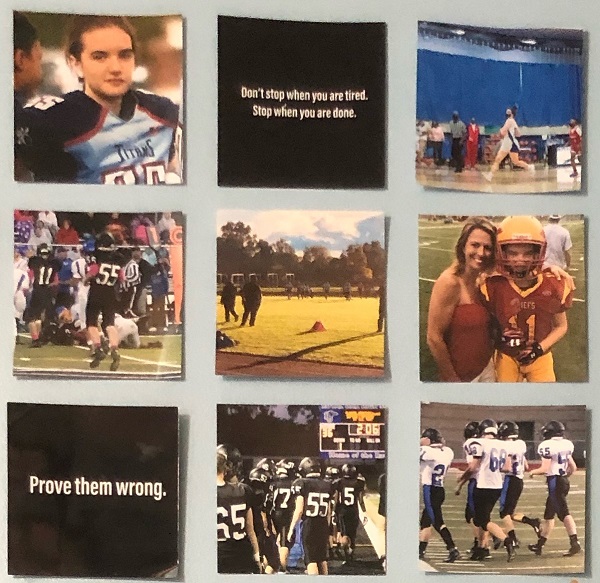 As soon as Elyse met her coaches, she realized how much she adored them. “They believe in my every day, and they tell me they believe in me, and that makes the sport that much better,” she said.
Finch had grown up with some of her teammates, and “they treat me just like everybody else.”
And Finch’s other friends “haven’t seen me any other way.”
Just like any offensive guard, she loves the satisfaction of getting a good block. She loves pulling – running around the line and ahead of a play instead of blocking straight ahead – and finding that defender waiting and “just coming and blowing them up and ruining their day is just so much fun.”
But she does want people to see female football players differently – until they see everyone on the field the same.
“I feel like when people first look at me or just any girls on a football team, their first baseline thought is doubtful; they doubt her/me,” Finch said. “But then a lot of the time I or any girls on the football team, we prove them wrong.
“I want to change the view so when you first see them on the football team, you’re like, ‘Dang, she must be awesome.’ I want to change the view so that instead of starting it off being negative … the expectation is no different than for a guy.”
Second Half's weekly Title IX Celebration posts are sponsored by Michigan Army National Guard.
Previous Title IX at 50 Spotlights
Oct. 26: Coach Clegg Sets Championship Standard at Grand Blanc - Read
Oct. 19: Rockford Girls Set Pace, Hundreds After Have Continued to Chase - Read
Oct. 12: Bedford Volleyball Pioneer Continues Blazing Record-Setting Trail - Read
Oct. 5: Warner Paved Way to Legend Status with Record Rounds - Read
Sept. 28: Taylor Kennedy Gymnasts Earn Fame as 1st Champions - Read
Sept. 21: Portage Northern Star Byington Becomes Play-by-Play Pioneer - Read
Sept. 14: Guerra/Groat Legacy Continues to Serve St. Philip Well - Read
Sept. 7: Best-Ever Conversation Must Include Leland's Glass - Read
Aug. 31: We Will Celebrate Many Who Paved the Way - Read
PHOTOS courtesy of Fenech Photography (top action photo) and Elyse Finch.