


Be the Referee: Football Rules Changes
September 5, 2019
This week, MHSAA Assistant Director Brent Rice discusses a pair of football rules changes made the enhance safety.
Be The Referee is a series of short messages designed to help educate people on the rules of different sports, to help them better understand the art of officiating, and to recruit officials.
Below is this week's segment - Football Safety Rules Changes - Listen
Among our football rules changes for this year are two which involve player safety.
The foul for tripping has been expanded to include a trip on the ball carrier. Intentionally tripping any player on the field – using the lower leg or foot to obstruct an opponent below the knees – will result in a 15-yard penalty.
And the definition of a horse-collar tackle has been expanded to include bringing down a runner backwards or sideways by grabbing the nameplate area on the back of the jersey – or inside the neck area of the jersey or shoulder plate. The penalty for a horse-collar tackle is 15 yards.
Past editions
Aug. 29: 40-Second Play Clock - Listen
Drogosh Closing Career of Unforgettable Impact on De La Salle Football
By
Keith Dunlap
Special for MHSAA.com
November 23, 2022
Dan Rohn admitted that the thought started to “hit me a little bit” on Tuesday.
 Rohn, the head football coach and athletic director at Warren De La Salle Collegiate, is obviously trying to focus entirely on Friday’s Division 2 championship game against Grand Rapids Forest Hills Central.
However, this week it has started to strike him that pretty soon, he’s going to have to get used to life without senior quarterback Brady Drogosh.
From the moment Drogosh started school at De La Salle as a freshman, Rohn said he has been “my quarterback,” having constant meetings in his office before school and texting countlessly throughout the day about school, football and life in general.
“We do this to build relationships with kids, and I’ve got a pretty special one with Brady Drogosh,” Rohn said.
And make no doubt, Drogosh will be a hard one for even a power like De La Salle to replace.
In three years as a starter, Drogosh has accumulated 7,784 yards of total offense – 3,152 rushing yards, 4,632 passing yards – and 98 total touchdowns (46 rushing, 56 passing).
This season, the 6-foot-5, 200-pound Drogosh has run for 1,188 yards and 17 touchdowns and completed 119-of-179 passes for 2,015 yards and 33 touchdowns – that 33 amounting to 10 more than he had his sophomore and junior seasons combined.
“Brady is that level, where if anything is going wrong, I don’t have to tell him now when he comes off of the field because he knows,” Rohn said. “That’s how you can tell someone has arrived.”
Drogosh will be making his third-straight start for De La Salle in a Final, and the seeds for his great high school career were planted through failure in his first at Ford Field as a sophomore.
In a 25-19 loss to Muskegon Mona Shores, Drogosh struggled in his start and was benched in the second half.
“He struggled, and he’ll openly admit that he didn’t have full grasp of the situation,” Rohn said. “It was definitely a learning moment for Brady.”
As painful as it was, it also lit a fire in him.
“I know as I was walking off of the field, I turned to two of my sophomores saying I don’t want to feel like this again,” Drogosh said. “I think that was the fuel for me.”
 Indeed, as Drogosh had an outstanding junior year which culminated in De La Salle defeating Traverse City Central in last year’s Division 2 Final, 41-14.
Then came the offseason, when Drogosh started his journey to becoming miles better as a senior.
He flew to California and participated in the Elite 11 quarterback competition, where he competed with some of the country’s best quarterbacks and learned under camp counselors who are some of the best college quarterbacks in the nation this year, including Alabama’s Bryce Young, USC’s Caleb Williams and UCLA’s Dorian Thompson-Robinson.
“You had three Heisman candidates there, so might as well learn anything you can,” Drogosh said.
An elite rusher last year, Drogosh has skyrocketed his career passing totals, becoming what Rohn dubbed as a “true dual-threat quarterback.”
“I definitely think my decision-making and accuracy has been better,” Drogosh said.
Not only does Drogosh not have much time left as a high school football player, he also doesn’t have much time remaining as a student in general.
Drogosh will sign in December to play at University of Cincinnati and become an early enrollee starting classes Jan. 7.
Rohn said throughout the recruitment process with Drogosh, college coaches said the No. 1 thing about him they were worried about was his throwing mechanics. But Rohn feels Drogosh being around a full-time quarterback coach in college will rectify any of those concerns.
“Him focusing on someone who can work with him 1-on-1 and develop his mechanics, I think he’s really going to take off,” Rohn said.
Also a member of De La Salle’s Division 1 championship basketball team last year, Drogosh will forgo the upcoming basketball season.
A 4.0 student, Drogosh said he’ll be able to come back in the spring for the school’s graduation ceremony and walk the stage with his classmates, but his official graduation party will come on Dec. 21 when he officially signs with the Bearcats.
“There will be a graduation party,” Drogosh said with a laugh, adding teammate Mason Muragin, an Illinois commit, also will participate in the festivities.
But before that, Drogosh and De La Salle are fully focused on pursuing a repeat championship against Forest Hills Central.
There will be plenty of time for career reflection and lifelong relationships made afterwards.
But no doubt, when Friday comes and goes, one of the biggest sentiments of all will be that it’s going to be awfully hard to replace Brady Drogosh.
 Keith Dunlap has served in Detroit-area sports media for more than two decades, including as a sportswriter at the Oakland Press from 2001-16 primarily covering high school sports but also college and professional teams. His bylines also have appeared in USA Today, the Washington Post, the Detroit Free Press, the Houston Chronicle and the Boston Globe. He served as the administrator for the Oakland Activities Association’s website from 2017-2020. Contact him at [email protected] with story ideas for Oakland, Macomb and Wayne counties.
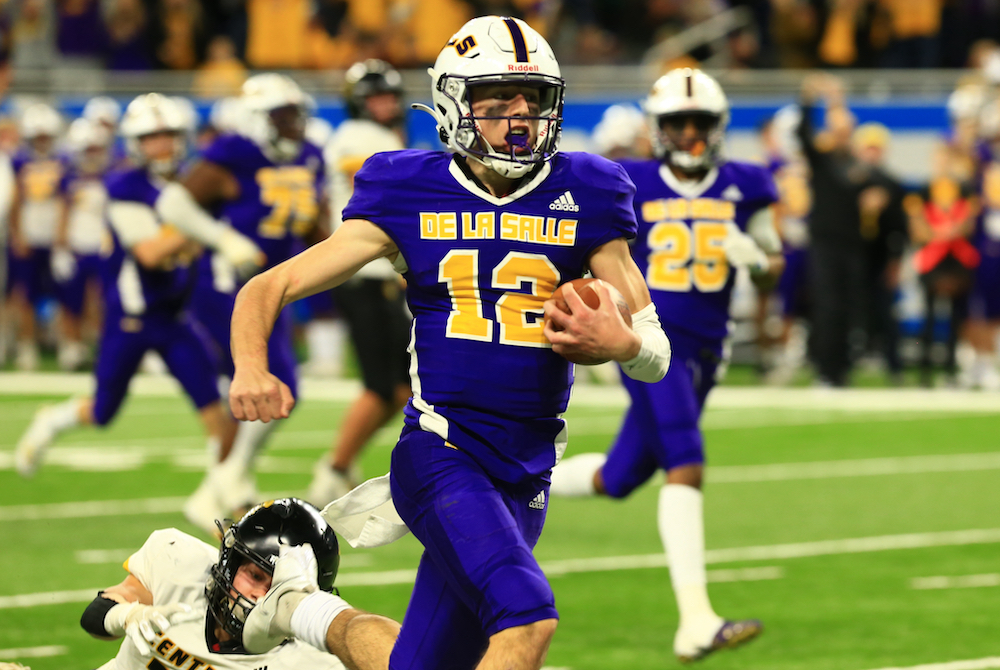
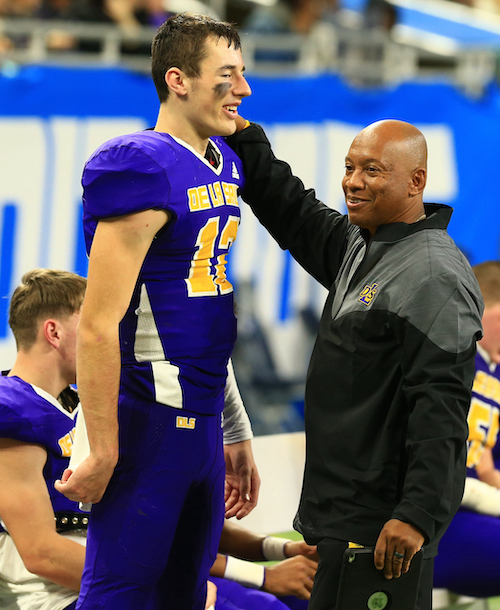
PHOTOS (Top) Warren De La Salle quarterback Brady Drogosh (12) pulls away from a Traverse City Central defender during last season’s Division 2 Final. (Middle) Pilots assistant coach Karl Featherstone, right, brings a smile to Drogosh’s face.