

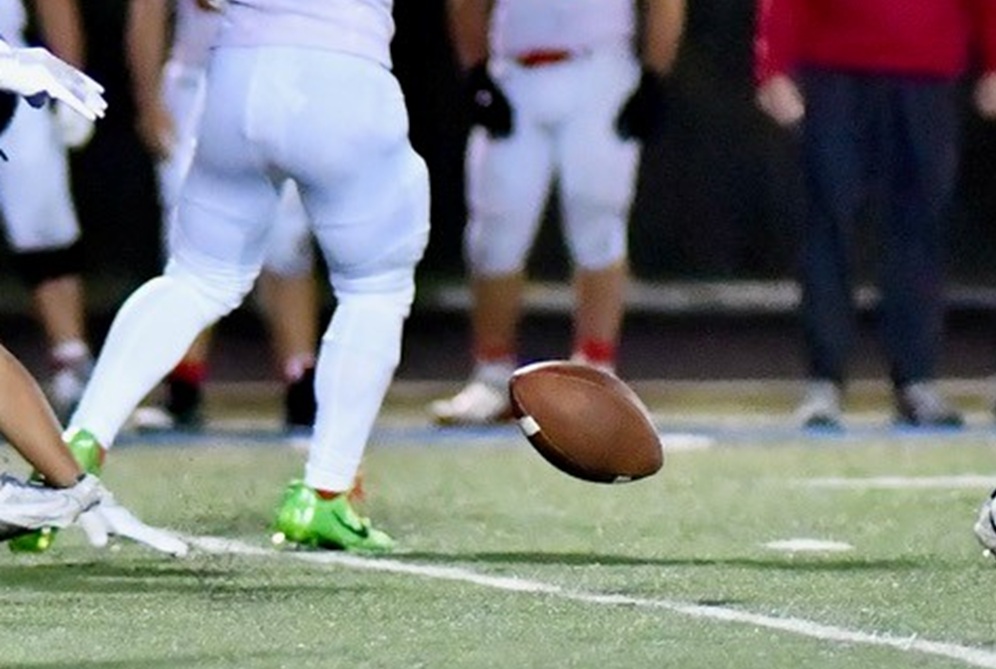
Be the Referee: Forward Fumble
By
Paige Winne
MHSAA Marketing & Social Media Coordinator
September 9, 2025
Be The Referee is a series of short messages designed to help educate people on the rules of different sports, to help them better understand the art of officiating, and to recruit officials.
Below is this week's segment – Forward Fumble - Listen
We have a Football “You Make the Call” for you today.
Team A has the ball at their 20-yard line. Team A’s quarterback gets the snap and starts running toward the sideline.
He’s tackled and fumbles the ball forward, towards the sideline. The ball rolls forward four yards and goes out of bounds before anyone can recover it.
Whose ball is it, and where is it marked?
Since the offense fumbled the ball, it went out of bounds and it wasn’t recovered by anyone, it remains the offense’s ball.
But the ball is marked back to the spot of the fumble. There’s no advantage to fumbling the ball forward.
If the ball had been fumbled backwards and out of bounds with no recovery, then the offense would retain possession where the ball went out of bounds.
Previous 2025-26 editions
Sept. 2: Field Hockey Basics - Listen
Aug. 26: Golf Ball Bounces Out - Listen
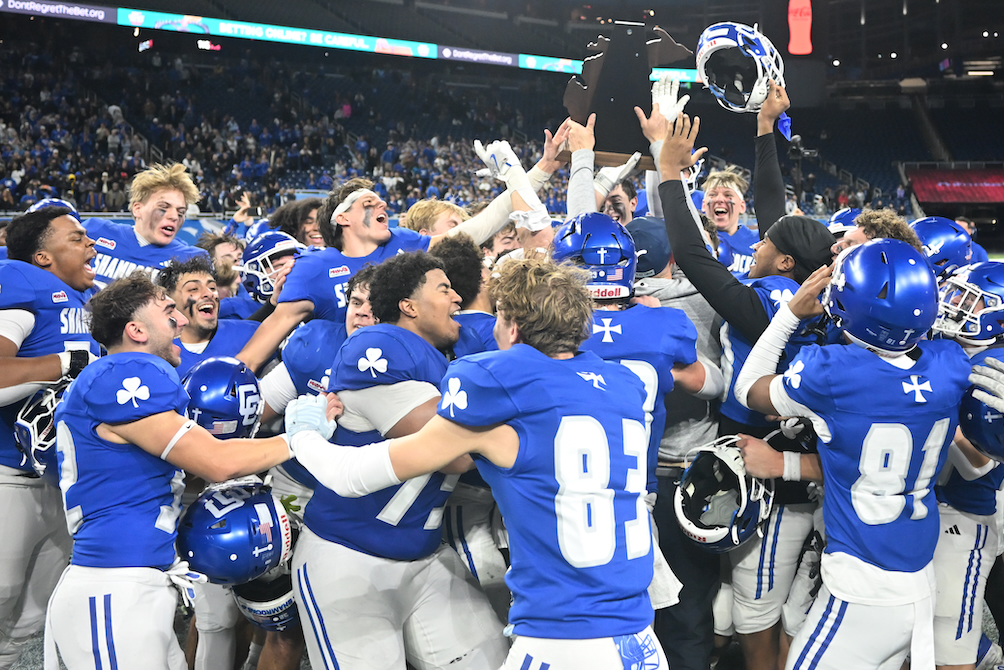
DCC Closes Season by Avenging 2024 Semifinal Loss to 'Finish What We Started'
By
Scott DeCamp
Special for MHSAA.com
December 1, 2025
DETROIT – The featured matchup of 2025 MHSAA Football Finals weekend at Ford Field pitted unbeaten heavyweights Detroit Catholic Central and Detroit Cass Tech in the Division 1 title bout.
DCC coach Justin Cessante used a boxing metaphor with his team in the days leading up to the main event. The Shamrocks essentially won by unanimous decision, although a knockout punch came from an unlikely source.
A 61-yard pick-6 by 6-foot-3, 300-pound senior noseguard Benny Eziuka with 3:12 remaining got the party started early and put the finishing touch on DCC’s dominant 42-19 victory over reigning champ Cass Tech to close Sunday night.
“We had a theme all week that our special teams and run game are going to be the body shots,” Cessante said. “Our uppercut is going to be making big plays on offense, and our defense – brick wall – was going to be the head shots.
“We talked about that all week and how we were going to play a physical, disciplined brand of football. I think we did that in all three phases.”
DCC did just that in capping a 14-0 season and capturing its first Finals title since 2009. The Shamrocks, who made their first championship game appearance since 2016, now have 11 wins in 18 trips to the final round.
Cass Tech (13-1) outgained DCC, 358-311, but the Shamrocks’ stingy defense forced multiple Technicians miscues, including two interceptions and a lost fumble.
Cass Tech suffered only its second Finals defeat in six overall trips to the championship game.
 “We left a lot of stuff on the field,” Cass Tech coach Marvin Rushing said. “We’ll come back in a couple weeks and watch some of this stuff and we’ll be pounding the table a little bit with some of the stuff that we left on the field.
“To be a champion, you’ve got to beat the man to be the man today. They get to hoist the trophy, and they deserve it.”
DCC junior quarterback Duke Banta and classmate Gideon Gash connected on three touchdown passes: 41 yards with 7:44 left in the first quarter, 37 yards with 7:36 left in the third, and 48 yards with 4:52 remaining in the contest.
Banta finished 9-of-11 passing for 156 yards and no interceptions. All three of Gash’s receptions went for scores. Older brother, senior Samson Gash, had five receptions for 25 yards.
DCC senior Cedric Williams led all rushers with 72 yards on 18 carries with a one-yard TD midway through the fourth quarter. Senior Joshua Peters scored on a five-yard run to give the Shamrocks a 13-0 lead late in the first half, while junior kicker Ty Goddard booted a 21-yard field goal early in the fourth quarter for the champions.
It was Eziuka who stole the show, however. The two-way starting lineman and Penn State commit realized a big man’s dream. Junior linebacker Jalen Montlouis pressured Cass Tech’s backfield near the Technicians’ 45-yard line and forced a risky throw, which Eziuka caught at his own 39. Eziuka got a couple blocks, rumbled down the DCC sideline, and stomped into the end zone to the roar of the crowd.
“You know, I was just in the right place at the right time. I caught the ball, my teammate Connor Ryan was throwing me a block, so I was like, ‘I mean, he made the effort, so I’ve got to try to score,’” Eziuka said. “You know, I made the cut and saw green grass. I was like, ‘That’s a long way, but I’ve got to try.’ I kept going. I saw one of their guys catching up to me. My teammate, Jack Janda, made a great block for me to get in there.
“When I was in the end zone, I had to make my way to the barrier because I was not standing up for very long. (The barrier) was supporting me. I definitely needed oxygen,” Eziuka added with a chuckle. “It was a great play for the entire team.”
Samson Gash was asked if he felt threatened by Eziuka and a potential claim of being fastest player on the team.
“A little bit. Low key, a little bit,” Gash said to laughter in the interview room.
In addition to its interceptions, DCC’s defense sacked talented sophomore quarterback Donald Tabron II three times and limited Cass Tech to 73 rushing yards. Tabron finished 25-of-37 for 285 yards with two TDs – one to senior Corey Sadler Jr. from 15 yards out with 5:24 left, and the other to senior William Sykes Jr. from 12 yards out with 14 seconds remaining.
 Sadler, a North Carolina commit, wrapped up his storied four-year varsity career with 11 receptions for 130 yards and made a co-team-high seven tackles.
“The four years have been great,” Sadler said. “I’m probably one of the best players to come through Detroit in the PSL league, so … it was a sad outcome today. You know, college is next. I just have to keep my head high. We fought. CC had a great game.”
Senior Justin Bonner also made seven stops for Cass Tech. For DCC, Montlouis led the way with eight tackles.
Sunday’s victory also represented a measure of revenge for DCC, which fell to Cass Tech in last year’s Semifinals, 17-14.
In the 2016 Final, the Shamrocks fell to the Technicians, 49-20.
“It’s a tremendous feeling,” said Cessante, who capped his fourth year leading DCC’s program. “Other than being married and my children, bringing a championship back to my alma mater, Detroit Catholic Central, where this championship belongs, obviously against a team (where) we just had enough over the years in regards to the rivalry that’s been built and them being really a nemesis and us getting over the hump and finishing what we started (is special).”
The Gash brothers have been double trouble for DCC opponents.
While it was Gideon’s turn to shine Sunday, the siblings reflected on what it means to share in the Shamrocks’ long-awaited championship and how special it was to share in it.
“It means everything to us. After we lost last year to Cass Tech, we knew we should have beat them. But like Coach Cessante said, we didn’t prove it,” Samson Gash said. “Our motto this year was, ‘Finish what we started.’
“Our seniors did a great job last year, and we needed to bring a state championship for this year and just working every single day with my brothers, my best friends for life, it means everything to us to go out on top, for sure.”
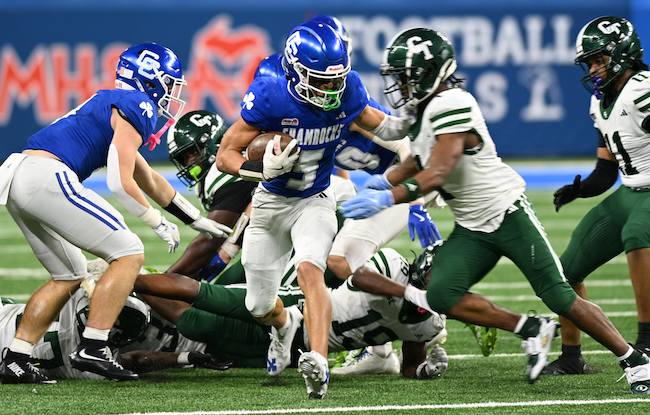
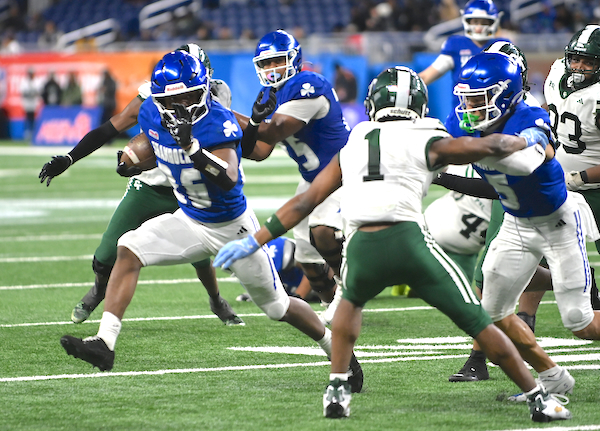
PHOTOS (Top) Detroit Catholic Central players celebrate Sunday while hoisting their championship trophy. (Middle) The Shamrocks’ Samson Gash (5) attempts to put space between himself and a Cass Tech defender. (Below) Cedric Williams (26) picks his path as Gash blocks in front of him.