

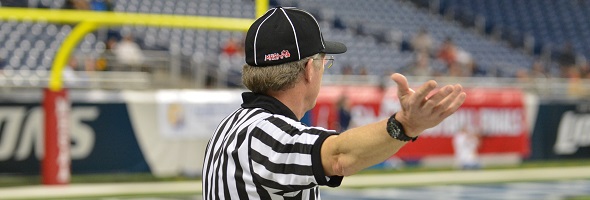
Be the Referee: Illegal Football Kick
October 22, 2020
This week, MHSAA officials coordinator Sam Davis presents a "You Make the Call" on the legality of a kicking scenario.
Be The Referee is a series of short messages designed to help educate people on the rules of different sports, to help them better understand the art of officiating, and to recruit officials.
Below is this week's segment - You Make the Call: Illegal Kick - Listen
Here’s a you-make-the-call situation today. It’s fourth down and a field goal is being attempted – but the holder muffs the snap. With the loose ball rolling around, the kicker swings his leg at it and boots it through the uprights. You make the call – is this legal?
There are only two ways a ball can be legally kicked for points on a play which starts with a snap from center. One is a place kick being held by another player – the other is the rarely seen drop kick.
Had the kicker picked up the ball, dropped it to the ground and kicked it on the bounce through the uprights, the result of the play would have been a field goal. In this instance, though, a 10-yard penalty is assessed from the line of scrimmage for illegal kicking, and the opposing team takes over from that spot.
Past editions
10/15: Toe the Line on Penalty Kicks - Listen
10/8: Disconcerting Acts - Listen
10/1: Ball Hits Soccer Referee - Listen
9/24: Clocking the Ball from the Shotgun - Listen
Unforgettable 5ive: 2021 Football Week 8
By
Jon Ross
MHSAA Director of Broadcast Properties
October 20, 2021
Here's a look at our Week 8 "Unforgettable 5ive" from MHSAA.tv and MHSAA media partner broadcasts:
► Grand Rapids Catholic Central stops Cedar Springs’ two-point conversion try, preserving a 41-40 GRCC win.
► Elkton-Pigeon-Bay Port Laker stops Bad Axe’s two-point conversion try, also preserving a one-point win 21-20.
► Saline stops Dexter on a two-point conversion try to tie during the fourth quarter of the Hornets’ 42-40 victory.
► Grand Blanc's Nathan Fidelino makes the sack in a 30-6 Bobcats win over Lapeer.
► Frankenmuth's Cole Jankowski intercepts an Essexville Garber pass in the Eagles' 40-6 win.