

Be the Referee: No Tackle Box
October 3, 2019
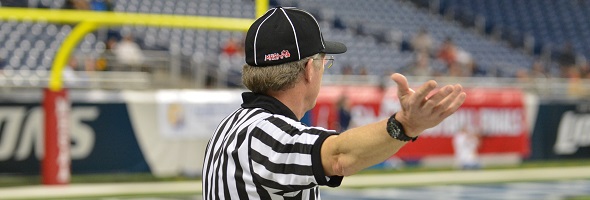
This week, MHSAA officials coordinator Sam Davis explains the difference between high school and college/pro rules in regards to the football tackle box and intentional grounding.
Be The Referee is a series of short messages designed to help educate people on the rules of different sports, to help them better understand the art of officiating, and to recruit officials.
Below is this week's segment - No Tackle Box - Listen
Today we are going to talk about the rules that govern the quarterback, specifically when the quarterback is being rushed and is looking to throw the ball away and avoid the sack.
Under both pro and college rules, they have what’s called the tackle box. When the quarterback gets outside of the original position of the offensive tackles and throws the ball and it reaches the line of scrimmage, there is never a foul for intentional grounding.
However, under high school rules there is no such thing as a tackle box. If the quarterback is either in pocket or scrambles outside of the pocket and now is trying to throw that ball away to avoid the sack, there always must be a receiver in the vicinity of the pass to avoid an intentional grounding foul.
Past editions
Sept. 26: You Make the Overtime Call - Listen
Sept. 19: Swimming Finishing Touch - Listen
Sept. 12: Curbing Gamesmanship By Substitution - Listen
Sept. 5: Football Safety Rules Changes - Listen
Aug. 29: 40-Second Play Clock - Listen
Highlight Reel: Friday Football Finals
November 26, 2016
By John Johnson
MHSAA Communications Director
A pair of repeat champions took center stage Friday at the first day of the MHSAA 11-Player Football Finals, powered by the Michigan Army National Guard, at Ford Field in Detroit.
Division 8
Muskegon Catholic Central 35, Ottawa Lake Whiteford 6
Due to technical difficulties, highlights of this game will be posted at a later date.
Division 2
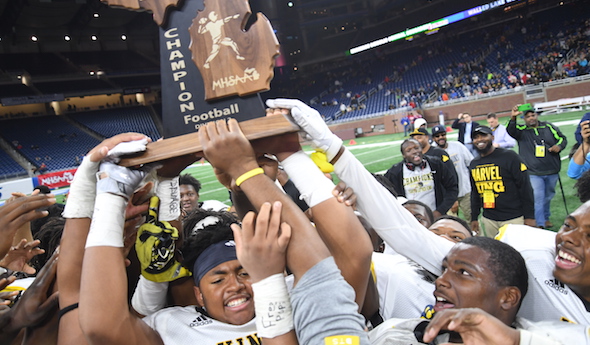
Detroit Martin Luther King 18, Walled Lake Western 0
Finn Hits Thomas for King TD - Late in the first half, Dequan Finn hit Ambry Thomas with a 9-yard touchdown pass for Detroit Martin Luther King.
Tip Drill Turns Into King TD - A tipped ball turned into a pick-six for Detroit Martin Luther King, as Jesse Scarber came up with this second interception of the game returned this one 56 yards for a score.
More Pick-Six Action By Morton - Detroit Martin Luther King returned a second interception for a score in the fourth quarter when Jay-Veyon Morton took this pick back for a TD.
Division 6
Jackson Lumen Christi 26, Maple City Glen Lake 14
Lakers Back In The Game - Trailing in the second quarter, Maple City Glen Lake gets back into the Division 6 Final when QB Cade Peterson finds a streaking Nick Rice going down the sideline for 57 yards and a score.
Ring The Bell - Jackson Lumen Christi's Bo Bell came up big with 238 yards rushing. Here's his longest run of the day, a 46-yard jaunt in the third quarter which set up a 3-yard scoring run – his lone TD of the game.
Division 4
Grand Rapids Catholic Central 10, Detroit Country Day 7
Yellowjackets Score On The Interception - Trailing in the second quarter, Detroit Country Day seized the lead when Roy McCree intercepted a pass and returned it 82 yards for a score.
Finding Its Offense At The Right Time - Early in the fourth quarter, Grand Rapids Catholic Central gets its lone first down of the Division 4 title game on this 44-yard pitch-and-catch from Jack Bowen to Michael Brown.
The MHSAA Football Finals are sponsored by the Michigan National Guard.
PHOTO: Detroit Martin Luther King players hoist the Division 2 championship trophy Friday at Ford Field.