

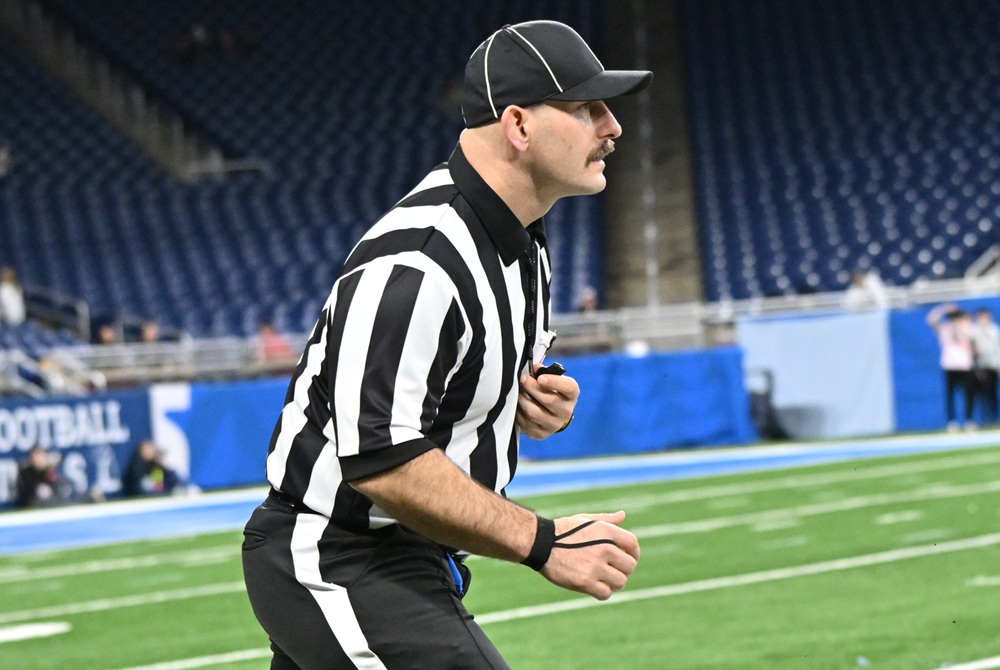
Be the Referee: Pass Interference
By
Paige Winne
MHSAA Director of Brand Management
November 3, 2026
Be The Referee is a series of short messages designed to help educate people on the rules of different sports, to help them better understand the art of officiating, and to recruit officials.
Below is this week's segment – Pass Interference - Listen
How well do you know the rules regarding pass interference and passes behind the line of scrimmage? Let’s find out.
The blue team has the ball. The quarterback throws a forward pass to a receiver who is positioned behind the line of scrimmage. Before the receiver can make the catch, a red team defender makes contact with him, and the pass falls incomplete.
Is this defensive pass interference?
The answer is no.
Under high school football rules, pass interference restrictions only apply to forward passes that cross the line of scrimmage. Because this pass was thrown to a receiver behind the line of scrimmage and did not cross it, there is no pass interference.
The same rule applies to backward passes. Pass interference cannot be called on a backward pass, regardless of where the receiver is positioned.
Previous 2026-27 editions
Oct: 27: Field Hockey Substitutions - Listen
Oct. 20: Foot Save in Volleyball - Listen
Oct. 13: Soccer Advantage - Listen
Oct. 6: Defensive Holding - Listen
Sept. 29: Minimum Number of Volleyball Players - Listen
Sept 22: Soccer Changes - Listen
Sept: 15: Dead Ball Penalty - Listen
Sept. 8: Libero Ejected - Listen
Sept. 1: Soccer Foul After Shot on Goal - Listen
Aug. 25: Fumble Out of Bounds - Listen

New Football Practice Policies
March 25, 2014