

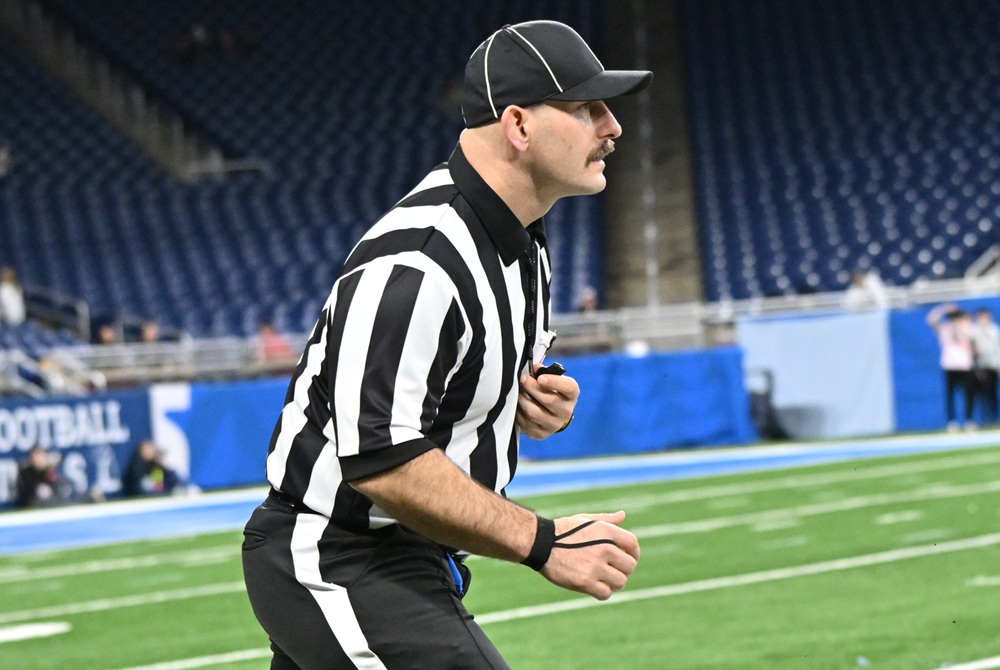
Be the Referee: Pass Interference
By
Paige Winne
MHSAA Director of Brand Management
November 3, 2026
Be The Referee is a series of short messages designed to help educate people on the rules of different sports, to help them better understand the art of officiating, and to recruit officials.
Below is this week's segment – Pass Interference - Listen
How well do you know the rules regarding pass interference and passes behind the line of scrimmage? Let’s find out.
The blue team has the ball. The quarterback throws a forward pass to a receiver who is positioned behind the line of scrimmage. Before the receiver can make the catch, a red team defender makes contact with him, and the pass falls incomplete.
Is this defensive pass interference?
The answer is no.
Under high school football rules, pass interference restrictions only apply to forward passes that cross the line of scrimmage. Because this pass was thrown to a receiver behind the line of scrimmage and did not cross it, there is no pass interference.
The same rule applies to backward passes. Pass interference cannot be called on a backward pass, regardless of where the receiver is positioned.
Previous 2026-27 editions
Oct: 27: Field Hockey Substitutions - Listen
Oct. 20: Foot Save in Volleyball - Listen
Oct. 13: Soccer Advantage - Listen
Oct. 6: Defensive Holding - Listen
Sept. 29: Minimum Number of Volleyball Players - Listen
Sept 22: Soccer Changes - Listen
Sept: 15: Dead Ball Penalty - Listen
Sept. 8: Libero Ejected - Listen
Sept. 1: Soccer Foul After Shot on Goal - Listen
Aug. 25: Fumble Out of Bounds - Listen

Football Practice Proposals
June 11, 2013
During 2013, a Football Task Force has been working on revisions to practice policies that might simultaneously improve acclimatization of players and reduce head trauma. Over three meetings, the following four-part recommendation has been developed:
-
During the first week of practice of the season, only helmets are allowed the first two days, only shoulder pads may be added on the third and fourth days, and full pads may not be worn until the fifth day of team practice.
-
Before the first regular-season game, schools may not schedule more than one “collision” practice in a day.
• A “collision” practice is one in which there is live, game-speed, player-vs.-player contact in pads (not walk-throughs).
• During any additional practice sessions that day, players may wear helmets and other pads (neither is mandatory). Blocking and tackling technique may be taught and practiced. However, contact is limited to players vs. pads, shields, sleds or dummies.
-
After the first regular-season game, teams may conduct no more than two collision practice days in any week, Monday through Sunday. During other days of practice, players may wear helmets and other protective pads (neither is mandatory). Blocking and tackling technique may be taught and practiced. However, contact is limited to players vs. pads, shields, sleds or dummies.
-
No single practice may exceed three hours, and the total practice time for days with multiple practice sessions may not exceed five hours.
• Warm-up, stretching, speed and agility drills and cool down are all considered part of practice. Neither strength/weight training activities nor classroom sessions are considered practice for the purposes of the three- or five-hour limits.
MHSAA staff will be taking this recommendation on the road from now through October to obtain constituent understanding and feedback. It is the intent of the Task Force to finalize its consensus regarding these matters by late November so they may be reviewed by the Michigan High School Football Coaches Association, the MHSAA Football Committee and at the MHSAA League Leadership meeting prior to Representative Council action in March 2014.