

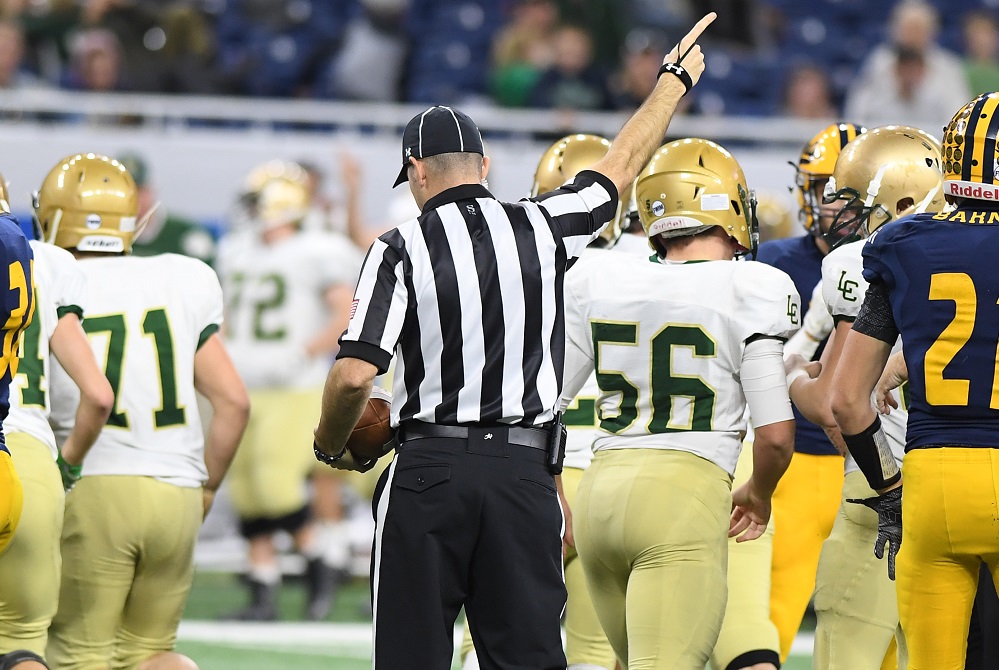
Be the Referee: Pass Interference
By
Geoff Kimmerly
MHSAA.com senior editor
September 2, 2021
This week, MHSAA officials coordinator Sam Davis explains the differences in high school pass interference rules from those at the college and pro levels.
Be The Referee is a series of short messages designed to help educate people on the rules of different sports, to help them better understand the art of officiating, and to recruit officials.
Below is this week's segment – Pass Interference – Listen
One of the big differences between high school football and the college or pro game is how pass interference is called.
In high school, there is no such thing as an “uncatchable” pass. If there is illegal contact by the defender while the ball is in the air, that’s pass interference, no matter where the pass ultimately ends up.
Also – in high school – a defender can “face guard” as long as no contact is made with the receiver. That is not pass interference, even if the defender does not look back for the ball.
Both of those interpretations differ from the college and pro game. Both (of those) levels have an uncatchable exception, and neither allows for face guarding.
Keep that in mind the next time you think you’ve spotted pass interference at the high school level.
Previous editions
Aug. 26: Protocols and Mechanics – Listen

Be the Referee: Points at the Edge
January 25, 2018
In this week's edition, assistant director Mark Uyl explains how scoring opportunities have increased in wrestling this season.
Be The Referee is a series of short messages designed to help educate people on the rules of different sports, to help them better understand the art of officiating, and to recruit officials.
Below is this week's segment – Points at the Edge of the Mat - Listen
There’s a new rule change that will add excitement to high school wrestling.
This new national rule now rewards aggressive action to score points or even work for a pin even when one of the wrestlers appears to be out of bounds.
Wrestling shall continue and points can be scored when a wrestler’s supporting points, while holding the opponent, remain in bounds. Those points of support include the knees, the side of the thighs, the rear end, the hands, and the head. For the purpose of the rule, the toes are not considered a supporting point if they are the only body part in bounds. If that happens, the whistle blows and the action would reset.
Past editions
January 18: Behavior Warning - Listen
January 11: Ice Hockey Safe & Sound - Listen
January 4: Why No Shot Clock - Listen
December 21: Coaches Responsible for Equipment - Listen
December 14: Mentoring New Officials - Listen
December 7: Dive on the Floor - Listen
November 30: Wrestling Weight Monitoring - Listen
November 23: Ejections - Listen
November 16: Toughest Call - Listen
November 9: Hurdling - Listen
November 2: The Survey Says - Listen
October 26: Helmet Comes Off - Listen
October 19: Goal Line Rules - Listen
October 12: No 1st-Year Fee - Listen
October 5: Athletic Empty Nesters - Listen
September 28: Misunderstood Football Rules: Kicking - Listen
September 21: Preparation for Officials - Listen
September 14: Always Stay Registered - Listen
September 7: Other Football Rules Changes - Listen
August 31: Pop-Up Onside Kicks - Listen
August 24: Blindside Blocks - Listen