


Be The Referee: Sideline Safety
November 12, 2019
This week, MHSAA officials coordinator Sam Davis explains the expectation for sideline safety concerning officials, coaches and team personnel who occupy this area of the football field.
Be The Referee is a series of short messages designed to help educate people on the rules of different sports, to help them better understand the art of officiating, and to recruit officials.
Below is this week's segment - Sideline Safety - Listen
Safety in football continues to be a hot topic. We have talked previously here about rules that have improved player safety. Today we’re going to focus on the adults - specifically coaches and officials that work at the sideline area just in front of the team box.
The rules require that from the time just before the snap until the end of the play, all coaches and team personnel must be completely out of the 6-foot safety zone located in front of the team box at each sideline. This then gives the official plenty of room to work unimpeded in either direction.
Now as soon as the play ends, coaches can move into this area to instruct their players or send in the next play and then move back prior to the next snap.
Past editions
Nov. 7: Officials Playlist - Listen
Oct. 31: Most Important Line - Listen
Oct. 24: Automatic 1st Downs - Listen
Oct. 17: Catch Momentum - Listen
Oct. 10: Golf Rules Changes - Listen
Oct. 3: No Tackle Box - Listen
Sept. 26: You Make the Overtime Call - Listen
Sept. 19: Swimming Finishing Touch - Listen
Sept. 12: Curbing Gamesmanship By Substitution - Listen
Sept. 5: Football Safety Rules Changes - Listen
Aug. 29: 40-Second Play Clock - Listen
In Memoriam: Tony Coggins (1971-2023)
By
Geoff Kimmerly
MHSAA.com senior editor
October 24, 2023
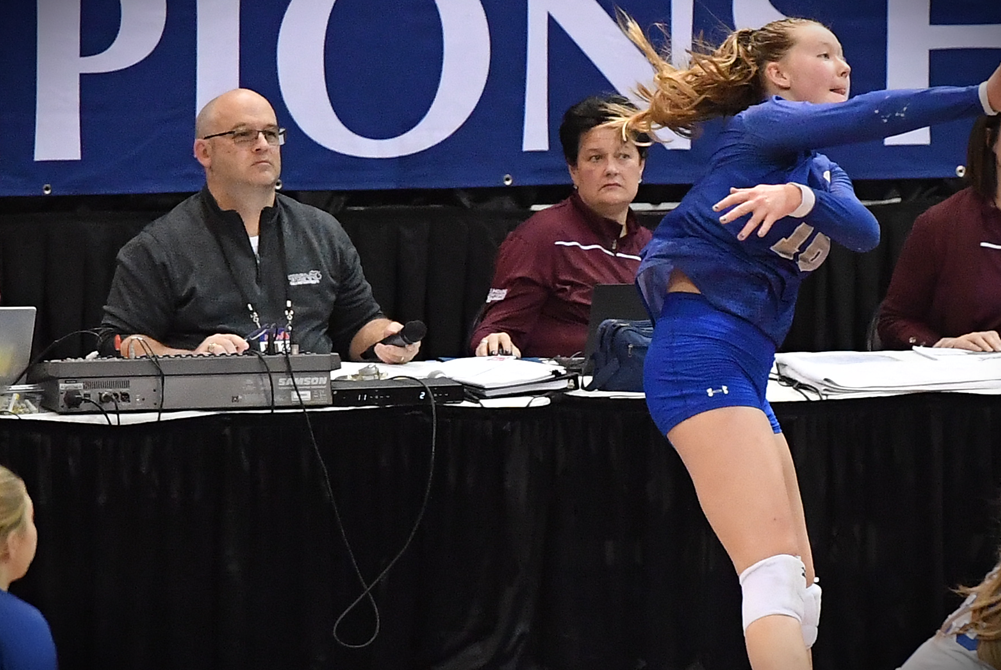
The MHSAA and Holly school communities are grieving this week after the sudden loss of Tony Coggins, a shining light in his educational community and an enthusiastic supporter of school sports as a public address announcer for several of our largest championship events.
But while that cheerful tone has been quieted, it surely will not be forgotten by the many fortunate to enjoy an event in the presence of that voice and the joyfulness he brought into every arena, press box and classroom.
Coggins, 51, died Saturday. He is survived by his wife Kristy and children Emma and Bradlee, among several family and friends from his local and greater sports communities.
 His career as a PA announcer began during his freshman year of high school in 1985, when his father Dale Coggins – Flushing’s athletic director at the time – couldn’t find anyone else to announce middle school football games. That was 39 years ago, and this fall Tony Coggins was in his 24th announcing at Holly, where he taught and served as an administrator in addition to his role as “Voice of the Holly Bronchos” for football, basketball, baseball, softball, volleyball, competitive cheer and swimming & diving over the years.
Coggins has been a mainstay among MHSAA Finals PA announcers over the last decade in football, basketball, softball and most recently volleyball. He lent his voice to college sports at University of Michigan as well. “Tony was a huge part of our Finals events. It’s hard to imagine it being the same without him,” MHSAA Executive Director Mark Uyl said.
As part of the run-up to the MHSAA public address announcers clinic in 2018, Coggins said this about what drew him to the microphone:
“I have zero athletic ability whatsoever, which is interesting because my father was an all-state running back. But I enjoy being involved, and I've always been the one for history and statistics and knowing what's going on,” Coggins said. “This is a way for me to be involved. It's a way for me to use a talent I've been given; public speaking has always come pretty naturally for me.
“So I worked at my craft to get better. I got better from watching the people around me, from studying the people I like, and the people – if I saw someone I didn’t care for – I'd make a note and say to myself, ‘Don't do that.’ I take feedback from people very personally, and I mean that in a good way. If somebody takes the time to come up and say, ‘You did this well; I think you should change this,’ that means they care about the program also. We all have the same goal in mind, and that's to make the experience good for the high school student and the parents, the fans, that come there.”
Funeral Mass will be celebrated at 11 a.m. Saturday, Oct. 28, at St. John Vianney, 2415 Bagley Street in Flint. There will be visitation from 2-8 p.m. Friday, Oct. 27, at the Swartz Funeral Home, 1225 West Hill Road, and at the church from 10 a.m. Saturday until the time of the Mass.
The Holly volleyball team played for something bigger tonight
Beloved PA announcer Anthony Coggins died on Friday night from a heart attack
Tonight v. Carman-Ainsworth, the Broncho community wore his favorite colors: maize & blue🟡🔵@HollyHighSchool|@BronchosAD
⬇️⬇️⬇️ pic.twitter.com/lPCRjjdmyL— Brandon Green🍀 (@BGreenReports) October 24, 2023