

Be the Referee: Video Review Success
December 5, 2019
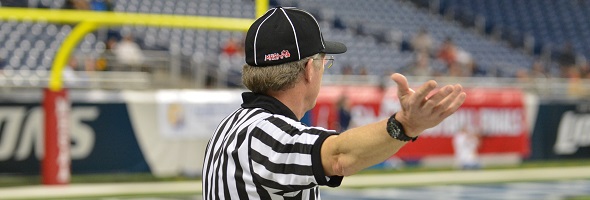
This week, MHSAA assistant director Brent Rice discusses the video review utilized for the first time at last weekend's Football Finals, and how it was successful.
Be The Referee is a series of short messages designed to help educate people on the rules of different sports, to help them better understand the art of officiating, and to recruit officials.
Below is this week's segment - Video Review Success - Listen
For the first time in MHSAA history, video review was utilized to confirm or correct judgment calls on the field for our Football Finals. While there is always some apprehension when adding new technologies to sports, the MHSAA’s approach to a limited replay process, reviewing only those plays that involved turnovers or scores, proved to be a terrific success.
There were a few instances where very close but consequential plays were overturned. However, the biggest confirmation replay provided was something we already knew – that is, that MHSAA officials are putting in hard work and dedication and getting the vast majority of their plays correct in real-time live action.
When needed though, competent replay officials were right on top of the situation to correct the plays without challenges, without controversy and with very little delay in the process.
Past editions
Nov. 28: More Injury Time - Listen
Nov. 21: Football Review - Listen
Nov. 14: Sideline Safety - Listen
Nov. 7: Officials Playlist - Listen
Oct. 31: Most Important Line - Listen
Oct. 24: Automatic 1st Downs - Listen
Oct. 17: Catch Momentum - Listen
Oct. 10: Golf Rules Changes - Listen
Oct. 3: No Tackle Box - Listen
Sept. 26: You Make the Overtime Call - Listen
Sept. 19: Swimming Finishing Touch - Listen
Sept. 12: Curbing Gamesmanship By Substitution - Listen
Sept. 5: Football Safety Rules Changes - Listen
Aug. 29: 40-Second Play Clock - Listen
Drive for Detroit: Week 4 Preview
September 14, 2017
By Geoff Kimmerly
Second Half editor
This is the time of year, every year, when we begin to notice the start of separation among the fast starters and truly elite teams in Michigan high school football.
 There are 122 teams (of 617 total) without a loss as the regular season creeps toward the midway point. And that number will go down by at least a few this weekend as a number of league races also take a turn with undefeated contenders facing off.
This week’s Drive for Detroit preview powered by MI Student Aid features three of those matchups and mentions a half-dozen more. Remember to stay with us Friday night and into Saturday for scores as they come in on the MHSAA Score Center, and click on teams off that page for updated standings and playoff points. MHSAA.tv will broadcast nine games across both peninsulas this weekend – click here for the schedule. All games below will be played Friday.
Bay & Thumb
Linden (3-0) at Fenton (3-0)
Fenton has claimed outright Flint Metro League titles by defeating Linden in the regular-season finale the last three seasons – wins by the Eagles in 2014 and 2016 would’ve meant a shared championship – but this fall the meeting comes in the heart of the league schedule. Linden has handed lone losses this season to both Flushing and Holly, and Fenton did the same to Ortonville Brandon – giving this the feeling of a few-weeks-early championship game again.
Others that caught my eye: Lake Fenton (2-1) at Goodrich (3-0), Marysville (2-1) at Marine City (3-0), Freeland (3-0) at Saginaw Swan Valley (2-1), Houghton Lake (2-1) at Beaverton (3-0).
Greater Detroit
Bloomfield Hills Cranbrook Kingswood (3-0) at Dearborn Divine Child (3-0)
Cranbrook Kingswood has experienced an upswing in football since longtime Detroit Country Day coach Joe D’Angelo took over in 2013. Coming off three straight playoff seasons, the Cranes have opened by outscoring their first three opponents by a combined 114-7 – and two of those teams also made the playoffs last fall. Divine Child has been similarly strong against a similar group of teams and has Big Ten-committed prospects on both sides of the ball (QB/S Theo Day – Michigan State, DE/TE Aidan Hutchinson – Michigan) as it continues to build of last season’s Division 3 Semifinal run.
Others that caught my eye: Warren Mott (3-0) at Macomb Dakota (2-1), Detroit Central (2-1) at Detroit Renaissance (3-0), Clarkston (3-0) at West Bloomfield (1-2), Waterford Mott (2-1) at Walled Lake Western (3-0).
Mid-Michigan
Grand Ledge (2-1) at Lansing Sexton (3-0)
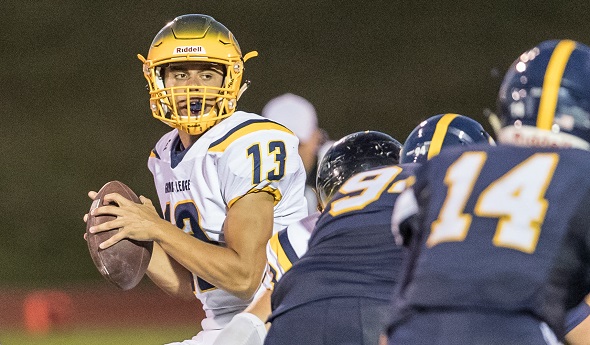
Grand Ledge and DeWitt were considered the unquestioned elite in the Lansing area heading into this season. Then the Panthers downed the Comets 14-7 in Week 2 to rise to the top of the list. But Sexton is building a solid argument as well giving up only 21 points so far and after handing Portland its first regular-season loss since 2014. Another victory tonight would put the Big Reds firmly in the discussion; the winner regardless will take a significant step toward the Capital Area Activities Conference Blue title.
Others that caught my eye: Vermontville Maple Valley (3-0) at Lake Odessa Lakewood (3-0), Lansing Catholic (3-0) at Williamston (2-1), Perry (2-1) at Olivet (3-0), Fulton (2-1) at Fowler (2-1).
Northern Lower Peninsula
Lincoln Alcona (3-0) at AuGres-Sims (3-0)
It’s hard to remember that 11-year span at the start of this century when Alcona didn’t make the playoffs once; the Tigers have qualified four of the last five seasons and are well on their way again with two wins this fall over playoff teams from a year ago. AuGres-Sims started what it hopes is a similar bounce-back going 7-3 last year despite falling to Alcona 58-20. If like opponents mean anything – they have two so far in 2017 – tonight’s game should be a lot closer than that last meeting and could end up deciding the North Star League title.
Others that caught my eye: Whittemore-Prescott (2-1) at Gaylord St. Mary (3-0), Evart (2-1) at McBain (2-1), Johannesburg-Lewiston (2-1) at Charlevoix (1-2), Kalkaska (3-0) at Elk Rapids (2-1).
Southeast & Border
Ypsilanti Community (2-1) at Adrian (2-1)
Once an annual power, we didn’t talk about Adrian for a few seasons until the Maples ended a string of four sub-.500 finishes by winning a District title last fall. They fell in an odd one, 11-7, last weekend after the power went out Friday and they had to resume Sunday morning. Ypsilanti Community also fell last week, to Pinckney, but has equaled last season’s win total and shut out Tecumseh on opening night.
Others that caught my eye: Dundee (2-1) at Hudson (3-0), Brooklyn Columbia Central (2-1) at Ida (3-0), Chelsea (2-1) at Tecumseh (2-1), Addison (3-0) at Napoleon (2-1)
Southwest Corridor
Stevensville Lakeshore (3-0) at St. Joseph (3-0)
Last week Lakeshore/Portage Central was the big game in the southwest part of the state, and following a 24-7 win the Lancers are headlining again as they face their other annual main competition in the Southwestern Michigan Athletic Conference West. Lakeshore has beaten St. Joseph in four straight. But the Bears have been tough defensively and can rely on running back Ryan Haynes, who has piled up more than 400 yards on the ground.
Others that caught my eye: Union City (3-0) at Quincy (3-0), Dowagiac (2-1) at Edwardsburg (3-0), Traverse City Central (2-1) at Portage Central (2-1), St. Joseph Lake Michigan Catholic (3-0) at Parchment (2-1).
Upper Peninsula
Ishpeming Westwood (3-0) at Gladstone (3-0)
Like Lakeshore above, Westwood finds itself in the top spot for as second straight week after downing previously undefeated L’Anse 38-10 to eclipse its win total from a year ago. The Patriots also handed Munising its lone loss this season, but the toughest competition so far should come from Gladstone – which switched to the Mid-Peninsula Conference this season after battling the biggest in the U.P. in the Great Northern Conference for more than two decades. Last week’s 43-0 win over Negaunee gave the Braves as many wins as they had all of last season and as many as they’ve had in any season since 2010.
Others that caught my eye: Marquette (1-2) at Escanaba (2-1), Munising (2-1) at Newberry (2-1), Gwinn (2-1) at Norway (3-0), Hancock (3-0) at L'Anse (2-1).
West Michigan
Muskegon (3-0) at Byron Center (3-0)
The Grand Rapids and Muskegon areas are loaded with outstanding matchups this weekend – see the others mentioned below – but this gets top billing because of Byron Center’s opportunity. Muskegon is a state power and came within minutes of winning the Division 3 title last year. But the Bulldogs finished 10-2 – earning their most wins since 2000 – with both losses to the Big Reds, in Week 4 and again in a Division 3 Regional Final.
Others that caught my eye: Grand Rapids Christian (3-0) at Grand Rapids South Christian (3-0), Zeeland East (3-0) at Holland (3-0), Whitehall (2-1) at Muskegon Oakridge (3-0), Muskegon Reeths-Puffer (3-0) at Muskegon Mona Shores (3-0).
8-Player
Bellevue (3-0) at Portland St. Patrick (3-0)
The Broncos moved into 8-player this season coming off two straight 3-5 finishes and one win in 2014. So far, it’s a perfect fit. Bellevue’s start has been nearly perfect defensively – it’s outscored its first three opponents by a combined 146-6. St. Patrick has a lot more experience in the 8-player format – the Shamrocks twice have come within a win or two of the MHSAA championship game since making the move in 2012. They’re coming off a 38-22 win over rival Webberville, which Bellevue beat 40-6 on opening night.
Others that caught my eye: Ontonagon (2-0) at Rapid River (3-0), Wyoming Tri-unity Christian (2-1) at Onekama (3-0), Deckerville (3-0) at Kingston (2-1), New Haven Merritt (2-1) at Bay City All Saints (2-1).
Second Half’s weekly “Drive for Detroit” previews are powered by MI Student Aid, a part of the Student Financial Services Bureau located within the Michigan Department of Treasury. MI Student Aid encourages students to pursue postsecondary education by providing access to student financial resources and information, including various student financial assistance programs to help make college more affordable for Michigan students. MI Student Aid administers the state’s 529 savings programs (MET/MESP) and eight additional aid programs within its Student Scholarships and Grants division. Click for more information and connect with MI Student Aid on Facebook and Twitter @mistudentaid.
PHOTO: Grand Ledge quarterback Nolan Bird targets a receiver during his team’s 14-7 loss to DeWitt in Week 2. (Click for more from HighSchoolSportsScene.com.)