

Beecher Becoming a Football School Too
November 14, 2012
By Bill Khan
Special to Second Half
FLINT — Basketball is a source of pride at Flint Beecher, with a tradition of excellence that includes four boys and two girls MHSAA championships.
Courtney Hawkins is as proud as anyone, having played on the 1984-85 and 1986-87 championship teams.
But hoops mania is also a source of frustration for Hawkins, the school's football coach and athletic director.
Where basketball is king, other athletic programs can sometimes suffer, as more and more kids are persuaded into specializing in one sport and playing in travel leagues outside of their high school season.
If you want to get Hawkins up on his soap box, ask him about the effect AAU basketball has had on the overall athletic program at Beecher.
Mr. Hawkins, the floor is yours ...
"It kills me to watch some kids who, you know just from the stuff they can do athletically, would be a heck of a football player or could contend for the state championship in the 100 meters or high jump," Hawkins said. "It's absolutely sickening. There are only so many basketball scholarships. They still haven't figured it out. Every year when basketball season is over, there are a number of kids who won't get scholarships, because there are so few. Every single year, there's a handful of boys -- every year -- who come to me and say, 'Coach Hawkins, I wish I would've played football and track.' It's happened seven years in a row and it will happen this year.
"AAU basketball is great. It makes everything seem so good. They get to travel across the country. AAU basketball is big business. It's not the best for every kid, especially when they tell these kids they're going to be the next LeBron James and the next year I see them at the store."
 Hawkins needs only to offer up himself as an example of how an athlete can have success beyond high school while still playing multiple sports as a prep. He was an all-stater in football, basketball, and track and field before focusing on football at Michigan State University. Hawkins went on to play nine seasons as a wide receiver in the NFL. He was a key member of MHSAA championship teams in basketball and track.
Beecher's reputation as a basketball school may finally be changing, albeit slowly.
Hawkins has only two members of last year's Class C championship basketball team on his football roster, but hopes that the team's first-ever run to the MHSAA Semifinals opens some eyes among hoopsters around school.
Beecher (8-4) will face Detroit Loyola (12-0) at 1 p.m. Saturday in a Division 7 Semifinal at Fenton High School. The Buccaneers get a Second Half High 5 this week after overcoming a 3-4 start to make the playoffs as an additional qualifier at 5-4 before winning three postseason games for the first time.
Beecher hopes to become only the fourth team with four losses to win an MHSAA championship. The Buccaneers can look to nearby Flint Powers Catholic, last year's Division 5 champion, for proof that it can be done.
"I didn't want to tell the team that, because they don't like other teams, but I looked at Powers coming in 5-4 and thought, 'Why can't we do the same thing?'" said senior Kermit Craig, a defensive end and tight end.
Beecher is in the playoffs for the sixth straight year, but this was the most unlikely team to advance this far. Beecher's other playoff teams won at least six games, including a 9-0 squad in 2009 that was bounced in the first round.
"Yeah, I'm surprised, but one thing we do is work hard every day," said senior Eric Cooper, a wide receiver and free safety. "I just came to practice every day motivating all the guys to work hard, keep their heads up, and we're going to get a blessing. That's what we got."
The Buccaneers squeaked out a 21-20 victory over Mt. Morris on Oct. 12 to begin their current five-game winning streak. Their crowning achievement so far was knocking off defending Division 7 champion Saginaw Nouvel in the Regional Final, 19-15. Now they're one victory away from a trip to Ford Field.
"I guess with the youth and the fact we snuck in at 5-4, it's surprising that we went this far," Hawkins said. "But with that being said, the way that they've worked and the way they've stayed committed, it's been one of my best groups from that standpoint. I've had some groups that had more success early in the season. This team has great senior leadership. We have some young kids who are just phenomenal in terms of following the senior leaders. They're very coachable, very good kids. This is my first year of having some kids who don't want to play basketball. My starting quarterback, (freshman) Marcus Wright, said, 'Coach, I'm a football player.' We don't get many of those here at Beecher."
There was a time when playoff appearances, let alone trips to the Semifinals, seemed more unlikely than what this 5-4 team has achieved in this postseason.
Hawkins returned to his alma mater in 2006 to take over a program that had 11 straight losing seasons. After a 2-7 inaugural season that saw considerable improvement, Beecher has gone 45-20 while playing as the smallest school in the Genesee Area Conference's Red Division.
"We had to change the attitude," Hawkins said. "There were a lot of people who were, 'We play basketball at Beecher.' That was the approach. Then there was the losing attitude throughout the whole football program. The first year, we were 2-7. We were in a lot of games, but you could see the losing attitude from being beat down all those years. We as a coaching staff stayed on them."
The fact that Hawkins would return to the community after an NFL career gives him considerable credibility with his players.
"That means a lot," Craig said. "Most people look up to him as a father. He came to build the program and led us to where we are now. I learned a lot from him. As a young man, I look up to him. If I have problems, I go to coach Hawkins and talk to him about it. He's more a man than a football coach. He leads you to the right way."
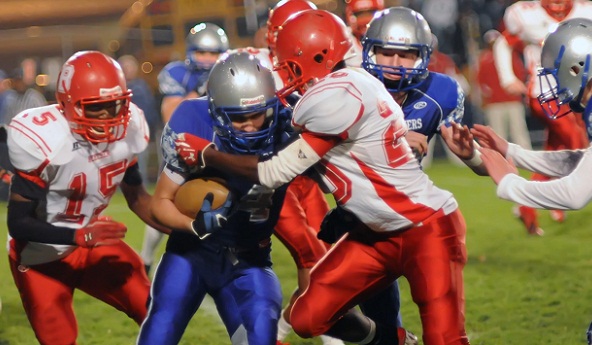
PHOTO: (Top) Beecher linebacker Tyrik Wicks (20) wraps up Saginaw Nouvel's Ryan Sullivan (4) as sophomore Mike Herd (15) also pursues during last weekend's Regional Final. (Middle) Flint Beecher coach Courtney Hawkins, who also played at Michigan State and in the NFL. (Click to see more from the Regional Final at HighSchoolSportsScene.com.)
NFHS Voice: Campaign Touts Benefits of High School Football
By
Karissa Niehoff
NFHS Executive Director
May 21, 2021
A full return to high school sports and performing arts programs – that’s the hope for this fall in schools across the country.
After a year of unprecedented challenges in keeping these programs going due to the pandemic, which included 11 states that conducted their primary football season this spring, there is great optimism as we look to a new school year.
Even in those states that were able to conduct activities last fall, attendance restrictions kept many fans out of stadiums and watching games online. However, with vaccine eligibility now at 12 years of age and older and with vaccinations continuing during the next three months, the likelihood of routines and traditions returning this fall grows stronger each day.
And there is no tradition more anticipated than the full-scale return of high school football. While there were 34 states there were fortunate enough to conduct football at some level last fall, the routines were anything but normal.
This fall, however, we anticipate a return to the energy and excitement of the 2019 season when 1,003,524 boys participated in 11-player football. That total marked a decline of only 2,489 from the previous year and was a good sign of a renewed confidence on the part of parents and student-athletes that concerns about the risk of injury were being addressed.
While boys participation in 11-player football has exceeded one million participants every year since 1999 and is overwhelmingly the most popular boys sport, there have been concerns about declines in past years.
Last fall, the NFHS and the National Football League announced a partnership to promote the growth, understanding and support for football at the high school level. The NFHS and NFL have been studying participation trends, developing educational tools and striving to restore confidence in students and parents that the sport is, in fact, more focused on risk minimization than ever before.
As a result, the springboard to the return of high school football next fall begins this week with the launch of the #ThisIsHSFootball campaign. Through this effort over the next few months, the NFHS will be reaching out to coaches, students, parents, officials, athletic directors and others with research information, participation trends and data on various risk mitigation efforts that, we believe, continues to make high school football safer than it has ever been.
As a part of this effort, the NFHS produced a video entitled “This is High School Football” designed to detail the benefits of participation in high school football.
As the video states, more so than at any other level of play, parents should feel good about their kids playing high school football.
>Here are some of the many educational and medical safeguards put in place the past 12 years to offer parents a comfort level about the safety standards that are a part of high school football.
► Concussion research and education. All NFHS high school playing rules require a student who is exhibiting signs of a concussion to be removed from the game and not allowed to return until the student has been cleared by a medical professional. Thanks to education and training on the part of students, coaches, trainers, parents and others, research data has shown positive trends in concussion rates. In a recent five-year period, concussion rates during practices dropped from 5.47 to 4.44 concussions per 10,000 athletic exposures.
► Concussion in Sport Course. This free online education course has been available through the NFHS Learning Center since 2010, and millions of individuals have taken the course for a deeper understanding about concussions.
► Concussion Laws. By 2014, every state had adopted state concussion laws that established mandatory protocols, and every state high school association has adopted policies that limit contact during preseason drills and in practices during the season.
► Football equipment. Manufacturers continue to produce higher quality equipment every year, and high school coaches are doing a much better job at teaching and coaching the rules of the game and making attempts to minimize risk of injury for players.
► Emergency Action Plans. Thanks to the NFHS Foundation, a copy of the “Anyone Can Save a Life” emergency action plan originally developed by the Minnesota State High School League was sent to all state high school associations and their high schools, and all schools have access to an AED to help save lives.
► Playing Rules. Risk minimization is a major focus of every NFHS sports rules committee. In football, helmet-to-helmet hits are not allowed.
High school football has been a significant part of schools, towns and communities across America for almost 100 years. The NFHS is committed to making the sport as safe as possible for the millions of kids who will play the sport in the years to come.
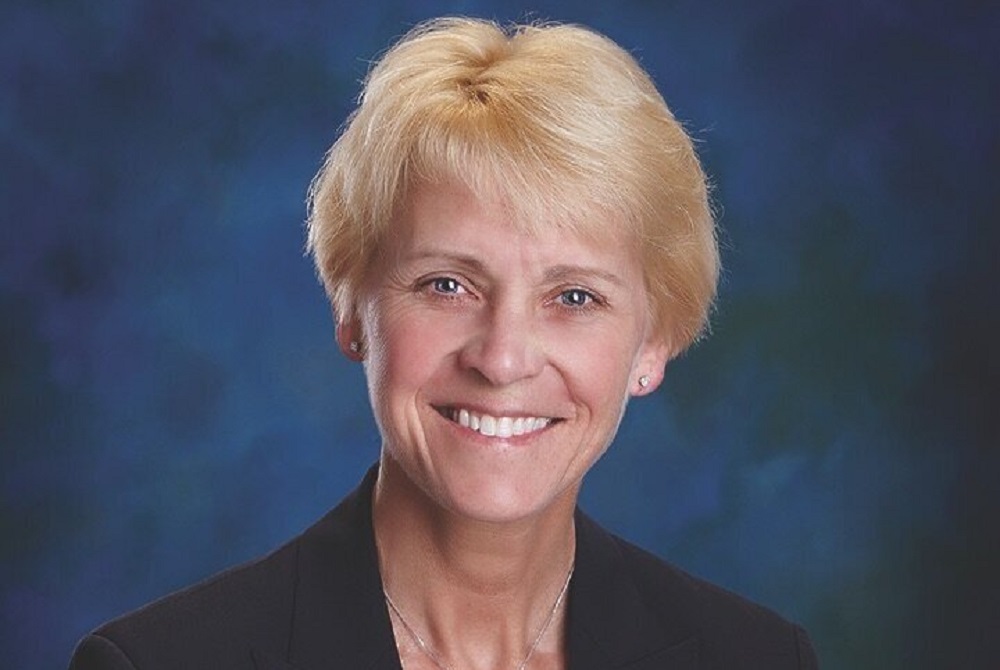
Dr. Karissa L. Niehoff is in her third year as executive director of the National Federation of State High School Associations (NFHS) in Indianapolis, Indiana. She is the first female to head the national leadership organization for high school athletics and performing arts activities and the sixth full-time executive director of the NFHS, which celebrated its 100th year of service during the 2018-19 school year. She previously was executive director of the Connecticut Association of Schools-Connecticut Interscholastic Athletic Conference for seven years.