

Behind Scenes, St Mary's Goes to Goddard
September 27, 2016
By Keith Dunlap
Special for Second Half
As a coach and athletic director at Orchard Lake St. Mary’s over nearly three decades, George Porritt has been asked plenty of times to recall details from his football program’s storied past.
 That comes with coaching a program that annually has a roster full of highly-touted high school players coveted by college recruiters and has seen the best not only shine for prominent college programs but also NFL organizations (see Allen Robinson of Jacksonville).
“When was the last time a player did that?”
“What is the school record in this category?”
“How often has your team done this in a season?”
“When was the last time you lost to this opponent?”
Porritt’s answer is usually quick and consistent.
“Ask Robin Goddard,” Porritt typically says.
For the past 40 years, turning to Goddard has been a frequent option for anyone around St. Mary’s, and for that matter, other schools around the state.
It is why there will be lots of people in the prep sports community thinking of him when he has surgery on Thursday to break up kidney stones that have been bothering him during recent weeks.
Goddard each year puts together media guides with records and teams at St. Mary’s that go all the way back to the early 1900s. (See "Michigan's Football Past: A Must Read")
He can easily point out the fact that St. Mary’s won a state basketball championship in 1933, lost in the state basketball semifinals in 1919 and won its first state baseball championship in 1913. (Note: The MHSAA was not formed until Dec. 1924; previous championship tournaments were hosted by various entities around the state.)
“If he doesn’t have it in something, he finds it right away,” Porritt said. “He goes to the library and he tries to dig it up. He calls the other school and has done it for years. He keeps a great history of our school.”
Surely though, there have to be times when people raise their eyebrows at Goddard and wonder how he can possibly get accurate information from a century ago, right?
Actually, not really.
Not around St. Mary’s, anyway, even if it is hard to fathom for many others that high school sports in Michigan actually did exist before the start of World War I.
“I won’t even challenge him,” Porritt said. “I know he found it somewhere. He’ll tell other schools what their records are historically, and they don’t even know what theirs is. He has fun doing it and will go anywhere and find any way to find out the history of whatever he is looking into.”
Goddard’s importance to the school isn’t limited to being arguably the Encyclopedia Britannica of prep sports in the state of Michigan.
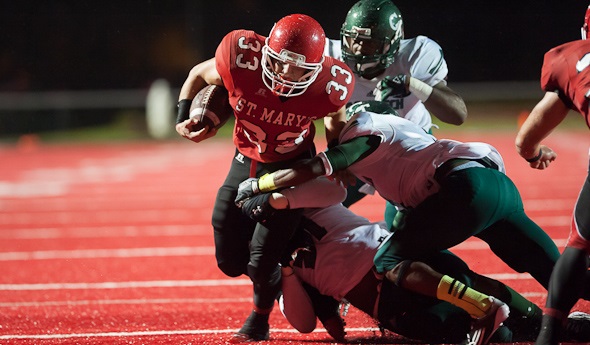
Also a facilities coordinator and valuable fundraiser, Goddard has spearheaded projects to put a track and lights at the football field, and was the architect of one of the most ambitious and out-of-box ideas ever seen at the school – the red artificial playing surface now on the football field.
 During Labor Day weekend in 2011, Goddard flew to Cheney, Wash., to meet with officials at Eastern Washington University, which at the time had the only red-colored artificial football field in the country.
Goddard picked the brains of the folks at Eastern Washington, came home and started a fundraising effort to try and secure $600,000 to bring a red-colored artificial surface to St. Mary’s.
By the following spring, the funds were raised and construction began on the field that was ready by the start of the 2012 season.
At the time, it was the third red-colored field in the country in addition to Eastern Washington and a high school field at Canyon High School in Texas.
Goddard also helped start the annual Polish Country Fair that takes place on the St. Mary’s campus every Memorial Day weekend, which is one of the most regularly-attended festivals in the Detroit area.
Len Karschnia, an administrator and assistant coach for the both the football and basketball teams at St. Mary’s, said when Goddard gets in touch with alums who have the means to donate back to the school, there usually is no hesitation because of their respect for Goddard.
“They always trust Robin to do that,” Karschnia said. “Everything he does (is) for the kids and the school, and that is why nobody is really reticent to give back to any projects that he runs because if he tells you on Tuesday he wants $500 to put up a banner in the gym, on Thursday the banner is up and done and there is a plaque on the wall saying thanks to whoever gave it to him.”
A staple at the school since he arrived in 1976, there obviously will be a lot of prayers and well-wishes around the state for a speedy recovery from surgery.
“He is a guy that whatever St. Mary’s needs, he’ll do it and he doesn’t need any fanfare for his good deeds,” Karschnia said. “It’s all for the kids, for George and for the school. That is really his value.”
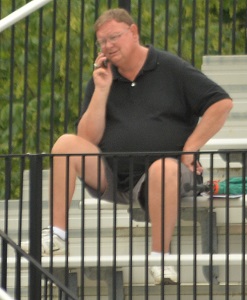
PHOTOS: (Top) Orchard Lake St. Mary's takes on Detroit Cass Tech on its home red turf in 2012. (Middle) Tucked away in the McLane Stadium bleachers, Robin Goddard watches the Eaglets' run to the 2015 Division 2 baseball championship. (Top photo by Terry McNamara.)
White Pigeon Building On 2018 Surge
By
Wes Morgan
Special for MHSAA.com
September 10, 2019
There won’t be any halftime ceremonies years from now celebrating the White Pigeon football team’s accomplishments in 2018. There’s no engraved award to display in the trophy case.
 But the Chiefs’ 7-3 season certainly rejuvenated the program and its supporters.
That it will spark prolonged success remains to be seen, admitted second-year head coach Shawn Strawser, who isn’t interested in making bold predictions. What he can say with certainty is his players are committed, disciplined, physical and hungry for another taste.
Leading up to last fall, White Pigeon had just one winning season (5-4 in 2014) since its last playoff appearance in 2009, a year that resulted in a 9-2 mark with a Division 7 Pre-District win over Decatur. Last year, the schedule paired the Chiefs with what would turn out to be the top two teams in the Southwest 10 Conference during the first three weeks of the season. Losses to Centreville (22-12) and Cassopolis (28-12) sandwiched a 38-8 victory over Marcellus. But White Pigeon went on to win its final six regular-season games to qualify for the postseason, a march which included the program’s first win over Mendon in 20 years (although the Hornets got revenge in the Division 8 Pre-District round with an 8-6 win over White Pigeon).
It all happened quickly from Strawser’s perspective. When Joseph Morsaw resigned as the head coach at the end of 2017, administrators turned to Strawser and Mike Gropp — a duo with past varsity experience who had spent recent years guiding the middle school program. Strawser was just about to leave for a vacation in St. Lucia and needed to think about whether he wanted to deal with everything that comes with the top spot at the varsity level.
“I called Mike and I was like, ‘We’re going to have to do this, aren’t we?’” Strawser said. “Mike was like, ‘Yep.’
“We had a nice group of seniors. I had actually coached those kids when they were in Rocket. I knew them all real well.”
Strawser also knew he needed to do a little recruiting, starting with then-junior Stone Kemp, who turned his focus as a freshman and sophomore to leading a Bible study after school rather than playing football.
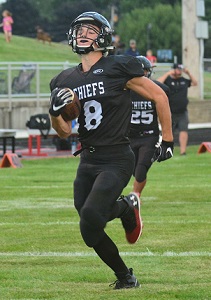 “He’s very persuasive, and so he got me back into it,” said Kemp, who finished with 398 rushing yards on 82 carries (4.9 per carry) and seven touchdowns as the Chiefs’ second back behind senior Carlos Castro in 2018. “I decided it would be a good place to be, and I think that’s where God wanted me.”
The benefits were twofold, Strawser said. It was obvious what Kemp brought to the team in terms of production, but Strawser noticed the positive impact Kemp had on his teammates as well.
“He’s a great athlete and an even better kid,” Strawser explained. “He is truly an all-around football player. Last year he played defensive end and outside linebacker. We stuck him out to cover one-on-one. This year we moved him back to safety. He has great hands and can pretty much do anything we ask him to do. He’s such a versatile player. He picked it up pretty fast for being out a couple years. He popped right back in like he didn’t miss a beat.”
To open the 2019 season, Kemp rushed for three touchdowns and returned the opening kickoff for a score in a 54-0 White Pigeon victory over Bloomingdale. He caught a touchdown pass in Week 2 in the Chiefs’ 14-8 win at Decatur, which required a goal-line stand during the final minute.
“It has been very enjoyable,” Strawser said of the program’s turnaround. “That was the whole point. On the bubble wasn’t good enough. We really wanted these kids to buy in, believe what we were doing and reap the rewards of their hard work. We preached every day mental toughness.
“Each time we had a successful game the confidence just grew. It has been a real fun ride. They were eager to do well. It paid off. We haven’t earned anything or proved anything this year yet, so we just have to keep grinding away.”
Though the Chiefs lost a ton of talent to graduation, people familiar with the program believed they could fill those voids. With 19 players on the roster, including three sophomores, the Chiefs have been able to do that, including a great effort from an offensive line that consists of a mix of experience and youth.
Captain and three-year starter Kobie DeBruine, a tackle who can play guard, sets the tone for a group that includes capable tight ends Dominick Pant – who has packed on 20 pounds of muscle since last season – and Chris Bontrager, guards Beau Freedline and Luke Gropp, and sophomore center Lane Esarey.
“That was the biggest question mark going into this season is that we were pretty young on the offensive line,” said Strawser, whose son, Lincoln Strawser, is back as a senior to guide the offense at quarterback. “They really got to work and made a lot of improvement from the scrimmage to Week 1.”
Now the Chiefs are after their first playoff victory since 2009 and fourth since 1990.
“We’re just looking for big things this year,” Kemp said. “This year I know it’s my last year to do it, so I just want to make the most out of every opportunity I get. I kind of like how people underrate us because it gives us a chance to show what we’ve got.”
 Wes Morgan has reported for the Kalamazoo Gazette, ESPN and ESPNChicago.com, 247Sports and Blue & Gold Illustrated over the last 12 years and is the publisher of JoeInsider.com. He can be reached at [email protected] with story ideas for Berrien, Cass, St. Joseph and Branch counties.
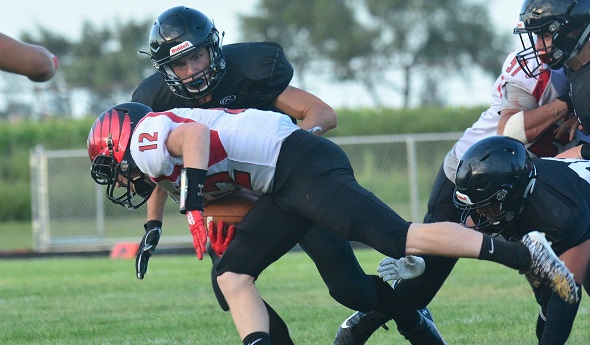
PHOTOS: (Top) White Pigeon defenders track down a ball carrier during their Week 1 win over Bloomingdale. (Middle) Stone Kemp breaks away on a long run. (Photos by John Gentry.)