


Best Practices
June 28, 2016
Two-thirds of concussions reported in Michigan high school football last fall occurred in games. Even though there are at least five times more hours of exposure during practices than games, there are half as many concussions during practice, according to the mandated concussion reporting requirement of the Michigan High School Athletic Association that is unmatched in the country in terms of its depth and breadth for a statewide requirement.
Michigan was among the handful of states to restrict contact in practice, in 2014, a full season prior to recommendations from the National Federation of State High School Associations and later action by most other statewide associations.
Some of those statewide organizations continue to operate without limitation on contact in football practices, while their counterpart organizations in other states have gone so far as to limit contact to a certain number of minutes in a day and/or week.
Entering mostly uncharted waters for high school football in early 2014, an MHSAA task force recommended that the number of practices be limited where collisions between players could occur – no more than one per day during preseason, no more than two per week after the first game.
This change was embraced by this state’s football coaches association and adopted by the MHSAA Representative Council. All parties liked the ease of administration of this policy, and all distrusted the idea of limiting the number of minutes of contact during practices.
If there is a 30-minute limit on contact in a day or a 90-minute limit on contact in a week, is it the same 30-minute or 90-minute period for all players, even if many are not involved in one or more of the contact drills? Or does the limit apply to each player individually; and if so, how is that tracked, and by whom?
These and other questions made coaches and administrators question how effective a limit on minutes might really be. Nevertheless, a 90-minute per week limit during regular season has been made an MHSAA recommendation for the 2016 season. This will provide an opportunity to address and possibly answer some of the questions that have been raised.
The MHSAA will survey schools this fall about their practice plans and the actual time spent in contact drills by players, assessing how that differs according to offense, defense, player position and grade in school, and determining best practices for how to track player contact minutes.
When Michigan acted in 2014 to limit contact in practice, it was one of the first states to do so. As Michigan takes additional steps to limit contact in practice, it will be one of the first states to do so after researching the best ways to actually do it.
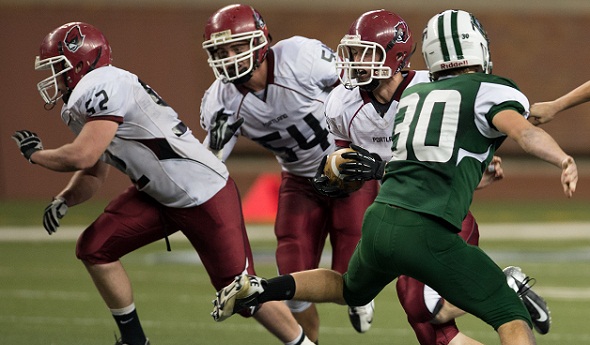
Portland Makes Right Moves for March
November 29, 2012
By Geoff Kimmerly
Second Half editor
Dylan Carroll and Adam Goodman knew the request was coming long before coach John Novara asked them to make a big change for their senior seasons on the Portland football team.
The writing was on the scale, so to say. At 6-foot-5 and 230 pounds, Carroll was among the three most sizable players on the Raiders’ roster this fall. And Goodman, at a solid 6-0, 200, wasn't far behind.
Still, it’s fair to assume not a lot of players want to trade in the opportunity to carry the ball for a jersey in the 50s. But Novara had no choice but to ask; he needed two new guards, and the best fits were tight end Carroll and the fullback, Goodman.
“At first, it was block, block, block. But after that, you get to pancake guys when you pull. Especially in this offense, guard is one of the best positions that we run,” Goodman said. “At first, it wasn't so exciting. But after that, it’s the best position. I would've played it all four years if I’d had the chance.”
Their one season on the line helped the Raiders produce unprecedented results.
Portland gets a Second Half High 5 this week after finishing a 13-1 season with its first trip to the MHSAA Finals – and first championship, thanks to a 12-9 win over Grand Rapids West Catholic.
The Raiders won in the same way they've made the playoffs every season over the last decade – with a mix of physical play up front, tough running and stout defense. That style often has been made possible by big bodies up front – a standout or two like alum and recently-graduated Eastern Michigan University 300-pounder Bridger Buche have been more the usual than occasional for Portland of late.
Not this season. For the Raiders to win again like they always have, it took the sacrifices of a couple smaller but just as tough seniors to be the catalysts.
“I think that was one of the keys to our success, offensively,” Novara said. “They graciously moved there. Without them moving to guards, I don’t know that we could've done this.”
Portland scored 500 points this season, likely its most ever (Michigan-football.com records date back to 1950). No other Raiders team had scored even 400.
Carroll and Goodman also were two of only three Portland players who pulled double duty, with Carroll also a starting defensive end and Goodman a starting linebacker. They helped key a defense that gave up just 13 points per game.
That defense gave up more than 14 points only once during the regular season – in a 41-32 loss to 2011 Division 5 runner-up Lansing Catholic. It gave up more than 20 twice in the playoffs, but hung on when it counted in a 45-28 win over reigning champion Flint Powers Catholic in the Regional Final and then the next week in a 28-23 nail-biter against Ann Arbor Gabriel Richard.
Portland scored all of its points of the MHSAA Final during the game's first 15 minutes. But the defense came up with three interceptions and two turnovers on downs, plus blocked a field goal attempt. The Raiders ended West Catholic’s final drive with a fourth-down stop on their 12-yard-line.
“The defense had been there all season, and we were just happy to make that one last play to win a state championship,” Goodman said.
And if he and Carroll’s moves to the offensive line hadn't been worth it completely before, they certainly became so that afternoon. As Carroll said after, he and most of his teammates are three-sport athletes who grew up together in their small town midway between Lansing and Grand Rapids. A position change hardly qualified as a sacrifice for an opportunity like this.
“I wasn't going to go out without a state championship this year. Our seniors deserved it,” Carroll said.
“We kept our mouths shut. We did whatever was best for the team, and we still worked as hard as we could this summer. It was well worth it.”
PHOTO: Portland linemen Adam Goodman (52) and Dylan Carroll (54) lead the way for teammate Auston Brandt during Saturday's Division 5 Final at Ford Field. (Click for more from Terry McNamara Photography.)