


Best Practices
June 28, 2016
Two-thirds of concussions reported in Michigan high school football last fall occurred in games. Even though there are at least five times more hours of exposure during practices than games, there are half as many concussions during practice, according to the mandated concussion reporting requirement of the Michigan High School Athletic Association that is unmatched in the country in terms of its depth and breadth for a statewide requirement.
Michigan was among the handful of states to restrict contact in practice, in 2014, a full season prior to recommendations from the National Federation of State High School Associations and later action by most other statewide associations.
Some of those statewide organizations continue to operate without limitation on contact in football practices, while their counterpart organizations in other states have gone so far as to limit contact to a certain number of minutes in a day and/or week.
Entering mostly uncharted waters for high school football in early 2014, an MHSAA task force recommended that the number of practices be limited where collisions between players could occur – no more than one per day during preseason, no more than two per week after the first game.
This change was embraced by this state’s football coaches association and adopted by the MHSAA Representative Council. All parties liked the ease of administration of this policy, and all distrusted the idea of limiting the number of minutes of contact during practices.
If there is a 30-minute limit on contact in a day or a 90-minute limit on contact in a week, is it the same 30-minute or 90-minute period for all players, even if many are not involved in one or more of the contact drills? Or does the limit apply to each player individually; and if so, how is that tracked, and by whom?
These and other questions made coaches and administrators question how effective a limit on minutes might really be. Nevertheless, a 90-minute per week limit during regular season has been made an MHSAA recommendation for the 2016 season. This will provide an opportunity to address and possibly answer some of the questions that have been raised.
The MHSAA will survey schools this fall about their practice plans and the actual time spent in contact drills by players, assessing how that differs according to offense, defense, player position and grade in school, and determining best practices for how to track player contact minutes.
When Michigan acted in 2014 to limit contact in practice, it was one of the first states to do so. As Michigan takes additional steps to limit contact in practice, it will be one of the first states to do so after researching the best ways to actually do it.
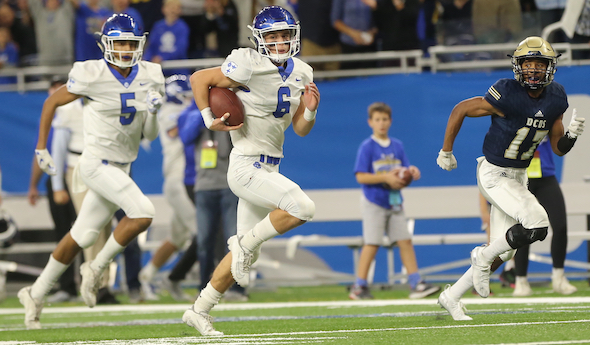
Sophomore QB Leads GRCC Title Surge
By
Paul Costanzo
Special for MHSAA.com
November 29, 2019
DETROIT – Joey Silveri and his Grand Rapids Catholic Central teammates wanted to prove Friday they had the talent to match up with Detroit Country Day.
It turns out, the Cougars had the talent to overwhelm the top-ranked football team in Division 4 as they cruised to a 44-0 victory in the Division 4 Final at Ford Field.
“Every week we get people telling us, ‘You guys are a good team, but we don’t really know how,’” the Catholic Central sophomore quarterback said. “’You guys don’t really have that good of players.’ To come out here against a great team like Country Day and prove everybody wrong is amazing.”
The win gave Catholic Central its fifth title and third in four years. In 2016 the Cougars also defeated Country Day. That one ended 10-7 – but this time, the result wasn’t in doubt by early in the second half.
“I can’t say that I saw 44-0 coming,” said Catholic Central coach Todd Kolster, who now has four titles to his credit. “I felt really good about our team. I felt really good about what we were doing. I felt really good about the character of the guys on our team. So, I felt like we could go out and get this.”
Silveri was the driving force, as he ran or threw for six total touchdowns, raising his season combined total to 54. He was 15-of-22 passing for 236 yards and rushed 18 times for 143 yards. The Cougars didn’t run a play that didn’t feature a Silveri run or throw until three plays into the third quarter. He either ran or threw on 39 of the Cougars’ first 40 plays.
“He’s a special kid – he's a special young man,” Kolster said. “I’m just really happy for him. I’m happy for our seniors. Joey has come in, and he’s adapted so well to our upperclassmen. They have so much respect for him because he’s such a hard worker. He’s a great character guy. He showed tonight why he is such a good player.”
Silveri was involved in three touchdowns in the first quarter, throwing a pair to Jace Williams (15 and 14 yards) and running for a 53-yard score. The 18 points were six more than Country Day had allowed in a game all season, as the Yellowjackets had cruised into the Finals at 13-0 and allowing 5.2 points per game.
“We saw a lot of one-on-one matchups and a lot of pressure coming,” Silveri said. “So, we knew if we got the ball out quick and gave our receivers a chance one-on-one, they would make plays.”
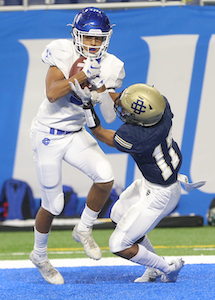 Williams certainly proved that point, as he tied a Finals record with three touchdown catches. He finished the night with four catches for 62 yards, adding a 23-yard touchdown reception to his two in the first quarter.
Each of his first two scores came on fade routes in which he won a fight for the ball with the defensive back.
“I feel like it set a tone for our offense and defense,” Williams said. “And our special teams were doing a good job today, too.”
Silveri also had a 23-yard touchdown pass to Drew Gommesen to give his team a 24-0 halftime lead, and his second touchdown run came from one yard out midway through the third quarter.
Not long after that run, the Cougars’ defense got in on the scoring, as Jake Passinault intercepted an attempted double pass and returned it 18 yards for a touchdown. That put the game in running clock, as the lead extended to 38-0.
The runback capped off an impressive day for the Catholic Central defense, which held the Yellowjackets to 18 yards rushing and 60 yards of total offense on 37 plays (1.6 per play). Country Day entered the game averaging 34.7 points per game and more than six yards per play.
“I just think you always have to be able to move the ball effectively, which we have been throughout the year,” Country Day coach Dan MacLean said. “We just didn’t. We just didn’t tonight. Credit to them, and it’s a disappointing finish for us. We’ll go back to the drawing board.”
Nolan Zeigler led the Catholic Central defense with 10 total tackles, while Brady Redmer had seven, including three for loss. Dan Southerington added an interception that set up the second Catholic Central score.
Country Day’s defense was led by Danny MacLean who had eight tackles, including one for loss. The Yellowjackets did have one bright spot on special teams, as they blocked all five of the Cougars’ extra point attempts.
“I’m proud of my guys as always,” MacLean said. “But it’s obvious we have work to do. We have work to do to get better. I think we will. We have a good group of kids. It was a good year. Disappointing finish, obviously. They had some good matchups tonight and they exploited them, so credit to them. But we’ll come back. We’ll come back. Country Day will come back.”
PHOTOS: (Top) Grand Rapids Catholic Central’s Joey Silveri breaks away against Detroit Country Day on Saturday. (Middle) Jace Williams pulls in one of his three touchdown catches during the Division 4 Final while Country Day’s Luke Ammori attempts to dislodge the ball.