


Best Practices
June 28, 2016
Two-thirds of concussions reported in Michigan high school football last fall occurred in games. Even though there are at least five times more hours of exposure during practices than games, there are half as many concussions during practice, according to the mandated concussion reporting requirement of the Michigan High School Athletic Association that is unmatched in the country in terms of its depth and breadth for a statewide requirement.
Michigan was among the handful of states to restrict contact in practice, in 2014, a full season prior to recommendations from the National Federation of State High School Associations and later action by most other statewide associations.
Some of those statewide organizations continue to operate without limitation on contact in football practices, while their counterpart organizations in other states have gone so far as to limit contact to a certain number of minutes in a day and/or week.
Entering mostly uncharted waters for high school football in early 2014, an MHSAA task force recommended that the number of practices be limited where collisions between players could occur – no more than one per day during preseason, no more than two per week after the first game.
This change was embraced by this state’s football coaches association and adopted by the MHSAA Representative Council. All parties liked the ease of administration of this policy, and all distrusted the idea of limiting the number of minutes of contact during practices.
If there is a 30-minute limit on contact in a day or a 90-minute limit on contact in a week, is it the same 30-minute or 90-minute period for all players, even if many are not involved in one or more of the contact drills? Or does the limit apply to each player individually; and if so, how is that tracked, and by whom?
These and other questions made coaches and administrators question how effective a limit on minutes might really be. Nevertheless, a 90-minute per week limit during regular season has been made an MHSAA recommendation for the 2016 season. This will provide an opportunity to address and possibly answer some of the questions that have been raised.
The MHSAA will survey schools this fall about their practice plans and the actual time spent in contact drills by players, assessing how that differs according to offense, defense, player position and grade in school, and determining best practices for how to track player contact minutes.
When Michigan acted in 2014 to limit contact in practice, it was one of the first states to do so. As Michigan takes additional steps to limit contact in practice, it will be one of the first states to do so after researching the best ways to actually do it.
Smith Takes on Next Challenge at Everett
August 6, 2018
By Geoff Kimmerly
Second Half editor
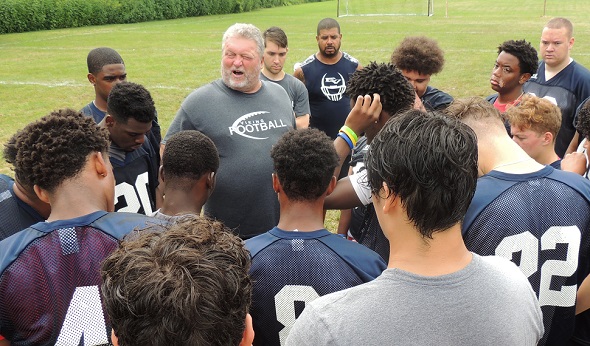
LANSING – On a frequently stormy Monday in the shadow of iconic Archie Ross Stadium, the sun broke in for the end of Lansing Everett’s first football practice – just in time for coach Mike Smith to remind his players they have an opportunity to accomplish great things this fall.
Senior Noah Smith knows it. He may have been a first-grader in 2007 when Mike Smith left one of the state’s top Division 1 programs at Holt, but he’s heard plenty about those Rams – who finished the coach’s tenure with 25 straight league wins over four seasons and a District title.
Noah Smith was following mid-Michigan football much more closely in 2013, when Mike Smith took over an Eaton Rapids program that had never made the playoffs and immediately led the Greyhounds to two postseason appearances in his first two seasons.
“I knew that at Eaton Rapids, he came in and changed the program – and when I heard that he was coming here, I was hoping he would do that here,” Noah Smith said.
And Noah’s reaction after Monday’s first session?
“He’s going to change the program,” Smith adamantly added.
It’s not that easy, and even over-the-top to say Mike Smith has made it look that way. But it’s also impossible to argue with his work over the last 30 years.
The Detroit Denby and Michigan State University graduate took over a Dansville team in 1989 coming off a 1-8 finish and led the Aggies to a combined 32-6 run over four seasons including two they finished at 9-1.
After a one-year stop at Eaton Rapids in 1993 (the Greyhounds went 5-4, their last winning season before 20 straight below .500), Smith moved on to Holt in 1994, taking a Rams varsity that hadn’t won more than six games since 1981 to the Class A championship game in 1995. Holt was 98-54 over his 15 seasons with the Rams.
Smith left to assist at Olivet College, then assisted at Grand Ledge for a season before returning to Eaton Rapids in 2013 and leading the Greyhounds to 7-5 and then 8-4 records over his first two seasons – and a 25-26 run overall while navigating a league that has sent three of its six teams to Ford Field over the last eight seasons.
Add it up, and the first four high school varsities (including Eaton Rapids twice) that Smith has taken over were a combined 8-28 the year before – and a combined 24-15 his first seasons. All told, Smith enters this fall at Everett 160-90 for his career and raring for this next challenge and the greater opportunities to educate that come with it.
“I love to teach. I love this part about, it’s not just the football,” Smith said. “It’s about doing something for someone else, the greater good, the whole thing like that. I just really, really enjoy coaching. But it’s not just that – it’s the teaching as well.”
Everett welcomes Smith coming off a 1-8 finish a year ago after former coach Marcelle Carruthers – who turned the program into a local power over 17 seasons – stepped down in the spring to become principal at Lansing Eastern.
 Smith had 25 players on the field Monday, with three more for sure on the way, and he expects to end up with a roster in the low 30s – and with junior varsity and freshman teams as well, the freshman team possibly the largest of the three.
Smith also took over as the school’s athletic director in January. He knew his athletes coming into the first practice, but not as football players – and he admitted to being a little nervous Sunday night as he readied for another start.
Noah Smith said his classmates were a little anxious as well when Mike Smith was hired. But that’s eased as they’ve become familiar with their jolly new leader who long has been known for matching intensity with playfulness and genuine care for his athletes.
Noah Smith is entering his fourth season on varsity and earned all-league honors as a receiver last season in the Capital Area Activities Conference Blue. Mike Smith’s “calmer” approach caught his attention Monday, even as the new coach did make vocal points on occasion.
“It brings us together even more. You realize that he’s there. He’s actually coaching us. He’s a real coach for us,” Noah Smith said.
Mike Smith said he’s watching this week to see who shows up every day and works hard every day – another part of the culture he’s bringing from his previous stops.
Noah Smith knows it will be sinking in “when people start listening all the time instead of most of the time. We listen, I can honestly say we listen, but we need to listen all the time instead of most of the time because most of the time’s not going to cut it.”
This first practice was over by noon, and Mike Smith already was enjoying what he saw about 100 yards in front of him – players on both sides of assistant Jacob Wyatt, chatting up the former Sexton and Eastern Michigan standout on their way to the locker room.
“If you do the right thing every day, the game’s going to take care of itself,” he said. “You need to know what kind of offense and defense to run and put your kids in the best spots to be successful. (But) the other thing I’ve always stressed to my teams, this team can’t be my team. It’s gotta be your team. When you can get the kids all playing for each other, you’ve got yourself there.”
PHOTOS: (Top) First-year Lansing Everett football coach Mike Smith talks with his team at the end of their first practice of this season Monday. (Middle) A row of Vikings line up during a kickoff drill. (Photos by Geoff Kimmerly.)