


Best Practices
April 10, 2012
For decades, football has had the greatest participation among high school sports. In recent years it’s become the greatest spectator sport as well. Today, MHSAA Football Playoff revenue exceeds that of Boys and Girls Basketball Tournaments combined. And if I ever want to generate comments to a blog, all I have to do is mention football.
I can write either the most inspired or inane words about most topics, and not generate a comment. But mention “football,” and opinions come fast and usually furious.
So it was with my eyes wide open that I challenged some “sacred cows” in my posting of March 20, questioned some of the standard operating procedures of high school football practice, and predicted that we will soon be making some changes in the sport I played through four years of college and coached in high school and to which I owe more of my character development than any other sport. I knew some readers would call me out of date and out of touch, knowing nothing of my past or my passion.
I knew some readers would challenge any comparison made with college and professional players, asserting that older players need fewer practices with less contact because they already have the skills and techniques of blocking and tackling. However, they miss the fact that it is the younger and still growing body that needs more care and caution, not less. Less hitting, not more. More heat and humidity acclimatization, not less.
I knew some readers would complain about diminishing time to develop young players, overlooking the proliferation of camps, clinics, combines, 7-on-7 leagues and the like which have improved skills and conditioning for many athletes prior to the official start of practice. If that were not true or if we would dial down the out-of-season demands, then I might not join the amassing advocates for reduced in-season practice demands. But sadly, it is true; coaches already have these kids year-round.
On the same day that I posted predictions of changes for football practice policies in Michigan, including more days before pads and fewer days with double sessions, the Georgia High School Association adopted policies that did just that, requiring five days of practice before the first with full pads and prohibiting two-a-day practices on consecutive days.
Such changes reflect the growing body of evidence regarding “best practices” for high school football, including the recommendations of the American Academy of Pediatrics, the Centers for Disease Control and Prevention, and the National Federation of State High School Associations. This train has left the station; and Michigan should be an early stop, an early adopter of practice policies modifications. We put our players, coaches and selves in peril if we ignore the evidence.
I’m embarrassed to say that for too long I avoided this topic because I knew it would bring ridicule. Then recently, a young but experienced head football coach told me that these are the kinds of changes that football needs. Needs to keep the game attractive to kids; and needs to keep the game safe for kids.
Moore Finishes Legendary King Career by Leading Crusaders to D3 Repeat
By
Scott DeCamp
Special for MHSAA.com
November 27, 2022
DETROIT – Dante Moore had no tears left to cry Saturday night, even happy tears, after he played his final high school football game for Detroit Martin Luther King at Ford Field.
“Everybody sees I’m not crying – I really cried before I got here to the game. Before I walked to the gate, I was crying and I cried last night,” Moore said.
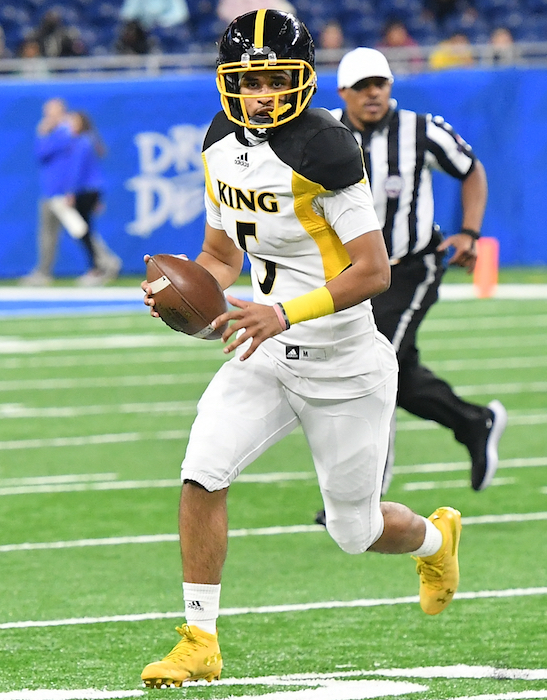
King’s four-year starting quarterback cemented his legacy, leading the Crusaders to their second-straight MHSAA Division 3 championship with a 56-27 victory over Muskegon.
The Oregon commit finished 21-of-26 passing for 275 yards with four touchdowns and no interceptions to power King (10-3) to its sixth Finals title overall and fifth in eight years.
Before Moore even took the field for his first offensive series against Muskegon (11-3), junior Jameel Croft Jr. staked King to an immediate lead with an electrifying 96-yard return of the game’s opening kickoff.
The Crusaders never looked back.
“I wasn’t expecting that. I just followed my blocks. Guys were blocking for me and the coaches set it up perfectly for me, for real,” Croft said. “It gave us a lot of momentum in the beginning of the game. It helped us out a lot.”
 Muskegon pulled within 14-7 midway through the first quarter and 21-14 three minutes into the second, but Moore & Co. always seemed to have an answer.
Croft scored the game’s first two TDs, as he added a 13-yard scoring catch from Moore to make it 14-0 with 6:28 left in the first quarter.
“We started out chasing. We gave up that opening kickoff for a touchdown and we just got ourselves chasing and kind of things went from there,” said Muskegon coach Shane Fairfield, whose team trailed 35-14 at halftime and pulled within 14 with five minutes left in the third but got no closer.
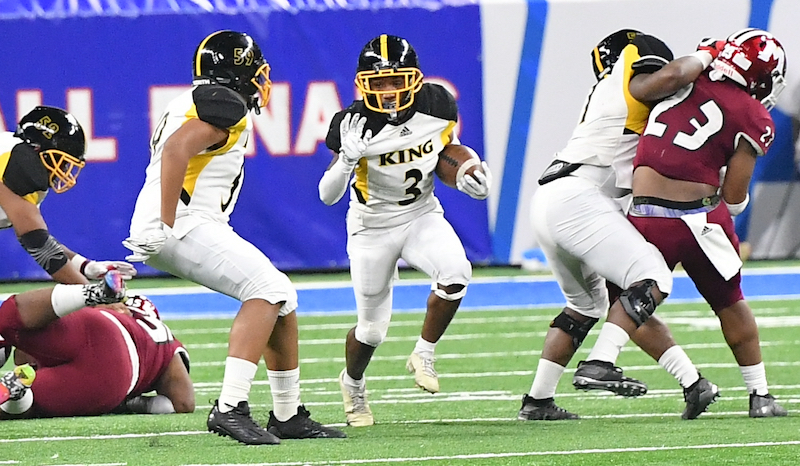
Croft was Moore’s top pass-catcher, finishing with six receptions for 64 yards and two TDs. Senior Sterling Anderson Jr. was a blur as King’s top rusher, totaling 207 yards on only 13 carries, highlighted by his 80-yard scoring sprint that gave the Crusaders a 49-27 lead with 10:55 remaining.
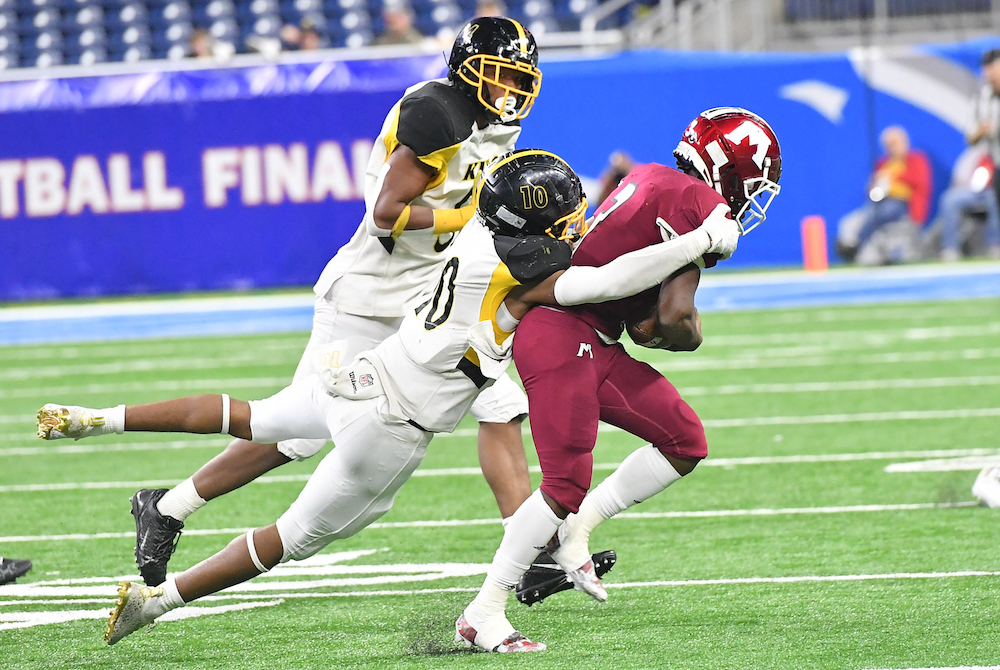
Seniors Samuel Washington and Tim Ruffin paced King defensively with nine and eight tackles, respectively. For Muskegon, senior Julian Neely registered a team-high seven stops, while junior Stanley Cunningham recorded two sacks among his six tackles.
Muskegon junior quarterback M’Khi Guy ran 20 times for 135 yards with two TDs, including a 60-yard breakaway to pull the Big Reds within 14-7 midway through the first quarter. He also completed 2-of-4 passes for 97 yards, including a 71-yard scoring strike to junior Destin Piggee.
Muskegon junior Jakob Price added 93 rushing yards and a TD on 17 carries, but the night belonged to King and Moore.
“There’s no excuse: That kid is amazing. He threw balls that we haven’t seen probably in my career,” said Fairfield, whose program was seeking its first Finals title since 2017. His Big Reds teams have been to the Finals to finish eight of his 13 seasons at the helm.
“Only one other guy threw touchdown passes like (Moore) and passes and balls like that in my career here, and that was (Bloomfield Hills Brother Rice’s) Alex Malzone – went to Michigan. Seems like we always see the (Dequan) Finns and the Dantes and Malzones and stuff when we get here, but you know, we’re here,” added Fairfield, whose 2018 squad lost to Finn and King, 41-25, in the Division 3 championship game.
King coach Tyrone Spencer said that his team overcame a lot of adversity this season. The Crusaders could not practice on their field because it’s undergoing a makeover, so they bussed to practice. They lost their season opener to Warren Central (Ind.), 44-26, and dropped the final two games of the regular season to Detroit Cass Tech (28-14) and Cincinnati Moeller (30-14).
 The Crusaders got it going in the playoffs, however. They threatened the Finals record for points by one team, established Friday night by Grand Rapids West Catholic with 59.
“(The season) was up and down, but the kids, I mean, they trust us and we got it back going,” Spencer said. “They’re a resilient group of kids. It speaks to their character.”
Moore mentioned the “championship culture” at King, how one expects to be a champion once he puts on that jersey.
It’s also about giving back and respecting the game, too, which has been a custom of Moore’s since his freshman year when King lost to Muskegon Mona Shores in the Division 2 Final, 35-26.
“My freshman year, me playing against Brady Rose and Muskegon Mona Shores, I remember Brady Rose pulled me to the side and that’s where I really got it from – him taking me to the side, telling me things I can work on, and me congratulating him for what he’s done and being one of the best players to come through Michigan to be honest and leading his team on his back,” Moore recalled.
“I just knew that I had to carry that on through this past year and really pull the (opposing) quarterbacks to the side, especially (those) younger than me. Me being a senior, I’ve been through a lot. I just want to give them the keys and terms to help them be the best they can be in high school.”
Croft called the 6-foot-2, 210-pound Moore a “great leader,” who is “so poised” and one who will leave “a great legacy right here for sure.”
“Special, man,” is how Spencer reflected on Moore’s four-year run.
“You know, he’ll be the one that they’ll talk about maybe the greatest we’ve ever had here,” Spencer said. “Just really proud of him and the person that he is. He deserves it. He works hard for it, and I just couldn’t be more pleased. It couldn’t happen to a better person.”
Meanwhile, Muskegon got off to a bit of a slow start this season by Big Reds standards. They lost two of their first five games, including a 49-16 road defeat to eventual Division 2 champion Warren De La Salle Collegiate, but got healthy and played their best football at the right time leading up to Saturday night.
Fairfield said the Big Reds battled and left it all on the field.
“They played 14 and when you play 14 games, of course this is going to hurt more because it’s the very last one and now you’ve got 364 days to get back,” he said.
PHOTOS (Top) Detroit King’s Samuel Washington (10) wraps up Muskegon’s M’Khi Guy during Saturday’s night’s Division 3 Final. (Middle) Crusaders quarterback Dante Moore rolls out looking for a receiver. (Below) King’s Sterling Anderson Jr. (3) follows his blockers through a sizable opening. (Click for more from Hockey Weekly Action Photos.)