


Best Practices
April 10, 2012
For decades, football has had the greatest participation among high school sports. In recent years it’s become the greatest spectator sport as well. Today, MHSAA Football Playoff revenue exceeds that of Boys and Girls Basketball Tournaments combined. And if I ever want to generate comments to a blog, all I have to do is mention football.
I can write either the most inspired or inane words about most topics, and not generate a comment. But mention “football,” and opinions come fast and usually furious.
So it was with my eyes wide open that I challenged some “sacred cows” in my posting of March 20, questioned some of the standard operating procedures of high school football practice, and predicted that we will soon be making some changes in the sport I played through four years of college and coached in high school and to which I owe more of my character development than any other sport. I knew some readers would call me out of date and out of touch, knowing nothing of my past or my passion.
I knew some readers would challenge any comparison made with college and professional players, asserting that older players need fewer practices with less contact because they already have the skills and techniques of blocking and tackling. However, they miss the fact that it is the younger and still growing body that needs more care and caution, not less. Less hitting, not more. More heat and humidity acclimatization, not less.
I knew some readers would complain about diminishing time to develop young players, overlooking the proliferation of camps, clinics, combines, 7-on-7 leagues and the like which have improved skills and conditioning for many athletes prior to the official start of practice. If that were not true or if we would dial down the out-of-season demands, then I might not join the amassing advocates for reduced in-season practice demands. But sadly, it is true; coaches already have these kids year-round.
On the same day that I posted predictions of changes for football practice policies in Michigan, including more days before pads and fewer days with double sessions, the Georgia High School Association adopted policies that did just that, requiring five days of practice before the first with full pads and prohibiting two-a-day practices on consecutive days.
Such changes reflect the growing body of evidence regarding “best practices” for high school football, including the recommendations of the American Academy of Pediatrics, the Centers for Disease Control and Prevention, and the National Federation of State High School Associations. This train has left the station; and Michigan should be an early stop, an early adopter of practice policies modifications. We put our players, coaches and selves in peril if we ignore the evidence.
I’m embarrassed to say that for too long I avoided this topic because I knew it would bring ridicule. Then recently, a young but experienced head football coach told me that these are the kinds of changes that football needs. Needs to keep the game attractive to kids; and needs to keep the game safe for kids.
Receiver-Turned-QB Finishes Job Helping GRCC Run Title Streak to 3
By
Scott DeCamp
Special for MHSAA.com
November 27, 2021
DETROIT – To the casual observer, Grand Rapids Catholic Central’s fifth MHSAA football title in six years may seem a little ho-hum.
Don’t tell that to John Passinault. This one was special – way different than what he may have envisioned at the start of the season.
The senior quarterback connected with Notre Dame commit Nolan Ziegler on a pair of second-half touchdown passes, and the GRCC defense did the rest in a 31-7 victory over Marine City in the Division 5 Final on Saturday at Ford Field.
Joey Silveri, GRCC’s three-year starting QB, suffered a season-ending knee injury in Week 4. That’s when Passinault, a 6-foot, 180-pound converted receiver, switched to the signal-caller position. Passinault picked up where Silveri left off and helped lead the Cougars to a second-straight Division 5 title, their sixth championship in the last dozen years and seventh overall.
“Well, it’s surreal. Before the season, if you would have told me this was going to happen, I would have told you you’re crazy,” said Passinault, who finished the game 15-of-28 passing for 221 yards with one interception.
“A bad thing happened to a really good kid, Joey Silveri, and that’s just the mindset of the team to step in where it’s needed. I went from wide receiver to quarterback and it’s pretty easy to do that when I have guys around me like Nolan, Ronin Russell-Dixon, Devin Fridley-Bell, Luke Kuzner, Jack Rellinger. I have all those guys around me, it’s easy to step into that role and just settle in.”
GRCC (14-0) completed its third perfect season in the last five years, but Marine City (13-1) made the Cougars work for it for the better part of three quarters Saturday.
GRCC led 10-0 in the second quarter after a 29-yard field goal by junior John Meyer and a 2-yard TD run by Rellinger, a senior. Marine City hung in there, however, and pulled within 10-7 on junior QB Jeff Heaslip’s 3-yard scoring pass to senior Charles Tigert with a little more than three minutes left in the half.
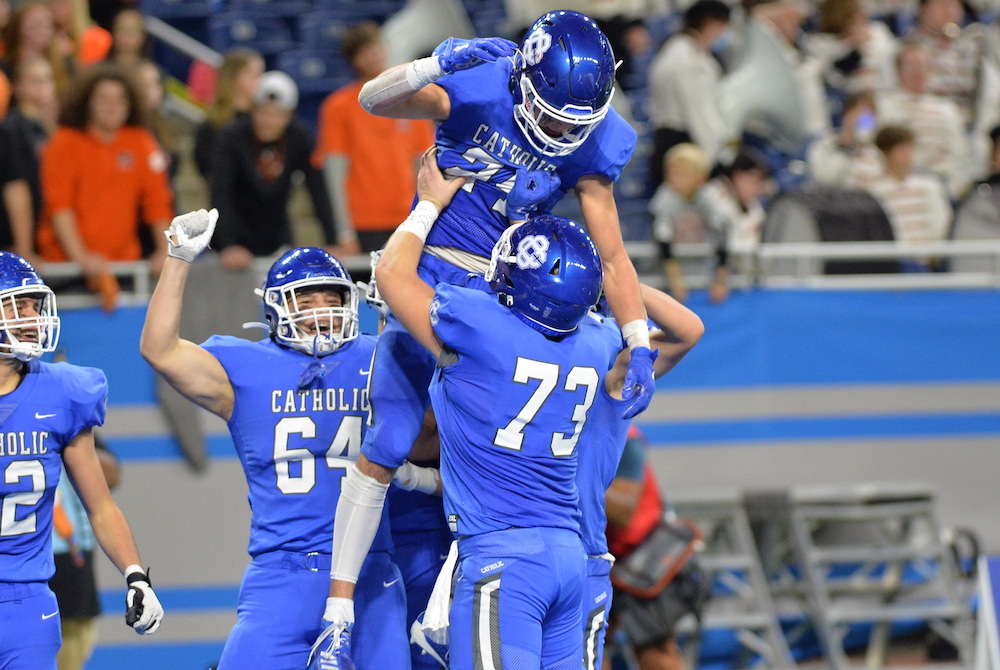
The score remained that way until the closing seconds of the third quarter. Ziegler, a 6-4, 210-pound receiver and linebacker, caught a pass over the middle from Passinault, turned the corner and raced down the sideline for a 59-yard scoring play.
That seemed to ignite the Cougars’ offense a bit.
 “My team, they blocked well, it was a great pass by John,” Ziegler said. “We were just kind of playing backyard football out there honestly, and we just got things going. I got a good block from the receivers, and I just got down and got it in.”
The Passinault-to-Ziegler connection struck again four minutes later, this time on a 17-yard TD play, as the Cougars began to pull away. Ziegler finished with seven receptions for 136 yards, plus he notched a game-high 13 tackles in displaying his Power Five college football credentials.
Senior linebacker Jack Klafeta put the exclamation point on the victory for GRCC with a 34-yard scoop-and-score midway through the fourth quarter. Klafeta notched nine tackles, as did junior Jack Cook.
“Just their athleticism all over the field, their physicality up front, made things very difficult,” said Marine City coach Daryn Letson, whose team allowed no more than 14 points in a single game this season prior to Saturday.
“You know, our defense played their hearts out. I think our whole team played their hearts out,” Letson said. “You know, they have those kids and we just weren’t able to do enough offensively when we needed to.”
GRCC finished with a narrow edge in total offense, 228-215. The Mariners outrushed the Cougars, 77-7.
Heaslip was 14-of-22 passing for 138 yards. Senior Wyatt Walker led Marine City defensively with nine tackles.
This was the sixth state title in 10 seasons overall for GRCC coach Todd Kolster, who is now 112-12 at the Cougars’ helm. They also won titles under him in 2010, 2016, 2017, 2019 and 2020. GRCC’s first came in 1987.
Kolster said the Cougars made great strides from the start of this season.
“It’s a pretty surreal thing for these guys up here – just unbelievably proud of them for so much that they’ve accomplished this year,” he said. “This team probably has come as far as any football team in a season that I’ve coached.
“Just coming together, learning what it takes, getting experience, understanding each other, fighting, competing. That’s a process and we were far, far away with them at the beginning of the season. To come here and be able to get this done, the credit goes 100 percent to our seniors.”
It was an emotional farewell for Passinault. He carried on the strong QB play provided by Silveri, who is a college prospect and led the Cougars to Finals titles in 2019 and 2020.
As a passer, Passinault proved more than capable in his own right. He threw for 2,307 yards and 37 TDs this season.
“This is it. That will probably be the last time I ever play football, so it’s just crazy to think that that’s the last time I’ll play specifically with these people,” Passinault said. “ … It’s just crazy. As a kid, you just dream about this. And to have it happen, it’s just a surreal feeling – and having dreams come true, it’s crazy.”
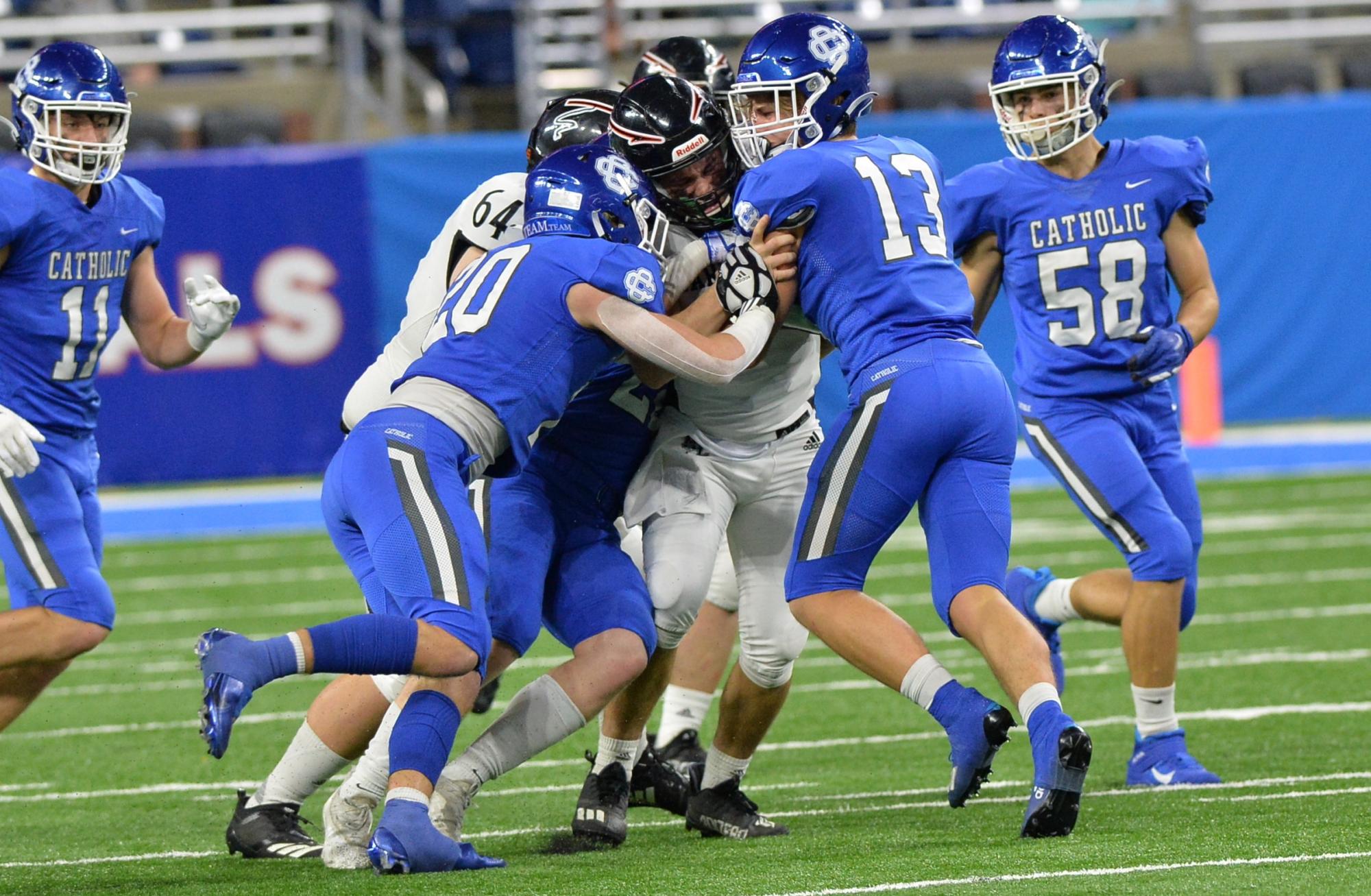
PHOTOS (Top) Grand Rapids Catholic Central’s Will Smith (73) hoists teammate Nolan Ziegler as they celebrate during Friday’s Division 5 championship win. (Middle) A host of GRCC and Marine City players stack up to a standstill. (Photos by Hockey Weekly Action Photos.)