


Best Practices
April 10, 2012
For decades, football has had the greatest participation among high school sports. In recent years it’s become the greatest spectator sport as well. Today, MHSAA Football Playoff revenue exceeds that of Boys and Girls Basketball Tournaments combined. And if I ever want to generate comments to a blog, all I have to do is mention football.
I can write either the most inspired or inane words about most topics, and not generate a comment. But mention “football,” and opinions come fast and usually furious.
So it was with my eyes wide open that I challenged some “sacred cows” in my posting of March 20, questioned some of the standard operating procedures of high school football practice, and predicted that we will soon be making some changes in the sport I played through four years of college and coached in high school and to which I owe more of my character development than any other sport. I knew some readers would call me out of date and out of touch, knowing nothing of my past or my passion.
I knew some readers would challenge any comparison made with college and professional players, asserting that older players need fewer practices with less contact because they already have the skills and techniques of blocking and tackling. However, they miss the fact that it is the younger and still growing body that needs more care and caution, not less. Less hitting, not more. More heat and humidity acclimatization, not less.
I knew some readers would complain about diminishing time to develop young players, overlooking the proliferation of camps, clinics, combines, 7-on-7 leagues and the like which have improved skills and conditioning for many athletes prior to the official start of practice. If that were not true or if we would dial down the out-of-season demands, then I might not join the amassing advocates for reduced in-season practice demands. But sadly, it is true; coaches already have these kids year-round.
On the same day that I posted predictions of changes for football practice policies in Michigan, including more days before pads and fewer days with double sessions, the Georgia High School Association adopted policies that did just that, requiring five days of practice before the first with full pads and prohibiting two-a-day practices on consecutive days.
Such changes reflect the growing body of evidence regarding “best practices” for high school football, including the recommendations of the American Academy of Pediatrics, the Centers for Disease Control and Prevention, and the National Federation of State High School Associations. This train has left the station; and Michigan should be an early stop, an early adopter of practice policies modifications. We put our players, coaches and selves in peril if we ignore the evidence.
I’m embarrassed to say that for too long I avoided this topic because I knew it would bring ridicule. Then recently, a young but experienced head football coach told me that these are the kinds of changes that football needs. Needs to keep the game attractive to kids; and needs to keep the game safe for kids.
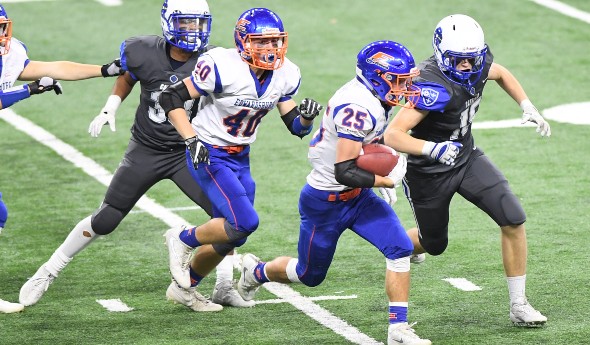
Moment: Goggins, Scott Go Distance
November 26, 2020
By John Johnson
MHSAA Director of Broadcast Properties
A few weeks back, we highlighted one of two of the “longest play” records in the MHSAA Football Finals where there’s a tie for the top spot – longest rushing play. Today, we feature the longest kickoff returns in the history of the games.
The longest kickoff return you can record in high school football is 99 yards, and that’s what Caden Goggins of Edwardsburg did in the 2017 Division 4 11-Player Football Final against Grand Rapids Catholic Central to tie a Finals game record with Tommy Scott of Muskegon Catholic Central, who accomplished the same against Munising in the 2014 Division 8 title game.
Goggins’ runback came in a game where he said “top that” to the other mammoth scoring plays – runs of 54, 55, 64, 79 and a Finals-record 90 yards.
Grand Rapids Catholic Central had just scored on its first possession of the second half to take a 28-13 lead. Goggins found daylight on the ensuing kickoff and was off to the races. “I saw the hole and just took off,” he told the South Bend Tribune after the game.
The pesky Eddies kept nipping at the heels of the Cougars all night long, getting within four points at 35-31 midway through the final period. But in the end, the Grand Rapids team prevailed, 42-31. Goggins would bring Edwardsburg back to Ford Field the next year, rushing for 125 yards and two touchdowns in a 28-7 win over Chelsea.
As for Scott, his 99-yard streak sent a second shock wave through the crowd after Munising had torched the Crusaders secondary for a 79-yard touchdown pass just 13 seconds earlier.
"It was huge to get the momentum right back after they took the momentum in the first three plays," Scott told the MHSAA Second Half after the game. "Making a big play like that can change a game."
Scott wasn’t finished. After being held to 14 yards rushing in the first half, he scored three second half touchdowns as MCC broke things open and won, 31-6. Scott finished the game with 92 yards on the ground.
Scott’s TD return broke the previous record of 97 yards by Brad Mesbergen of Zeeland West in the 2011 Division 4 Final.