


Best Practices
April 10, 2012
For decades, football has had the greatest participation among high school sports. In recent years it’s become the greatest spectator sport as well. Today, MHSAA Football Playoff revenue exceeds that of Boys and Girls Basketball Tournaments combined. And if I ever want to generate comments to a blog, all I have to do is mention football.
I can write either the most inspired or inane words about most topics, and not generate a comment. But mention “football,” and opinions come fast and usually furious.
So it was with my eyes wide open that I challenged some “sacred cows” in my posting of March 20, questioned some of the standard operating procedures of high school football practice, and predicted that we will soon be making some changes in the sport I played through four years of college and coached in high school and to which I owe more of my character development than any other sport. I knew some readers would call me out of date and out of touch, knowing nothing of my past or my passion.
I knew some readers would challenge any comparison made with college and professional players, asserting that older players need fewer practices with less contact because they already have the skills and techniques of blocking and tackling. However, they miss the fact that it is the younger and still growing body that needs more care and caution, not less. Less hitting, not more. More heat and humidity acclimatization, not less.
I knew some readers would complain about diminishing time to develop young players, overlooking the proliferation of camps, clinics, combines, 7-on-7 leagues and the like which have improved skills and conditioning for many athletes prior to the official start of practice. If that were not true or if we would dial down the out-of-season demands, then I might not join the amassing advocates for reduced in-season practice demands. But sadly, it is true; coaches already have these kids year-round.
On the same day that I posted predictions of changes for football practice policies in Michigan, including more days before pads and fewer days with double sessions, the Georgia High School Association adopted policies that did just that, requiring five days of practice before the first with full pads and prohibiting two-a-day practices on consecutive days.
Such changes reflect the growing body of evidence regarding “best practices” for high school football, including the recommendations of the American Academy of Pediatrics, the Centers for Disease Control and Prevention, and the National Federation of State High School Associations. This train has left the station; and Michigan should be an early stop, an early adopter of practice policies modifications. We put our players, coaches and selves in peril if we ignore the evidence.
I’m embarrassed to say that for too long I avoided this topic because I knew it would bring ridicule. Then recently, a young but experienced head football coach told me that these are the kinds of changes that football needs. Needs to keep the game attractive to kids; and needs to keep the game safe for kids.
1st & Goal: Week 6 in Review
October 6, 2020
By Geoff Kimmerly
Second Half editor
There’s no pretending this football season hasn’t been a little different, for obvious reasons.
But every week seems to reintroduce something familiar – and looking at the statewide scoreboard after Week 6, it was the “first time since the last time” list.
If that’s a theme, Jonesville, Ann Arbor Huron, Centreville and Brimley are among the stars with accomplishments this week they hadn’t enjoyed in a while. Details are below as we take a glance again at the scores that jumped off the page most from the weekend’s action.
Bay & Thumb
HEADLINER Grand Blanc 34, Lapeer 16 The Bobcats (2-1) had lost both regular-season and playoff games to Lapeer the last two seasons, last year by 34 and 28 points, respectively. But they handed the Lightning (2-1) only its second defeat during the regular season over the last three seasons. Click below for more from WJRT.
Grand Blanc hungry for some redemption after last season. The Bobcats got the win over Lapeer 34-16.@GB_Bobcat_FB @_GB_Athletics_ @LapeerAthletics https://t.co/0ngytOdOiG
— ABC12WJRT (@ABC12WJRT) October 3, 2020
Watch list North Branch 27, Croswell-Lexington 20 The Broncos (3-0) handed the Pioneers (2-1) their first loss, a week after avenging last year’s loss to Almont. Up next is Richmond, the only other team that defeated North Branch during the 2019 regular season.
Remember this one Hemlock 48, Midland Bullock Creek 32 The Huskies (3-0) still see Millington, and Millington still faces Bullock Creek (1-2), and it’s likely some combination of those results determines the Tri-Valley Conference West I champion.
More shoutouts Sanford Meridian 28, Harrison 8 The Mustangs (3-0) kept themselves in the hunt for the Jack Pine Conference championship, with Meridian, Harrison (2-1) and Beaverton all trailing league leader Clare by a win. Goodrich 42, Lake Fenton 27 The Martians (2-1) did the same in the Flint Metro League Stars, holding on just a game back of league leader Ortonville Brandon after delivering Lake Fenton (2-1) its first defeat.
Greater Detroit
HEADLINER Clarkston 24, West Bloomfield 21 (OT) The Wolves showed they’re absolutely back after coming all the way back from a 21-7 deficit to edge the rival Lakers (2-1) in overtime. Clarkston (3-0) sits alone atop the Oakland Activities Association Red standings with as many wins as it earned all of last season. Click for more from the Oakland Press and see highlights below from State Champs Sports Network.
VIDEO: Check out the highlights of the West Bloomfield at Clarkston (@ClarkstonWolves) football game from Friday night. @TheeJungle @JeffKosin
Brought to you by @LawrenceTechU. For more information on Lawrence Tech go to https://t.co/q9SHxffe6h pic.twitter.com/QoAaTX5vQs— STATE CHAMPS! Michigan (@statechampsmich) October 3, 2020
Watch list Canton 21, Brighton 20 Canton is off to its first 3-0 start since 2015 and leads the Kensington Lakes Activities Association West after edging the reigning Division 1 runner-up Bulldogs (1-2).
Remember this one Clinton Township Chippewa Valley 42, Sterling Heights Stevenson 27 In the loaded six-team Macomb Area Conference Red, reigning champion Chippewa Valley (2-1) stopped previously-surging Stevenson (2-1) to create a four-way tie atop the standings.
More shoutouts Detroit Catholic Central 14, Warren De La Salle Collegiate 10 The Shamrocks (3-0) clinched a share of the Detroit Catholic League Central title, avenging last season’s 14-3 loss to the Pilots (1-2). Auburn Hills Oakland Christian 21, Whitmore Lake 7 The Lancers (3-0) sit atop the Michigan Independent Athletic Conference after finishing second to Whitmore Lake (1-2) a year ago.
Mid-Michigan
HEADLINER Portland 21, Lansing Catholic 7 The Raiders (2-1) saw an overall six-game winning streak against Lansing Catholic end in last season’s District Final as the Cougars went on to win Division 5. But Portland ran its regular-season winning streak against Lansing Catholic (2-1) to six in a matchup that put the Raiders in solid position to win the Capital Area Activities Conference White title. Click for more from the Lansing State Journal and see highlights below from WLNS.
For a sixth straight year Portland (@RaidersPAA) wins the regular season showdown against CAAC White foe Lansing Catholic, topping the Cougars 21-7.
Full highlights from the @DeanTrailways ?? #5thQuarter ??https://t.co/PV0wwPehQh— Audrey Dahlgren (@AudreyDahlgren) October 3, 2020
Watch list New Lothrop 44, Montrose 15 The Hornets (3-0) appear the team to beat again in the Mid-Michigan Activities Conference after improving on last year’s win over reigning league runner-up Montrose (2-1) – although Durand also is unbeaten and will have a say.
Remember this one Fowlerville 17, Holt 14 Morgyn Muck’s 44-yard last-minute go-ahead field goals surely won’t be forgotten soon by the Gladiators (2-1).
More shoutouts East Lansing 17, Lansing Waverly 0 The Trojans have produced outstanding receivers before him, but Andrel Anthony Jr. is resetting all the school’s receiving records, including for career yardage in this win. Lake Odessa Lakewood 43, Stockbridge 26 The Vikings (2-1) set themselves up to face Olivet this week with a share of the Greater Lansing Activities Conference title on the line.
Northern Lower Peninsula
HEADLINER Kingsley 36, Traverse City St. Francis 23 The Stags (3-0) took a major step toward repeating as Northern Michigan Football Conference Legends champions, as St. Francis (1-2) annually finishes among the top two in the division. Owen Graves piled up 287 yards rushing and scored four times for Kingsley. Click for more from the Traverse City Record-Eagle.
VIDEO: Check out the highlights of the Kingsley at Traverse City St. Francis football game from Friday night.
Video Courtesy: WPBN-TV
Brought to you by @MHSAA pic.twitter.com/t8xnm42oEG— STATE CHAMPS! Michigan (@statechampsmich) October 3, 2020
Watch list Manistee 42, Harbor Springs 20 Manistee (3-0) tuned up well for this week’s Lakes 8 Athletic Conference decider against Muskegon Catholic Central, handing Harbor Springs (2-1) its first defeat.
Remember this one Traverse City Central 41, Cadillac 17 The first-place Trojans (3-0) now own wins over the two teams tied for second in the Big North Conference, Cadillac (2-1) and Traverse City West.
More shoutouts Evart 29, Houghton Lake 22 The Wildcats (1-2) celebrated their first win, knocking Houghton Lake (2-1) out of a tie for first in the Highland Conference. East Jordan 30, St. Ignace 6 The Red Devils (2-1) had lost all four previous meetings to the Saints since they joined the NMFC Legacy together.
Southeast & Border
HEADLINER Jonesville 44, Reading 18 There are plenty of impressive numbers coming off the weekend’s most surprising score. Jonesville (2-1) hadn’t beaten Reading since 2014, having lost the last two meetings with the Rangers by a combined 112-0. Reading (2-1) hadn’t lost a Big 8 Conference game since 2016, and only one other regular-season game over the last three seasons. This sets Jonesville up to compete with Week 9 opponent Homer for this year’s league title – although Reading faces Homer first in Week 8. Click for more from the Hillsdale Daily News.
Watch list Blissfield 28, Clinton 14 The Royals (3-0) are alone atop the Lenawee County Athletic Association with wins over two of three second-place teams and the third, Brooklyn Columbia Central, not on the shortened schedule.
Remember this one Ann Arbor Huron 18, Ann Arbor Pioneer 8 The Hurons (1-1) broke an 18-game losing streak to rival Pioneer (0-2) that went back to 2002.
More shoutouts Sand Creek 50, Ottawa Lake Whiteford 14 The Aggies’ first win over Whiteford since 2011 kept Sand Creek (3-0) tied for first in the Tri-County Conference. Chelsea 42, Schoolcraft 21 Scheduled after two other cancelations, this last-minute matchup pitted teams both often among the highly-ranked in their divisions.
Southwest Corridor
HEADLINER Centreville 36, Cassopolis 7 The Bulldogs (3-0) not only scored their first points on Cassopolis since 2015, they defeated the Rangers (2-1) for the first time in 10 recent meetings. Cassopolis also hadn’t lost a league game since 2017. Centreville will play co-leader Mendon this week for a share of the Southwest 10 Conference championship. Click for more from JoeInsider.com.
Watch list Buchanan 31, Berrien Springs 15 The Bucks (3-0) have equaled last year’s win total and with another victory will guarantee their best finish since 2016. Buchanan had lost the last three Berrien Springs matchups by a combined 127-0.
Remember this one Constantine 55, Watervliet 6 The Falcons (2-1) locked up a Watervliet offense that had scored a combined 107 points in two wins to start the fall.
More shoutouts Paw Paw 49, Sturgis 0 The Trojans (2-1) have put themselves back in the football conversation in the Wolverine Conference, but Paw Paw (3-0) made sure the title talk still centers on itself and Week 9 opponent Edwardsburg. Kalamazoo United 44, Parchment 6 The Titans (3-0) remain in position to challenge for a third-straight Southwestern Athletic Conference Lakeshore title.
Upper Peninsula
HEADLINER Gladstone 28, Sault Ste. Marie 26 The has been a whirlwind start for Gladstone, which didn’t play in the opening “Week 4” and then defeated Negaunee by two Week 5 on just a few days of prep. And now, this past weekend, the Braves (2-0) edged a Sault Ste. Marie team (2-1) that appeared to be the U.P.’s best after its first two victories. Click for more from the Escanaba Daily Press.
Watch list Marquette 10, Kingsford 0 The Redmen (2-1) ran their winning streak over Kingsford (2-1) to three and sit in good position to win the Great Northern Conference, with Menominee – which Marquette beat by 23 in Week 4 – up next.
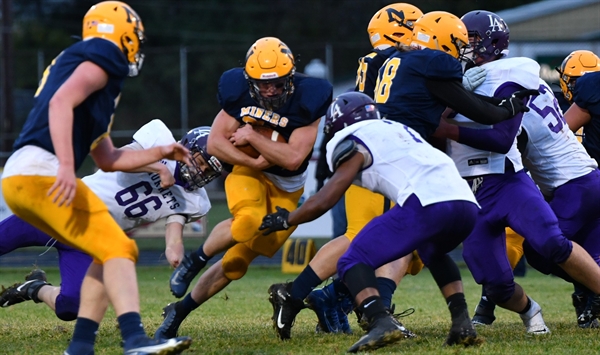
Remember this one Negaunee 29, L’Anse 6 The Miners (2-1) bounced right back after a two-point loss to Gladstone two weeks ago.
More shoutouts Manistique 12, Bessemer 0 The Emeralds (1-2) picked up their first win of the season with their first defensive shutout since 2012. Bark River-Harris 43, Norway 12 The Broncos (1-2) also earned their first victory, putting up a big number after scoring a combined six points over the first two weeks.
West Michigan
HEADLINER Grand Rapids Catholic Central 42, Cedar Springs 28 The rebuilt Ottawa-Kent Conference this fall placed GRCC – coming off five straight league titles, most recently in the Blue – in the Gold with two-time reigning White champion Cedar Springs (2-1). Undefeated Grand Rapids South Christian still must face both, but the league race appears down to those three and with the Cougars and Sailors tied for the lead. Click for more from the Grand Rapids Press.
VIDEO: Check out the highlights of the Cedar Springs at Grand Rapids Catholic Central (@GRCC_CougarsFB) football game from Friday night.
Video Courtesy: WXMI-TV
Brought to you by @MHSAA pic.twitter.com/mCjob7Onzn— STATE CHAMPS! Michigan (@statechampsmich) October 3, 2020
Watch list Byron Center 35, Grand Rapids Forest Hills Central 14 The Bulldogs (3-0), along with Lowell, have emerged as the frontrunners in the O-K White, with Forest Hills Central (2-1) and East Grand Rapids one game behind.
Remember this one Grand Rapids Union 59, Wyoming 57 Union’s 45-game losing streak, going back to 2015, came to an end in a game with so many points scored it will be included in the MHSAA record book at the end of the season.
More shoutouts Zeeland West 34, Zeeland East 14 With a third-straight win over the Chix (2-1), the Dux (3-0) moved into first place in the O-K Green with Muskegon Mona Shores. Grandville 21, Hudsonville 17 The Bulldogs (3-0) share the lead in the O-K Red with Rockford after breaking a two-game losing streak against the Eagles (2-1).
8-Player
HEADLINER Gaylord St. Mary 54, Whittemore-Prescott 18 The Snowbirds (3-0) topped 50 points for the third time in three games, this time against a first-year 8-player program that had given up a combined 44 points over its first two weeks. St. Mary is averaging 55 points per game and certainly provided the Cardinals (2-1) their toughest 8-player challenge so far. Click for more from the Iosco County News-Herald.
Watch list Adrian Lenawee Christian 55, Climax-Scotts 8 Lenawee Christian continued its impressive start in 8-player, handing former 11-player foe Climax-Scotts (2-1) its first defeat of the fall and improving its scoring margin for the season to 141-14.
Remember this one New Buffalo 28, Wyoming Tri-unity Christian 26 The Bison (3-0) have gone from contributing players to Bridgman as part of a cooperative team in 2018 to winning one game in its first season of 8-player a year ago, to putting together one of the strongest starts of 2020.
More shoutouts Brimley 42, Engadine 30 The Bays (1-2) broke a 15-game losing streak against Engadine and after falling 66-8 in last year’s meeting. Cedarville 32, Rapid River 20 The Trojans (2-1) had lost their three most recent games with Rapid River (2-1) by eight or fewer points each time.
PHOTO: Negaunee's Lukas Nelson (25) finds a brief opening Friday before L'Anse closes it up. (Photo by Cara Kamps.)