


Best Practices
April 10, 2012
For decades, football has had the greatest participation among high school sports. In recent years it’s become the greatest spectator sport as well. Today, MHSAA Football Playoff revenue exceeds that of Boys and Girls Basketball Tournaments combined. And if I ever want to generate comments to a blog, all I have to do is mention football.
I can write either the most inspired or inane words about most topics, and not generate a comment. But mention “football,” and opinions come fast and usually furious.
So it was with my eyes wide open that I challenged some “sacred cows” in my posting of March 20, questioned some of the standard operating procedures of high school football practice, and predicted that we will soon be making some changes in the sport I played through four years of college and coached in high school and to which I owe more of my character development than any other sport. I knew some readers would call me out of date and out of touch, knowing nothing of my past or my passion.
I knew some readers would challenge any comparison made with college and professional players, asserting that older players need fewer practices with less contact because they already have the skills and techniques of blocking and tackling. However, they miss the fact that it is the younger and still growing body that needs more care and caution, not less. Less hitting, not more. More heat and humidity acclimatization, not less.
I knew some readers would complain about diminishing time to develop young players, overlooking the proliferation of camps, clinics, combines, 7-on-7 leagues and the like which have improved skills and conditioning for many athletes prior to the official start of practice. If that were not true or if we would dial down the out-of-season demands, then I might not join the amassing advocates for reduced in-season practice demands. But sadly, it is true; coaches already have these kids year-round.
On the same day that I posted predictions of changes for football practice policies in Michigan, including more days before pads and fewer days with double sessions, the Georgia High School Association adopted policies that did just that, requiring five days of practice before the first with full pads and prohibiting two-a-day practices on consecutive days.
Such changes reflect the growing body of evidence regarding “best practices” for high school football, including the recommendations of the American Academy of Pediatrics, the Centers for Disease Control and Prevention, and the National Federation of State High School Associations. This train has left the station; and Michigan should be an early stop, an early adopter of practice policies modifications. We put our players, coaches and selves in peril if we ignore the evidence.
I’m embarrassed to say that for too long I avoided this topic because I knew it would bring ridicule. Then recently, a young but experienced head football coach told me that these are the kinds of changes that football needs. Needs to keep the game attractive to kids; and needs to keep the game safe for kids.
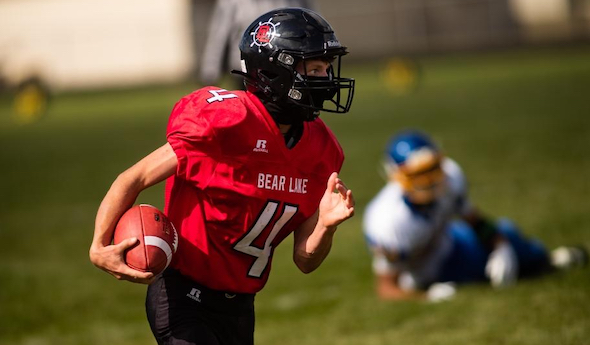
Bear Lake Looks to Begin New Streak
September 25, 2020
By Tom Spencer
Special for Second Half
When Bear Lake takes steps on the football field at Brethren tonight, the Lakers have a chance they never had last fall.
 It’s a chance to win two games in a row and remain undefeated. Bear Lake is coming off a 26-6 win over Ashley last week, the Lakers’ first win since 2018. The victory sparked a lot of relief and a great celebration in the Bear Lake community.
“It was a long time coming,” said assistant coach and offensive coordinator Samantha Mullet. “Seeing the guys get to experience the results of all their hard work was rewarding.
“But it’s just the beginning,” she continued. “They’ve set the bar now. They know that feeling only comes if you’ve earned it.”
Mullet, who goes by Sam and Coach Sam, has been an assistant coach with head coach John Prokes since 8-player football began at Bear Lake four seasons ago. She was also an intern the summer of 2019 for the Baltimore Ravens and coach John Harbaugh.
The Lakers’ seniors who have played football since their freshman year are thrilled to take the field tonight. Wins have been hard to come by and they were 0-9 in 2019. COVID-19 nearly took away their chance to play football in 2020 and feel the jubilation of victory.
It was long, hard summer of training not knowing the future of all MHSAA sports. The Lakers’ last victory was 28-18 over Big Rapids Crossroads Academy during the 2018 campaign.
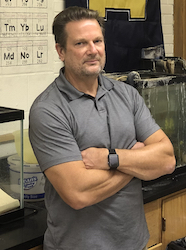
“Participating in sports is one opportunity that provides our young adults with an experience that will only continue to help them with the trials and tribulations throughout their own life,” noted Prokes, who also teaches science in the middle and high school. “We are fortunate to have football at our school and in our community.
“The memories we've established will last well beyond the wins and losses.”
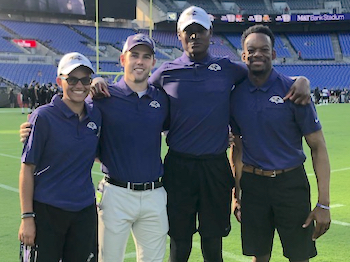 Mullet and Prokes have been together since Bear Lake exited a football co-op with Onekama to start the exciting 8-player football option. It hasn’t been a smooth road, but both feel the ship is righted now and the future is bright.
Bear Lake athletic director Karen Leinaar couldn’t be happier with the football program. She had never served a school district previously that didn’t offer football.
“The cool thing was the community stepped up and the board made a commitment to football,” she said. “They took a chance and it paid off.
“These two coaches have given hundreds and thousands of hours to these kids,” she continued. “Taking it from nothing to where it is today is great!”
A new culture of football began this summer as training for a possible 2020 season began. Not knowing how COVID-19 would impact MHSAA sports, the Lakers embarked on significant changes.
“With students having been out of school and away from each other since March, we felt it was important to get the kids together and active again, even if it was just for socially-distanced outdoor workouts,” recalled Mullet. “They were really the shift from there – they showed up and worked hard day after day, even when the future of sports was uncertain.
“Their attitude and commitment made us realize this could be the group to really establish our program,” she continued. “We’d been building, but without much of an identity. These guys committed to defining the vague ‘success’ we’ve always talked about and hashed out exactly how things were going to go down – what would be required of everyone and what would not be tolerated of anyone.”
The Lakers took their name and turned it into a “LAKES” acronym for core qualities that all players and coaches must be – Loyal, Accountable, Knowledgeable, Excellent, Resilient, and Selfless.
“We took an Edward Everett Hale quote and used it to establish our creed,” Mullet said. “‘I am only one. But I am one. I cannot do everything, but I can do something. And because I cannot do everything, I will not refuse to do the something that I can do. What I can do, I should do. And what I should do, by the grace of God, I will.’”
 The Lakers’ new creed and culture also came with new helmets featuring improved safety components to start the season. The helmets were made possible by a grant from the Manistee County Community Foundation.
The Lakers were led offensively to victory Saturday afternoon by Bryce Harless and Jake Griffis. Harless connected on 5 of 8 passes for 100 yards and two touchdowns and rushed for 105 yards and a touchdown on 10 carries. Griffis had five receptions for 109 yards and two touchdowns.
Tate Aultman led the Lakers defensively with 10.5 tackles and a sack. Griffis and Quentin Ruize each had nine tackles and combined on a sack. Jack Cook recorded nine tackles.
“We are not the biggest team, by no means,” Prokes said after the Bears snapped their losing streak. “We’ll probably be outsized in every game we play, but we play with a lot of heart.
“Our guys aren’t going to back down from anybody.”
And, when they walk on the field for every practice and tonight’s game, each player must contribute, Mullet believes.
“Every single player has been instrumental in pushing our culture forward,” she said. “As our creed implies, if one person doesn’t do their job, doesn’t give 100 percent effort, doesn’t buy in, the whole team fails.
“You may only have one job, but that one job is critical to the success of the whole team.”
Prokes and Mullet are appreciative of tremendous support they've received from everyone in the Bear Lake community, especially the boosters.
“The town has really embraced the team and has shown nothing but encouragement and patience with our development,” Mullet said. “They've enjoyed the experience that comes with having a football program including the tailgating, Friday Night lights, and even Saturday afternoons.”
And every Laker tonight will be playing with an undefeated helmet.
 Tom Spencer is a longtime MHSAA-registered basketball and soccer official, and former softball and baseball official, and he also has coached in the northern Lower Peninsula area. He previously has written for the Saginaw News, Bay County Sports Page and Midland Daily News. He can be reached at [email protected] with story ideas for Manistee, Wexford, Missaukee, Roscommon, Ogemaw, Iosco, Alcona, Oscoda, Crawford, Kalkaska, Grand Traverse, Benzie, Leelanau, Antrim, Otsego, Montmorency, Alpena, Presque Isle, Cheboygan, Charlevoix and Emmet counties.
PHOTOS: (Top) Bear Lake’s Jack Cook makes a move upfield during last week’s win over Ashley. (Middle) Bear Lake assistant Samantha Mullet, far left, during her Baltimore Ravens internship, with, following left to right, John Wolfe (co-founder of ShirtFaced), Tim Goins (coach from Japan’s X League) and Jordan Hogan (formerly at Cornell, now a new assistant coach for the Arizona Cardinals). (Below) Bear Lake head coach John Prokes in his science classroom. (Photos courtesy of the Bear Lake football program.)