

Brother Rice Finds Championship Burst
November 23, 2012
By Bill Khan
Special to Second Half
DETROIT — Jason Alessi appeared to be running out of gas.
The Birmingham Brother Rice junior was all over the football field, matching teammate John Plaskey with a game-high 12 tackles from his free safety position in the MHSAA Division 2 championship game against Muskegon on Friday at Ford Field.
Alessi ran down ball carriers on back-to-back big plays late in the third quarter to make touchdown-saving tackles, but got up slowly on the next play after missing a tackle in the backfield. For someone who spent the day chasing Muskegon's speedy backs, who could blame him if fatigue was setting in?
With a championship on the line, however, Alessi still had 91 yards and the dream of a lifetime within him.
On the kickoff following a game-tying touchdown, Alessi caught a cross-field lateral from sophomore Delano Madison and went 91 yards for the championship touchdown with 2:13 remaining in Brother Rice's 35-28 victory over Muskegon in an epic battle between two of Michigan's premier programs.
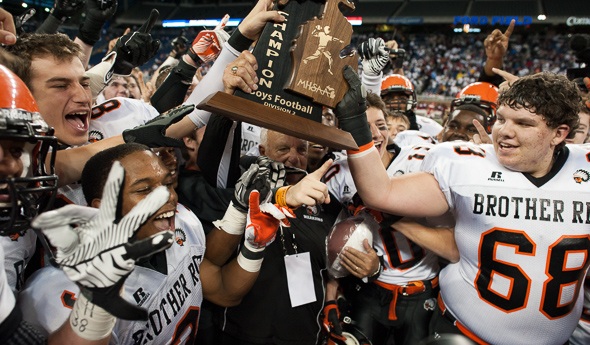
It was the eighth MHSAA championship for Brother Rice, which won consecutive titles for the first time.
"Our motto here is never give up," Alessi said. "We played our hearts out. We knew it was going to be a dogfight. We knew we had to give our whole heart into it. We left everything we could out on the field. It was amazing."
With the experience of 53 years of head coaching at his disposal, legendary Brother Rice coach Al Fracassa gave the green light to run a gadget play the Warriors (12-2) didn't install until the week of the championship game.
Fracassa admitted he was skeptical about even using practice time to work on a somewhat-risky lateral play, but deferred to coach David Sofran, who runs the special teams. Brother Rice considered running the play on its first kick return and also to open the second half, but didn't pull this one out of the bag of tricks until after Muskegon tied the game 28-28 on a 51-yard touchdown pass from backup quarterback Deshaun Thrower to Keondre Craig with 2:31 left in the game.
"We practiced it every day in practice for the last week," Alessi said. "A couple times it did not work. It would be a bad throw or I caught it and there would be guys in front of me. It was a huge risk. Once I heard the coach call that play, I was really excited. I knew it could be a really big play. I didn't know it would be a touchdown, but I knew it would be a huge play."
Madison caught the kickoff at the 4-yard line, took a few steps forward, then passed the ball back to Alessi. Alessi had a clear path down the left side, made some defenders miss at midfield, and was in the clear.
"It's almost unreal," Alessi said. "I dreamed about this moment. Who knew it would come true? It's an amazing feeling."

It was the second trick play Brother Rice used to take the lead in a frantic fourth quarter that will go down as one of the greatest in championship game history.
Two plays after Muskegon (12-2) tied the game 21-21 on an 11-yard run by Marcus Smith, Brother Rice recaptured the lead on a 77-yard flea-flicker pass from sophomore Alex Malzone to junior Corey Lacanaria with 3:29 left in the game.
The play began with a handoff to junior running back Brian Walker, who pitched the ball back to Malzone. Lacanaria, who opened the scoring with a 16-yard catch, was wide open behind the Muskegon defense when he caught the ball at the Big Reds' 41-yard line.
"We had the feeling right before they threw that flea-flicker that if we could get a stop right then, our offense was moving," Muskegon coach Shane Fairfield said. "They were a little tired. Their hands were on their hips. Our kids did a great job of conditioning in the pool room all week, but they made the call and the play and we didn't."
Muskegon hung in there, despite an ankle injury to senior standout quarterback Jalen Smith, who had a game-high 138 yards on 17 carries. Smith was injured with 2:38 left in the third quarter, but Thrower came in and tied the game 14-14 with a 1-yard touchdown run. Smith came back for three plays on the next drive, but didn't play during the final 9:43. Thrower, who attempted only seven passes all season, went 8-for-17 for 143 yards and a touchdown.
"Jalen got hurt," Thrower said. "He had the offense moving real good. I didn't want to slow the tempo down. I wanted to make plays. I didn't want the seniors' last game to be off a loss."
Brother Rice appeared to have the game wrapped up when Thrower threw an incompletion on fourth-and-12 with 57 seconds left in the game. But a fumbled snap while the Warriors were going to take a knee gave Muskegon the ball at its own 5-yard line with 55 seconds to go.
Thrower completed three passes for 46 yards, getting the ball to Brother Rice's 49-yard line before the game ended with an incompletion toward the end zone as time expired.
"We had a lot of players just making great plays out there," Brother Rice senior linebacker Jon Reschke said. "We stopped (Muskegon's ground game). We shut it down. We got them running other things that they didn't want to run, like throwing the ball. They're an 80-percent run team. Everyone knows they're a great rushing team. They had a great rushing game this game, but we got them out of that and got them to pass in the fourth quarter. That's what won us the ball game."
Brother Rice got out to a 14-0 lead on back-to-back scoring drives in the first half before Muskegon's defense settled in and kept the Warriors off the board on their next five possessions. Muskegon cut the margin to 14-7 on a 9-yard run by Javontae Langston with 6:28 left in the second quarter. After a lull in the action, the teams proceeded to score 42 points in the final 13:58 of the game.
"I thought the game was never going to end, really," Fracassa said. "I was suffering down there, 'C'mon, get this game going!' It's just a wonderful thing to happen to a team. They're going to remember it forever."
The burning question after the game was whether this would be the farewell appearance for Fracassa, the winningest coach in Michigan high school football history. He has a 416-117-7 record in eight years at Royal
Oak Shrine and 44 at Brother Rice. He recently turned 80.
Fracassa said he hasn't made a decision on his future.
"I have to go home and talk to my wife about this," Fracassa said. "I love the game. It's done so much for me. It gave me a scholarship to Michigan State. I played football, baseball and basketball in high school. Sports mean a lot to me. I'd like to give back. If I can coach in some capacity, if the good Lord is good to me and gives me good health, I'd like to help somebody out. I have to make the decision pretty soon. My birthday came fast a few weeks ago."
Shon Powell ran seven times for 97 yards and a touchdown for Brother Rice. Malzone was 8-for-10 for 167 yards and two touchdowns, while Cheyne Lacanaria was 4-for-6 for 44 yards and a touchdown as the Warriors' quarterback tandem.
Click for full statistics and to watch a replay of the game. See below for the full press conference.
PHOTOS: (Top) Birmingham Brother Rice and coach Al Fracassa pose with the Division 2 championship trophy Friday. (Middle) Brother Rice's Jason Alessi (4) runs toward the end zone for the go-ahead touchdown late in the title game. (Click for more from Terry McNamara Photography.)
DeWitt Rewrites Finals Rushing Record Book in Completing Perfect Run
By
Scott DeCamp
Special for MHSAA.com
November 30, 2025
DETROIT – Traverse Moore had no idea about his record-setting day until the final moments of Sunday’s Division 3 Football Final.
“Honestly, I wasn’t worried about that. I was worried about getting the state championship win,” the shifty and speedy DeWitt senior quarterback said.
Moore and the Panthers left no doubt whatsoever. They ran into the history books.
On the strength of Moore’s Finals-record 397 rushing yards and four touchdowns, DeWitt rolled past Mount Pleasant, 54-20, in a battle of unbeatens at Ford Field. Moore’s effort shattered the record set in last year’s Division 6 Final by Jackson Lumen Christi’s Kadale Williams (314).
“We’ve been dreaming about it since fourth grade when we first started playing together. For this group of seniors to do that today, I couldn’t be happier,” said Moore, whose squad is the second from DeWitt to capture a Finals football title. The 2020 team won the first championship.
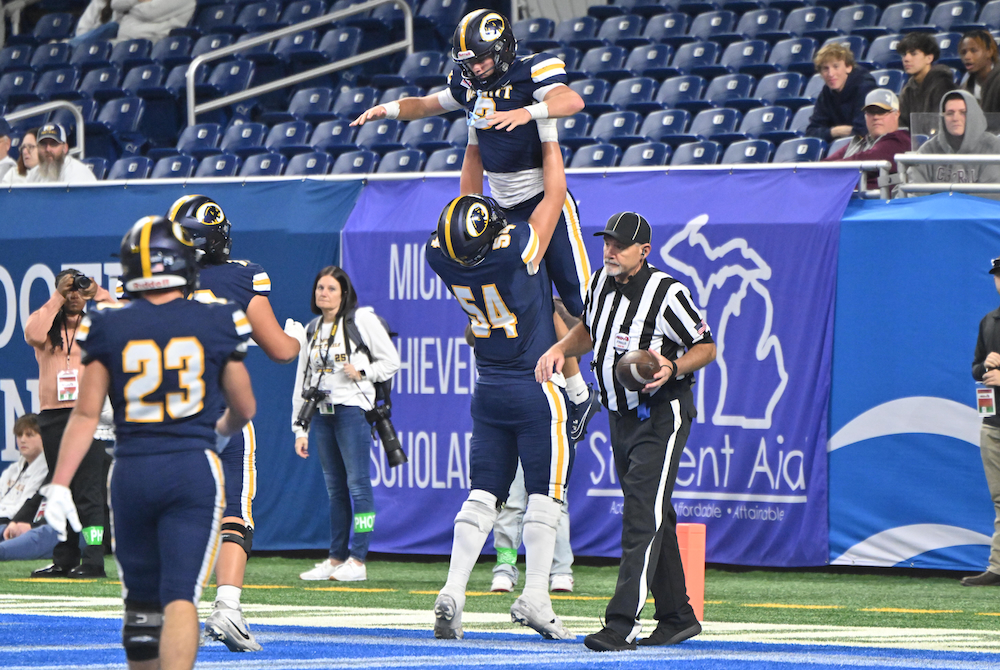
In DeWitt’s eighth championship game appearance, Moore scored three TDs in the opening quarter to tie a Finals record and help stake the Panthers to a 26-7 lead. The 6-foot, 195-pound Central Michigan University commit scored from 30 yards out barely two minutes into the contest, from 33 yards a little more than a minute later, and sprung free for a 74-yarder just past the midway point of the first quarter.
Moore’s fourth TD came on a 13-yard run barely three minutes into the second quarter. He had the Finals record for rushing yards early in the third quarter. He carried the ball 32 times in the game, good for 12.4 yards per attempt. Moore also completed 4 of 8 passes for 64 yards and a TD.
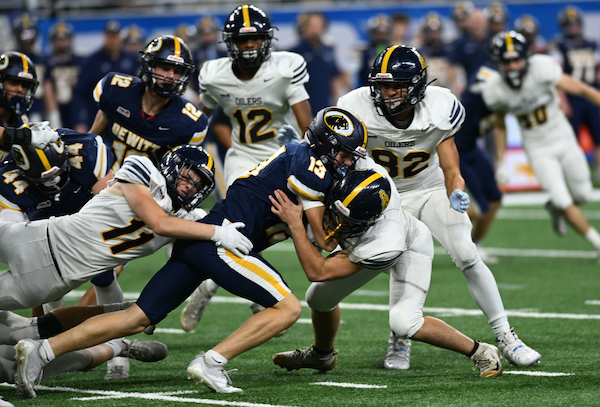 As a team, DeWitt (14-0) rushed for a Finals-record 575 yards on 58 attempts (9.9 per carry). It surpassed the previous record of 549 rushing yards by Constantine in the 2004 Division 6 Final.
Moore tipped his cap to DeWitt’s offensive line and tight ends, an all-senior unit comprised of Jackson Hildebrant at center, Sam VanZee and Luke Nolen at guards, Drew Rumsey and Landon Fitzpatrick at tackles, and Jacob Schorfhaar and Caleb Haman at tight ends.
“The guys up front have been special all year,” Moore said. “That’s a group of seniors that have been together since fourth grade – all of us have been together since fourth grade. They’ve been playing O-line since fourth grade, so that’s a special connection and they’re just workhorses, man.”
Sophomore Channing Ridley also reached the 100-yard plateau for DeWitt, finishing with 101 yards on 10 carries, including a 13-yard TD. Senior Jadon Bender caught a 35-yard TD pass from Moore, and junior Tyler Bashore closed out the Panthers’ scoring with a four-yard run. Bashore ended with 77 yards on 16 carries.
DeWitt piled up 219 rushing yards in the first quarter, 153 in the second, 73 in the third, and 130 in the fourth.
“In the offseason, we looked at what we had coming back,” said veteran DeWitt coach Rob Zimmerman, who completed his 27th season at the helm. “DeWitt’s probably known for being a team that throws the football around quite a bit. Last year we were physical and we threw a lot more, but with what we had coming back up front and the speed that we have, you can’t take away everything that we have.
“It’s a great combination with all the single-wing stuff that we do, which nobody else does, and so that’s an issue. But then we have the ability to run right at you and our counter game has been phenomenal for the last two years,” Zimmerman continued. “It’s a tough matchup, and then you add in the tempo, too, that we show quite a bit. I think we’re faster (in that tempo) than anybody else is as far as running plays. Put all of those things together, it’s pretty tough to stop.”
Mount Pleasant (13-1) got on the board midway through the first quarter on a 31-yard TD pass from junior Xavier Creguer to senior Riley Olson. Creguer added a four-yard scoring run with 12 seconds remaining in the first half, but the Oilers were still facing a 40-14 deficit headed into the halftime break.
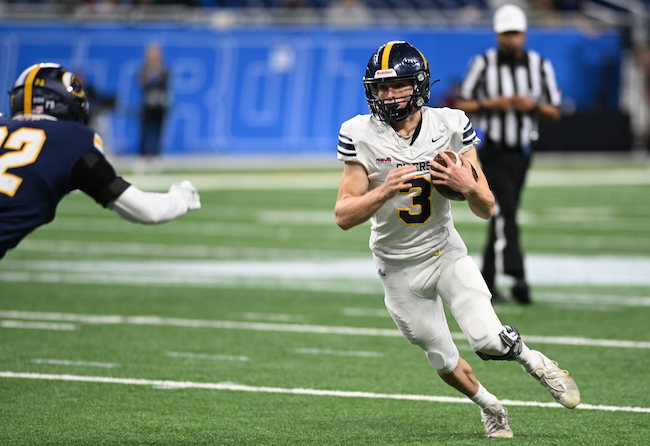
Creguer joined Moore in the record books with his 91-yard TD run in the third quarter – longest in Finals history, surpassing 90-yard scoring runs by Edwardsburg’s Nick Bradley (2017) and Farmington Hills Harrison’s Nick Williams (1994).
It was an uphill battle for Mount Pleasant, which made its second Finals appearance and still seeks its first championship.
 “I wonder if a little bit of the bright lights got to us to start with. We made a few mistakes from the start … . Just a few, little things that we’d like to have back,” Mount Pleasant coach Jason McIntyre.
“That’s a tremendous DeWitt team. It would have been really difficult to hang up the middle, but I think you saw what we could have done maybe if we would have been able to start a little fresher, a little cleaner. … Their offense is super difficult to defend. I thought we were well-prepared in terms of alignment, but the speed in which they do it and obviously No. 2’s (Traverse Moore) a really good player.”
Creguer finished with 162 rushing yards on 12 carries. He also threw for 66 yards.
Senior William Garcia led all defenders with 11 tackles for Mount Pleasant, while Olson notched 10 stops. Senior Lucas Brandell recorded a team-high six tackles for DeWitt.
DeWitt lost in last year’s Semifinal to eventual champion Zeeland West, 32-20. That defeat lingered with the Panthers and fueled them for this season’s run to glory.
“I mean, that stung. Last year stung. It hurt,” DeWitt senior Miller Wing said. “But when winter lifts rolled around, 5:45 in the morning, that’s the reason for it. It’s just staying together as a team. We’re so close.”
DeWitt has been a perennial contender in Division 3. The Panthers have advanced to the Semifinals or further seven of the last eight seasons.
According to Zimmerman, it’s all about the culture, establishing expectations, and putting in the work.
“The older kids have always helped our younger guys to understand the expectations within the program, and I think that’s a big part of why we’re where we’re at as a program,” Zimmerman said. “These guys want to be the next dude, and they work to get there.
“Ton of similarities (between the two championship teams) from a toughness standpoint, leadership standpoint, work ethic. I mean, these guys put in an unbelievable amount of time in the offseason to get where they’re at. This class, from sophomore (season on up), they’re 35-1 as a class, so it’s a pretty good group.”
PHOTOS (Top) DeWitt’s Sam VanZee (54) hoists teammate Traverse Moore into the air in the end zone Sunday. (Middle) Landon Kurncz (13) attempts to surge ahead with Mount Pleasant’s Keagan Wernette-Beals (11) and another defender wrapping him up. (Below) The Oilers’ Xavier Creguer prepares to take on a DeWitt defender.