

Brother Rice Finds Championship Burst
November 23, 2012
By Bill Khan
Special to Second Half
DETROIT — Jason Alessi appeared to be running out of gas.
The Birmingham Brother Rice junior was all over the football field, matching teammate John Plaskey with a game-high 12 tackles from his free safety position in the MHSAA Division 2 championship game against Muskegon on Friday at Ford Field.
Alessi ran down ball carriers on back-to-back big plays late in the third quarter to make touchdown-saving tackles, but got up slowly on the next play after missing a tackle in the backfield. For someone who spent the day chasing Muskegon's speedy backs, who could blame him if fatigue was setting in?
With a championship on the line, however, Alessi still had 91 yards and the dream of a lifetime within him.
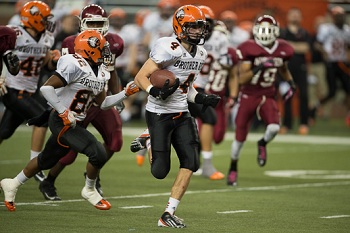
On the kickoff following a game-tying touchdown, Alessi caught a cross-field lateral from sophomore Delano Madison and went 91 yards for the championship touchdown with 2:13 remaining in Brother Rice's 35-28 victory over Muskegon in an epic battle between two of Michigan's premier programs.
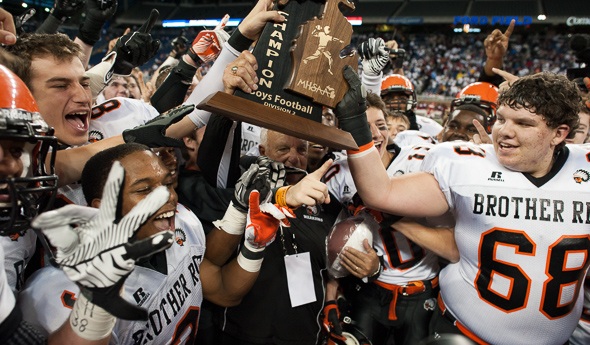
It was the eighth MHSAA championship for Brother Rice, which won consecutive titles for the first time.
"Our motto here is never give up," Alessi said. "We played our hearts out. We knew it was going to be a dogfight. We knew we had to give our whole heart into it. We left everything we could out on the field. It was amazing."
With the experience of 53 years of head coaching at his disposal, legendary Brother Rice coach Al Fracassa gave the green light to run a gadget play the Warriors (12-2) didn't install until the week of the championship game.
Fracassa admitted he was skeptical about even using practice time to work on a somewhat-risky lateral play, but deferred to coach David Sofran, who runs the special teams. Brother Rice considered running the play on its first kick return and also to open the second half, but didn't pull this one out of the bag of tricks until after Muskegon tied the game 28-28 on a 51-yard touchdown pass from backup quarterback Deshaun Thrower to Keondre Craig with 2:31 left in the game.
"We practiced it every day in practice for the last week," Alessi said. "A couple times it did not work. It would be a bad throw or I caught it and there would be guys in front of me. It was a huge risk. Once I heard the coach call that play, I was really excited. I knew it could be a really big play. I didn't know it would be a touchdown, but I knew it would be a huge play."
Madison caught the kickoff at the 4-yard line, took a few steps forward, then passed the ball back to Alessi. Alessi had a clear path down the left side, made some defenders miss at midfield, and was in the clear.
"It's almost unreal," Alessi said. "I dreamed about this moment. Who knew it would come true? It's an amazing feeling."
It was the second trick play Brother Rice used to take the lead in a frantic fourth quarter that will go down as one of the greatest in championship game history.
Two plays after Muskegon (12-2) tied the game 21-21 on an 11-yard run by Marcus Smith, Brother Rice recaptured the lead on a 77-yard flea-flicker pass from sophomore Alex Malzone to junior Corey Lacanaria with 3:29 left in the game.
The play began with a handoff to junior running back Brian Walker, who pitched the ball back to Malzone. Lacanaria, who opened the scoring with a 16-yard catch, was wide open behind the Muskegon defense when he caught the ball at the Big Reds' 41-yard line.
"We had the feeling right before they threw that flea-flicker that if we could get a stop right then, our offense was moving," Muskegon coach Shane Fairfield said. "They were a little tired. Their hands were on their hips. Our kids did a great job of conditioning in the pool room all week, but they made the call and the play and we didn't."
Muskegon hung in there, despite an ankle injury to senior standout quarterback Jalen Smith, who had a game-high 138 yards on 17 carries. Smith was injured with 2:38 left in the third quarter, but Thrower came in and tied the game 14-14 with a 1-yard touchdown run. Smith came back for three plays on the next drive, but didn't play during the final 9:43. Thrower, who attempted only seven passes all season, went 8-for-17 for 143 yards and a touchdown.
"Jalen got hurt," Thrower said. "He had the offense moving real good. I didn't want to slow the tempo down. I wanted to make plays. I didn't want the seniors' last game to be off a loss."
Brother Rice appeared to have the game wrapped up when Thrower threw an incompletion on fourth-and-12 with 57 seconds left in the game. But a fumbled snap while the Warriors were going to take a knee gave Muskegon the ball at its own 5-yard line with 55 seconds to go.
Thrower completed three passes for 46 yards, getting the ball to Brother Rice's 49-yard line before the game ended with an incompletion toward the end zone as time expired.
"We had a lot of players just making great plays out there," Brother Rice senior linebacker Jon Reschke said. "We stopped (Muskegon's ground game). We shut it down. We got them running other things that they didn't want to run, like throwing the ball. They're an 80-percent run team. Everyone knows they're a great rushing team. They had a great rushing game this game, but we got them out of that and got them to pass in the fourth quarter. That's what won us the ball game."
Brother Rice got out to a 14-0 lead on back-to-back scoring drives in the first half before Muskegon's defense settled in and kept the Warriors off the board on their next five possessions. Muskegon cut the margin to 14-7 on a 9-yard run by Javontae Langston with 6:28 left in the second quarter. After a lull in the action, the teams proceeded to score 42 points in the final 13:58 of the game.
"I thought the game was never going to end, really," Fracassa said. "I was suffering down there, 'C'mon, get this game going!' It's just a wonderful thing to happen to a team. They're going to remember it forever."
The burning question after the game was whether this would be the farewell appearance for Fracassa, the winningest coach in Michigan high school football history. He has a 416-117-7 record in eight years at Royal
Oak Shrine and 44 at Brother Rice. He recently turned 80.
Fracassa said he hasn't made a decision on his future.
"I have to go home and talk to my wife about this," Fracassa said. "I love the game. It's done so much for me. It gave me a scholarship to Michigan State. I played football, baseball and basketball in high school. Sports mean a lot to me. I'd like to give back. If I can coach in some capacity, if the good Lord is good to me and gives me good health, I'd like to help somebody out. I have to make the decision pretty soon. My birthday came fast a few weeks ago."
Shon Powell ran seven times for 97 yards and a touchdown for Brother Rice. Malzone was 8-for-10 for 167 yards and two touchdowns, while Cheyne Lacanaria was 4-for-6 for 44 yards and a touchdown as the Warriors' quarterback tandem.
Click for full statistics and to watch a replay of the game. See below for the full press conference.
PHOTOS: (Top) Birmingham Brother Rice and coach Al Fracassa pose with the Division 2 championship trophy Friday. (Middle) Brother Rice's Jason Alessi (4) runs toward the end zone for the go-ahead touchdown late in the title game. (Click for more from Terry McNamara Photography.)
Friday's Game-Winner Latest, Greatest Highlight for Adrian Kicker Hassan
By
Doug Donnelly
Special for MHSAA.com
September 30, 2025
When Zack Hassan was a freshman, he decided to play two sports at Adrian High School – soccer and football.
 Because he was a soccer player, the Maples’ football coaches decided he would be a good candidate to be a kicker.
“I had never really kicked a football before, but they thought I could because I played soccer,” Hassan said. “I thought, ‘Sure, why not?’”
Fast forward four years and Hassan is no longer a soccer player. He not only is the Adrian kicker – he is eying a college football scholarship and Friday had the biggest moment of his career when he booted a 37-yard field goal as time expired to give Adrian its biggest football win in years.
“I love the pressure moments,” Hassan said. “I like having all of the eyes on me and going out there and kicking.”
Hassan also played receiver and defensive back the last couple of years, but is focused entirely on kicking this season because of a knee injury suffered toward the end of basketball season. He’s delayed surgery because he didn’t want to miss his senior year of football.
“I could have played receiver this season, but I wanted to be safe,” Hassan said. “I had a choice. I could have had surgery before the season or in the middle, but I just wanted to finish out my last year.”
The injured knee part of his kicking leg – but that’s probably for the best if he had to be injured at all.
“As a kicker its almost better because I don’t have to worry about planting,” he said. “That would be constant impact on it. It’s not super bad. I think I will recover quickly. I should be 100 percent by April or May. I should probably try to save the leg, but I enjoy kicking. I like to kick as much as possible in practice.”
Hassan handles all placekicking duties for Adrian, but doesn’t punt. Maples coach Joel Przygodski said Hassan would make a good punter, though.
“He has a strong leg,” he said. “He regularly kicks off to the 10-yard line. It’s a nice weapon to have.”
Hassan’s family moved to Adrian from Sylvania, Ohio, when he was in middle school.
“When I was growing up, I thought I was going to be a basketball player,” he said.
After he joined the varsity football team as a freshman, he decided he liked kicking.
“After freshman year I thought maybe I could get some free tuition out of this,” he said.
 He’s made two college visits already – to Baldwin Wallace in Ohio and Macalester College in Saint Paul, Minn., which has offered him a scholarship. He’s headed back to Macalester in a few weeks to check out what it’s like on game day.
“They are a very good school to get an education,” said Hassan, who has a grade point average above 4.0.
Hassan’s siblings stayed on the soccer route. His older sister was a college goalkeeper and his younger sister plays soccer for Adrian.
On Friday, Adrian was locked in a 0-0 tie with unbeaten Ypsilanti Lincoln. In the fourth quarter the two teams exchanged punts, swapping field position. Adrian got the ball back with fewer than 40 seconds left.
“As coaches, we talked about whether or not we wanted to play it safe, play for overtime,” Przygodski said.
After an incomplete pass on first down, running back Luke Bruggeman carried the ball up the middle and broke a tackle to put the ball past midfield. He even got out of bounds to stop the clock.
“I was thinking, okay, we are in business,” Przygodski said.
After quarterback Jaxon Dowling connected with receiver Adam Parker to reach the Lincoln 25-yard line, Przygodski knew the Maples had a chance. Hassan was warming up.
“We were telling him to be ready,” Przygodski said.
Hassan had missed two field goals earlier in the game. One of those attempts was from 48 yards out.
“My coaches just told me to get ready and told everyone else to stay away from me,” Hassan said.
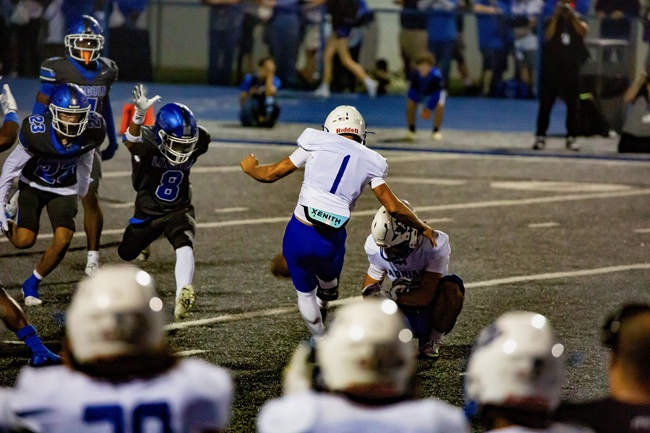
With less than 1.5 seconds to play, Adrian reached the 20-yard line and called timeout. Hassan trotted out onto the field. The snap was a little slower than he was used to, he said, but he lined up perfectly and hit the 37-yarder, sending the Maples into a frenzy and stunning the home crowd of about 3,000 people at Lincoln’s homecoming.
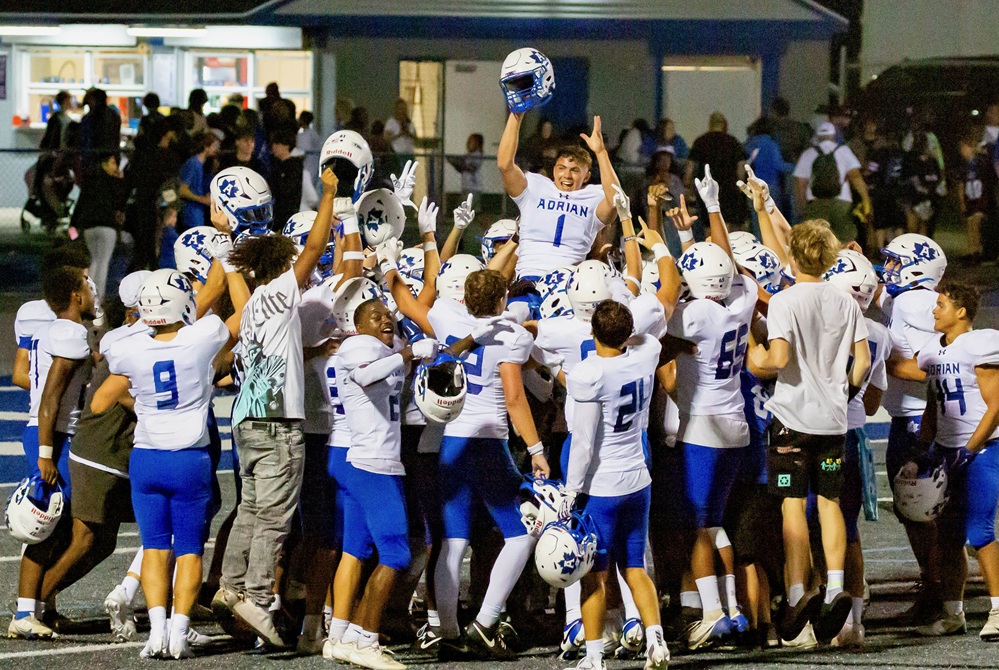
Hassan was carried off the field by teammates – and not because of an injury.
“After we shook hands, we went into huddle and everyone was like, ‘Lift him up, lift him up,’” he said.
The win was a big one for Adrian, which continues to make strides under Przygodski’s leadership. Adrian is 4-1 with chief rival Tecumseh coming up this week. The Maples have a lot of momentum for the rest of the season.
“Going into the season we were really unsure how we were going to be, because we lost a lot of seniors last year,” Hassan said. “It’s good. We’ve had a lot of people step up. We are turning a lot of eyes right now.”
 Doug Donnelly has served as a news and sports reporter at the Adrian Daily Telegram and the Monroe News for 30 years, including 10 years as city editor in Monroe. He's written a book on high school basketball in Monroe County and compiles record books for various schools in southeast Michigan. He is now publisher and editor of The Blissfield Advance, a weekly newspaper. E-mail him at [email protected] with story ideas for Jackson, Washtenaw, Hillsdale, Lenawee and Monroe counties.
PHOTOS (Top) Adrian kicker Zack Hassan is carried by his teammates after making the game-winning field goal Friday against Ypsilanti Lincoln. (Middle) Hassan steps into his winning kick. (Photos by Marnette Sutherland.)