

Bush Legacy: Culture of Opportunity
By
Doug Donnelly
Special for MHSAA.com
April 6, 2018
By Doug Donnelly
Special for Second Half
CHELSEA – For the first time as Chelsea High School athletic director, Brad Bush has to hire a football coach.
 What’s more, he has the unenviable task of replacing himself.
“I would say that nobody cares more about Chelsea football than I do,” Bush said. “It’s important to me that we find the very best person we can.”
Bush has coached the Bulldogs for 21 seasons. But, his coaching background goes much deeper than that.
He played at Ypsilanti High School for Hall of Fame coach Bill Giarmo, graduating in 1988. After playing quarterback at Cornell University in the Ivy League, he returned to Michigan, graduating from Eastern Michigan University, and started coaching for Bill Kohn, another inductee to the Michigan High School Football Coaches Association Hall of Fame. Bush then went to East Kentwood to coach with Giarmo.
Through his own playing days, coaching with those legends of the game and absorbing everything he could from afar, Bush has developed an impressive culture at Chelsea.
“Friday nights in Chelsea are a big deal,” he said. “We want to keep that tradition.”
Bush became the varsity head coach at Chelsea in 1997. At the time, Chelsea had only two playoff appearances. Bush’s Bulldogs went 3-6 that first season. After that, Chelsea didn’t have a sub-.500 finish for 15 years. The Bulldogs have been kept out of the playoffs only once since 1998.
Chelsea has had only three head coaches since 1965.
“I’m fortunate,” Bush said. “I went for a few more years than the other guys. It’s a great place to coach.”
Temperance Bedford head coach Jeff Wood was an assistant with Bush at Ypsilanti during the 1990s and said he thought then that Bush was going to develop into a great head coach.
“We knew he was going to accomplish greatness, not only as a football coach, but as a father, husband and professional in education,” Wood said. “Brad has always won and lost with great class and dignity. He’s a true Hall of Famer.”
If Bush never coaches at Chelsea again, his lasting legacy might be that culture surrounding the Bulldogs program. It’s known for its large number of football players, from middle school through the varsity, and a system that ensures every student athlete on every team leading to the varsity will play in every game. Teams at the middle school, freshman and junior varsity levels all start 22 players each game – with no two-way starters. For a Class B/Division 3 school, that isn’t the norm.
“We’ve had the same philosophy for 20 years,” he said. “Everybody plays in every middle school, freshman and junior varsity game. That’s how we do it. We start 22 kids on every level. Our kids know they will have the opportunity to play.
“Every kid on every level is going to play in every game. On most nights, we play more kids than the other team has players.”
While every school loses some athletes, or potential athletes, along the way, Bush said this system helps maintain a student’s interest in the sport. Often, he said, a player who may not necessarily be a starter as a freshman will learn the game, develop and turn into a starter by senior year.
“We feel that, over time, with repetition and practice, a kid will become an expert at his position,” he said. “For us, this is a big piece. … That was my thing here. I didn’t invent it. I absorbed it, watched it at other places.”
It’s tough to argue with the results. Chelsea won or shared Southeastern Conference championships in 1999, 2000, 2001, 2003, 2004, 2006, 2007, 2008, 2011, 2012, 2015, 2016 and 2017. The Bulldogs won seven District championships during the Bush era and played in the 2015 Division 3 championship game, falling to Orchard Lake St. Mary’s at Ford Field
He said he learned how to build a program from Giarmo and how to coach a football team under Kohn. Bush was quick to credit his assistant coaches who have remained with the program for years and helped build the culture. He said the program has sacrificed win-at-all-cost at the lower levels with the goal of developing varsity football players.
“You have to manage it,” he said. “That’s why you need a great staff. We have been lucky here with a great, dedicated group of guys. They always have the ultimate goal in mind.”
Bush said he won’t hamstring the next coach into running his system, but anticipates whoever is hired will buy into the culture after seeing what it’s about.
“The next coach has to run it the way he wants to run it, but I do believe we have created a culture here and we’d like to maintain that. You want to hire the right person who is going to handle the kids the right way.”
In addition to coaching at Chelsea and leading the entire athletic program, Bush also is heavily involved in the Michigan High School Football Coaches Association as a past president, serves on the Michigan High School Athletic Association football committee and has served on the National Federation football rules committee. He’s coached in all-star games and is a true believer in high school sports.
His record at Chelsea is 169-60.
“I have great energy,” Bush said. “I love coaching. I have a great passion for it, but I also know when you need to do certain things. I felt this was just the right time for the athletic department and the football team. It wasn’t one thing that led me to this.
“I love the game. I’m going to be very much involved.”
 Doug Donnelly has served as a sports and news reporter and city editor over 25 years, writing for the Daily Chief-Union in Upper Sandusky, Ohio from 1992-1995, the Monroe Evening News from 1995-2012 and the Adrian Daily Telegram since 2013. He's also written a book on high school basketball in Monroe County and compiles record books for various schools in southeast Michigan. E-mail him at [email protected] with story ideas for Jackson, Washtenaw, Hillsdale, Lenawee and Monroe counties.
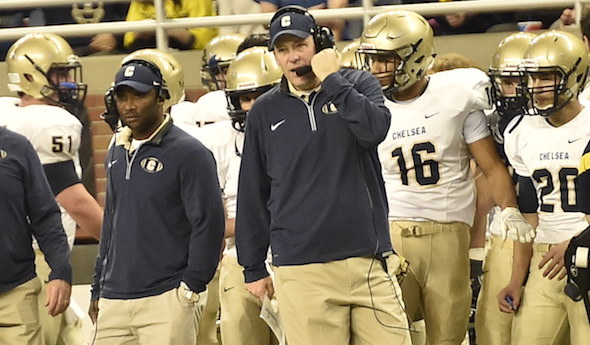
PHOTO: Chelsea's Brad Bush coaches his team during the 2015 Division 3 Final at Ford Field.
Colon Finishes Perfect Season with 1st Title
November 23, 2019
By Ryan Stieg
Special for Second Half
MARQUETTE – It was a long trip for the Colon football team, driving all the way from near the Ohio border to the Upper Peninsula for the MHSAA Division 1 8-Player Final
But the Magi made the journey worthwhile.
Behind solid defensive play and the running of fullback Brandon Crawford – who finished with 205 rushing yards – Colon defeated Suttons Bay 26-14 to win its first Finals championship.
Colon head coach Robbie Hattan credited his defense and some thorough conditioning for pushing the Magi over the top. They intercepted four passes and returned one pick for a touchdown.
“In the regular season, our first team defense didn’t give up a point,” he said. “So we get to the playoffs and obviously, when you get to the playoffs, you play at a different level. So we gave up 12 points, 12 points, seven points. Our defense has been the strength of our team.”
“We condition so much,” he said. “During camp, we have different military branches come in to push our kids. We had the Navy SEALs, we had the Army Rangers, Air Force Special Ops. These kids were putting in the work. We figured it out, and we ran 168 miles this season. It’s nuts how much we’ve ran, but we do that and the kids know it. We call it Monday run day. So Monday practices are no fun, but they reaped the rewards tonight and we still had legs in the fourth.”
Even though Suttons Bay’s trip up north fell short, head coach Garrick Opie praised his team for giving everything it had right to the end.
“The great thing about my team and the great thing about our kids, they don’t give up and they never have,” he said. “I think we’ve seen games like Gaylord St. Mary’s and other games being won in the last minute, and I think we still think that way until the last second.
“The one thing that I said to our team was I wanted each player to leave with an empty tank, and they did. So that’s all I can ask for. They did phenomenal.”
Trying to maintain a slim one-point lead at the start of the third quarter, the Magi (13-0) made a huge play defensively. With the ball deep in Suttons Bay territory, Crawford intercepted a screen pass from his defensive lineman spot and ran it into the end zone. After the extra point, the Magi led 14-6.
 After forcing a Colon punt, the Northmen answered on their third possession of the quarter. Quarterback Bryce Opie scrambled away from pressure and hit Hugh Periard with a 47-yard pass to the Colon 37. Later, on 4th-and-inches at the Magi 14, Opie sneaked up the middle to the 10. Two plays after that, he scored on a four-yard run. He also picked up the 2-point conversion, and the game was tied 14-14.
Before the end of the quarter, Colon used its rushing attack to march down the field. Crawford plowed his way from the Suttons Bay 43 to the 15, and three plays later quarterback Phillip Alva punched the ball into the end zone from the 1. However, a bad snap on the extra point forced the Magi to pass, and the throw was intercepted in the end zone.
Suttons Bay (12-1) wasn’t shaken though. A 31-yard run from Camryn Knaub helped the Northmen to the Colon 6. But on fourth down, Opie’s pass fell incomplete ,and Colon took over on downs. Just two plays later, Crawford rumbled down the Magi sideline for a 94-yard touchdown. The conversion failed and Colon led by 12 with 7:36 left.
Suttons Bay had one last real chance to get back in the game after blocking a Colon punt with about six minutes remaining, but Jonathan West ended the rally with another interception.
“They just kept trying to push me out of bounds and didn’t really try to tackle me, so I just kept my feet going,” Crawford said of his touchdown. “I think that and the interception by Jonathan were the turning point. Those really helped us.”
“Brandon is a heck of a football player,” Hattan said. “That kid is going to be playing college football someday. He loves having the ball in his hands in big situations. We know we can rely on him, and he really took care of business today.”
While the second half was a little more explosive, the first half was fairly quiet offensively. Colon got on the scoreboard first on its second possession of the game, on a Crawford 24-yard run. With the extra point, Colon led 7-0 with 7:31 to go in the first quarter.
After forcing a Magi punt early in the second quarter, the Northmen started to generate some offense. Opie picked up a first down on a run from the Suttons Bay 49 to the Colon 38, and two plays late a costly Magi penalty moved the ball to the 23. On the next play, Opie threw a pass into double coverage in the corner of the end zone, but Lucas Mikesell adjusted and made a leaping catch behind both Magi defenders for a touchdown. The extra point was blocked though, and Suttons Bay trailed 7-6 with 8:26 left in the half – and the score stayed the same heading into the break.
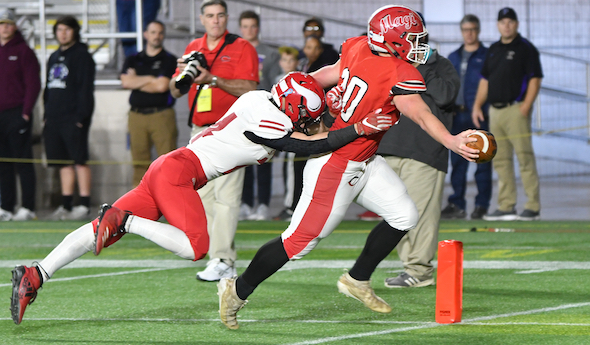
PHOTOS: (Top) Colon’s Brandon Crawford reaches for the end zone while a Suttons Bay defender attempts to prevent the score Saturday. (Middle) Suttons Bay quarterback Bryce Opie works to avoid Justin Miller’s rush. (Photos by Cara Kamps.)