


Catch These New Rules as Fall Kicks Off
August 7, 2014
By Geoff Kimmerly
Second Half editor
The first practices of 2014-15 begin next week for approximately 110,000 student-athletes taking part in eight sports in which the Michigan High School Athletic Association sponsors postseason tournaments, with nearly 41,000 football players practicing under a new policy in that sport aimed at continuing to improve player safety.
The new practice policy was proposed by a Football Task Force made up of coaches, administrators and MHSAA staff which met during 2012 and 2013, and approved by the MHSAA’s Representative Council at its Winter Meeting on March 21.
The modifications are meant to promote heat acclimatization and limit helmet-to-helmet contact during practices. They include:
- During the first week of practice, only helmets are allowed the first two days, only shoulder pads may be added on the third and fourth days, and full pads may not be worn until the fifth day of team practice.
- Before the first regular-season game, schools may not schedule more than one “collision” practice in a day. A collision practice is defined as one in which there is live, game-speed, player-versus-player contact in pads involving any number of players.
- After the first regular-season game, teams may conduct no more than two collision practice days in any week, Monday through Sunday.
- No single football practice may exceed three hours, and the total practice time for days with multiple practice sessions may not exceed five hours. Neither strength/weight training activities nor video/classroom sessions are considered practice for the purposes of the three or five-hour limits.
Previously, schools were required to conduct at least three days of practice without pads before beginning contact. The change to four days for gradual addition of pads was added to assist athletes in acclimating to being physically active in hot weather. Guidelines reducing the amount of collision practice go hand in hand with rules changes that have been made to reduce helmet-to-helmet contact in game situations. The policies in detail can be found on the Football page of the MHSAA Website.
“We think these new policies, with respect to the number of collision practices there can be before the first game, and after the first game, really are where 85 to 90 percent of our coaches already were,” said John E. “Jack” Roberts, executive director of the MHSAA. “This new policy sends a signal to that 10 to 15 percent to get on board with the rest of us to make football just as safe as it can possibly be.”
Practice in football must begin on August 11 for all schools wishing to begin regular-season games the weekend of August 28-30. Schools must have 12 days of preseason practice at all levels before their first game, and those 12 days of practice may not occur before 16 calendar days.
Practice sessions for all other sports begin on Wednesday (August 13). In golf and tennis, competition may commence no earlier than after three separate days of team practice, and not before seven calendar days. The first day competition may take place in golf and tennis is August 20. In all other fall sports, contests can take place after seven days of practice for the team and not before nine calendar days. The first day competition may take place in cross country, tennis, soccer, swimming and diving, and volleyball is August 22.
Only one football date precedes Labor Day, and most varsity games will take place on Thursday, August 28, that week. Subvarsity competition may begin on Wednesday, August 27. In Week 1, 255 games will be played on Thursday, 53 contests will be played on Friday, and five games will be played on Saturday.
Continuing the focus on player safety, a number of rules changes were made in football for 2014:
- Rules were added restricting targeting of opponent and illegal helmet contact with defenseless players, with both resulting in 15-yard penalties. Targeting is defined as taking aim at an opponent with the helmet, forearm, hand, fist, elbow or shoulder to initiate contact above the shoulders and with an intent beyond making a legal tackle or block, or playing the ball. A defenseless player can be considered one no longer involved in a play, a runner whose progress has been stopped, a player focused on receiving a kick or a receiver who has given up on an errant pass, or a player already on the ground.
- Illegal contact to a quarterback now will be considered roughing the passer, and the offense will receive an automatic first down in addition to the previous 15 yards from the penalty.
- On kickoffs, the kicking team must have at least four players on either side of the kicker, and no kicking team players except for the kicker may line up more than five yards behind the free-kick line. These changes were made to improve safety by balancing the kicking formation and shortening the potential run-up by kicking team players heading down the field to tackle the ball carrier.
A number of significant rules changes will go into effect for other fall sports:
- In cross country, the ban on wearing jewelry has been lifted (and also for track and field in the spring). The National Federation of State High School Associations deemed the ban unnecessary in these two sports because there is little risk of injury with minimal contact between competitors. Elimination of the rule will allow officials to further focus on the competition.
- In soccer, Michigan has adopted the National Federation rule stating home teams must wear solid white jerseys and socks, with visiting teams in dark jerseys and socks (dark defined as any color contrasting white). Also, officials may now wear green and blue shirts in addition to red and black as alternates to the primary yellow shirt with black pinstripes.
- Also for soccer, both field players and goalkeepers must now leave the field when injured and the referee has stopped the clock. Previously, an injured goalkeeper was not required to leave the game when the referee stopped the clock; going forward, the keeper must be replaced.
- In swimming and diving, one change affects the beginning of races and another impacts a specific event. The use of starter’s pistols is now prohibited; starters must use an alternative sounding device to start races. Additionally, in the backstroke, a swimmer may not submerge his or her entire body after the start except for during turns. The swimmer must remain on or above the water surface on the finish, eliminating the abuse of submerging well before touching the wall. This change also applies to the finish of the backstroke leg of the individual medley.
The 2014 Fall campaign culminates with postseason tournaments beginning with the Upper Peninsula Girls Tennis Finals the week of Sept. 29, and wraps up with the 11-Player Football Playoff Finals on Nov. 28-29. Here is a complete list of fall tournament dates:
Cross Country:
U.P. Finals – Oct. 18
L.P. Regionals – Oct. 24 or 25
L.P. Finals – Nov. 1
11-Player Football:
Selection Sunday – Oct. 26
Pre-Districts – Oct. 31 or Nov. 1
District Finals – Nov. 7 or 8
Regional Finals – Nov. 14 or 15
Semifinals – Nov. 22
Finals – Nov. 28-29
8-Player Football:
Selection Sunday – Oct. 26
Regional Semifinals – Oct. 31 or Nov. 1
Regional Finals – Nov. 7 or 8
Semifinals – Nov. 15
Finals – Nov. 21
L.P. Girls Golf:
Regionals – Oct. 8 or 9 or 10 or 11
Finals – Oct. 17-18
Soccer:
Boys L.P. Districts – Oct. 13-18
Boys L.P. Regionals – Oct. 21-25
Boys L.P. Semifinals – Oct. 29
Boys L.P. Finals – Nov. 1
L.P. Girls Swimming & Diving
Diving Regionals – Nov. 13
Swimming/Diving Finals – Nov. 21-22
Tennis:
U.P. Girls Finals – Oct. 1 or 2 or 3 or 4
L.P. Boys Regionals – Oct. 9 or 10 or 11
L.P. Finals – Oct. 17-18
Girls Volleyball:
Districts – Nov. 3-8
Regionals – Nov. 11 & 13
Quarterfinals – Nov. 18
Semifinals – Nov. 20-21
Finals – Nov. 22
The MHSAA is a private, not-for-profit corporation of voluntary membership by more than 1,500 public and private senior high schools and junior high/middle schools which exists to develop common rules for athletic eligibility and competition. No government funds or tax dollars support the MHSAA, which was the first such association nationally to not accept membership dues or tournament entry fees from schools. Member schools which enforce these rules are permitted to participate in MHSAA tournaments, which attract more than 1.4 million spectators each year.
Brogan Shepherds Lumen Christi Legacy
By
Chip Mundy
Special for Second Half
November 17, 2017
By Chip Mundy
Special for Second Half
JACKSON – It has been nearly 38 years since Herb Brogan became head football coach at Jackson Lumen Christi. It is hard to imagine anyone facing tougher circumstances in a promotion than he did early in 1980.
 Lumen Christi was coming off its second Class B championship in three seasons, this one capping an undefeated season. Head coach Jim Crowley was named the Michigan High School Football Coaches Association Class B Coach of the Year, and Brogan had been on the varsity staff since 1973 and had been part of the program since 1971.
It was a close coaching staff, but everything changed on the first Friday night of 1980. Crowley confronted a man in his driveway as he returned home from picking up his daughter. After sending his daughter inside, Crowley was shot and killed, leaving the Jackson community shocked and saddened.
At age 30, Brogan was chosen to succeed Crowley, his friend and mentor who had been the coach at rival St. John while Brogan played for St. Mary. The two schools merged in 1968, and Crowley was named head coach. Crowley and Brogan formed a strong friendship during their years together, and Brogan was the obvious choice to be the new head coach after Crowley’s sudden death.
“You’re in shock,” Brogan said of his recollections of that tragic night. “It played out slowly, and it was a long, long night. I remember that.”
Taking over the program under those circumstances was challenging for Brogan.
“It was hard just because I missed Jim,” he said. “I had the support of his family, and the coaching staff remained the same and constant, and the kids bonded together. We just worked our way through it.”
A year later, the MHSFCA created the Jim Crowley Award, and continues to hand it out each season.
Through the years, Brogan put his own stamp on the program, but the Crowley influence always has been evident to those who could recognize it.
“A lot of the plays are the same; that play-action pass is the way we ran it back then,” Brogan said. “He established the foundation, and a lot of the things are run the same way. Circumstances have changed, but the tradition has stayed the same.”
Maintaining tradition
Brogan’s first two teams both finished the regular season undefeated. In 1980, Lumen Christi lost to Farmington Hills Harrison 7-6 in the Class B Regional, and in 1981, the 9-0 Titans were denied a playoff spot despite outscoring their opponents by a combined score of 301-26.
 From 1981-94, Lumen Christi made the playoffs just twice but still had 12 winning seasons out of 14 and never finished worse than 4-5. In 1995, Lumen Christi had an unbeaten regular season and won a playoff game before losing to Detroit Country Day.
The following season, Lumen Christi won its third MHSAA title – and the first with Brogan as head coach – and the most prolonged successful run in school history was underway.
Since 1992, Lumen Christi has not been worse than 6-3 in any season. It also has 263 wins – an average of more than 10 per season over 26 seasons. The Titans won seven MHSAA championships during that run, including two capping back-to-back 14-0 seasons in 2000-01.
Brogan said each title brought its own satisfaction.
“They are all different, and the kids are different,” he said. “Sometimes you expect it, like in 2000 and 2001 and in 1996. It would have been a disappointment if we didn’t win those.”
And sometimes the expectations are not as high. At the beginning of the 2016 season, Brogan saw promise in his young team but was unsure how things would turn out. It did not look real promising after the Titans started 1-2.
“The team did what we hoped it would do,” he said. “We knew we weren’t going to be very good early on, and we weren’t, but we were young and we had a chance to get a lot better and we did.”
Lumen Christi ran the table, winning its last 11 games with a few key victories along the way. One of those came in the sixth week against Coldwater.
“The Coldwater game that we won in overtime was a big confidence booster because we had already lost two games at that point,” senior fullback/linebacker Kyle Minder said. “It was a big game to win.”
Senior left guard Austin Maynard, then a junior, pointed to the victory over Schoolcraft in the Division 6 District Final as a key point in the season.
“We found out we can win it all because that team was probably the best we faced all year,” he said. “When we won that game, we looked at each other saying. ‘It’s possible that we could win it all.’ “
The 11-game run was capped with a 26-14 victory over Maple City Glen Lake at Ford Field in Detroit.
“It was what everyone dreams about; the feeling that happens when you win is indescribable,” Maynard said. “It feels like you are on top of the world and nothing can bring you down. You know all the hard work that you put in during the summer paid off.”
The players, however, wanted more.
“They have embraced the challenge of being the defending champions,” Brogan said. “We’ll see what happens, but it’s been on their minds ever since we walked off Ford Field last year.”
Driven to repeat
Brogan does not shy away from scheduling a tough foe or two in the non-conference, and this season the Titans opened against four-time reigning Division 5 champion Grand Rapids West Catholic for the second year in a row. They knocked off the Falcons 27-24 to get the season off to a rousing start.
“In the non-conference, there is nobody better to play than Grand Rapids West Catholic,” senior tight end/defensive end Cameron White said. “Just having them on our schedule is great, and to come out with a win was awesome.”
 One of the neat aspects for this group of players is that it is the first to complete an entire season of playing its home games at the high school. In the past, Lumen Christi has always played its home games at Withington Community Stadium, which is located at Jackson High School. A few years ago, Lumen Christi opened its own field and eventually ended up playing all of its home games there.
“I was a little bit concerned about that because Withington is such a nice venue, and we wondered how the kids would accept it, but they love it,” Brogan said. “I think the kids in the school like it, and they have their own little section down there in the end zone and there is a lot of enthusiasm down there.
“It’s nice getting dressed here and walking out to play a ballgame.”
It certainly has been a hit with the players.
“It’s nice to be at our own school and not have to travel for home games,” senior receiver/defensive end Sam Mizner said. “It’s nice to have that LC in the middle of the field all of the time.”
Maynard said it’s a different feeling to be playing on the school grounds.
“When we played at Jackson High, they are one of our biggest rivals in football, so playing there you just didn’t feel at home,” he said. “Here we are playing in front of our home crowd at home.”
This year’s team is experienced with strong line play, and one improvement over last year – at least statistically – is on defense. The Titans have allowed an average of 12.8 points per game after giving up 17 a year ago.
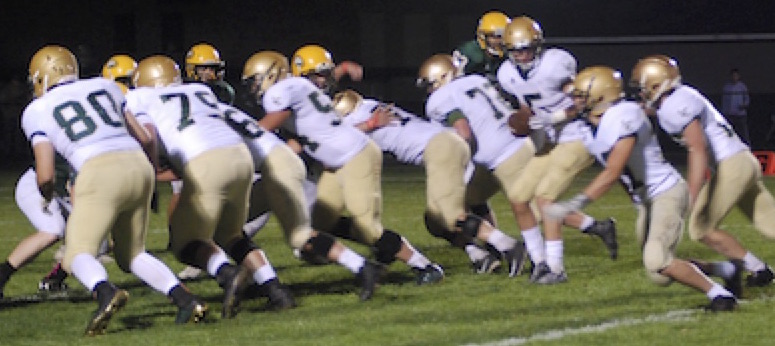
“Offensively, we’re physical, and we have a great offensive line,” Brogan said. “I’d say that’s the strength of our team. We’ve been able to block everybody all year long. We have two good tailbacks who have rushed for 1,800 yards and a fullback who has rushed for 750. Our quarterback has thrown for about 1,200 yards and completed 68 percent. We haven’t thrown it a lot, but we have thrown it effectively off our play-action stuff. When we have been able to run it well, we’ve been able to hurt people.
“It’s an experienced group. Most of these kids had a role in the state championship last year. We returned a lot. It’s a mature group. They are fun to coach and fun to be around. They enjoy themselves and play hard and play with intensity, but they have a lot of fun doing it.”
Lumen Christi played an eight-game schedule this regular season and went 7-1 with a one-point loss to Battle Creek Harper Creek in the third week of the season.
“I think it was a very good point in the season when we ended up losing,” White said. “It was a wake-up call that everything wasn’t going to be easy and everything wasn’t going to be given to us.
“It showed that we need to work that much harder.”
Lumen Christi will take an eight-game winning streak into its Division 6 Semifinal on Saturday. The first eight Finals championships in school history were either in Class B or Division 5, but declining enrollment dropped the Titans to Division 6 in 2014. But that hasn’t necessarily meant an easier road to a title. This year, perennial powers Ithaca and Traverse City St. Francis are meeting in the other Semifinal game.
“Last year, I thought Division 5 was more difficult than Division 6, but overall this year, Division 6 is probably more difficult than Division 5,” Brogan said. “What I have found over the years is that there are really good teams in every division, just the further down you go there are less of them.
“We felt last week that seven of the eight teams who were left could win it, and now, any of the four could win it.”
Brogan – The Leader
With a lengthy resume as impressive as Brogan’s, there is no doubt who is in charge. And the players know of him long before they ever play for him.
 “When you come into the program in seventh grade, you look at Coach and he’s a very intimidating guy,” Maynard said. “You know the hard work that he is going to put you through just from the stories you’ve heard, and true football players want that; they want coaches to come up to you and challenge you and put you through the most difficult workouts you’ve ever been through.”
And, when they mess up, they will hear about it.
“At first, you are scared of making a mistake, but you have to do everything 100 percent,” Mizner said. “You know you are going to get yelled at because you’re not perfect, but things will happen and you’ll get better during the season.”
Brogan will coach with an iron fist, but he isn’t one to run up the score. Often during his career a 28-0 halftime lead ended with something like a 35-0 victory.
He preaches clean play and will not tolerate any of his players doing something that might be deemed dirty. His players told of one such instance this season. One of the Titans pushed an opposing player after the play, and as White told it, that player felt the wrath of Brogan.
“Coach Brogan got in his face,” White said. “It solved the problem, and the player learned his lesson. And he learned his lesson at conditioning, too.”
And finally, there is a saying around football circles in Jackson. It goes something like this: “If Lumen Christi is close at halftime, the coaches will more often make the proper halftime adjustments to give the Titans the edge in the second half.”
In typical style of the low-key coach, Brogan directs that credit to his assistant coaches.
“I think we have a great coaching staff, and honestly, they do a lot more of that stuff than I do,” he said. “We have an offensive staff and an offensive coordinator and a defensive staff and a defensive coordinator, and my job is to sit here and talk to the media.”
Brogan is fifth all-time in coaching wins in the state of Michigan and second among active coaches. His career record is 341-83, and he is one of just 10 coaches to reach 300 career victories. He doesn’t appear to be slowing down.
“It’s still fun,” he said. “I don’t have a lot of classes anymore, and in the offseason I can kind of do what I want to do. I’m coaching with great guys and coaching great kids.
“I’ll be here as long as these guys want me around.”
 Chip Mundy served as sports editor at the Brooklyn Exponent and Albion Recorder from 1980-86, and then as a reporter and later copy editor at the Jackson Citizen-Patriot from 1986-2011. He also co-authored Michigan Sports Trivia. E-mail him at [email protected] with story ideas for Jackson, Washtenaw, Hillsdale, Lenawee and Monroe counties.
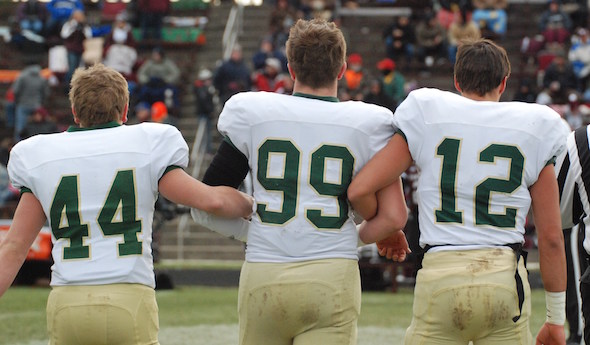
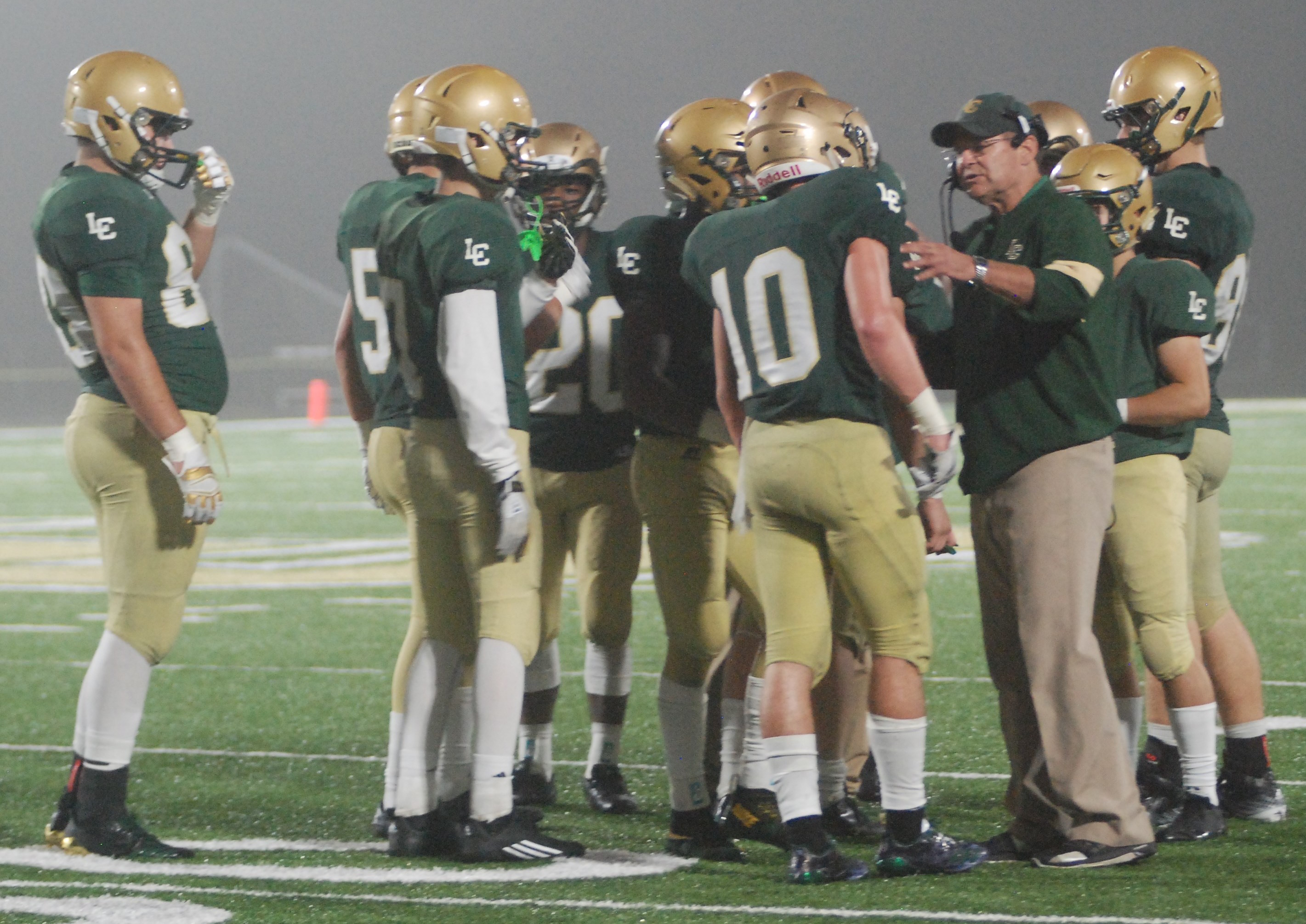
PHOTOS: (Top) Lumen Christi players stand arm-in-arm. (Middle top) Titans coach Herb Brogan talks things over with his players. (Middle below) Lumen Christi fullback Kyle Minder, left, leads the way for tailback Sebastian Toland. (Below) The Titans are succeeding again behind a powerful offensive line. (Photos courtesy of the Jackson Lumen Christi football program.)