

Chain Gang Linked by Decades of Down & Distance
By
Pam Shebest
Special for MHSAA.com
September 18, 2018
SCHOOLCRAFT — Skip Fox figures he and his buddies have the best seats in the house when it comes to Schoolcraft football.
 And the four have had them for a combined 167 years.
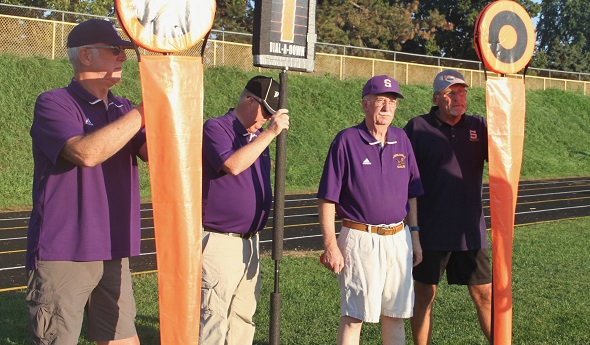
Fox, Jeff Bell, David Krum and Dick Goldschmeding make up the chain gang for the Eagles’ home games, and boast tenures individually and working together that surely rank among the longest in Michigan for providing that gameday duty.
They work well together, an asset when it comes to games like Schoolcraft’s 49-48 double overtime win against Saugatuck last Friday.
Each has a specific job with Bell and Goldschmeding working the chains, Krum the clip and Fox the down box.
Do they lose focus during those long games?
“Never,” Bell said, as the others burst into laughter, with one chiming in: “Good answer.”
“We’re always consummate chain people,” Bell continued. “Never once have I been leaning on that stake and having Dick on the other end pull me along to get going.”
The camaraderie among the four is evident as they share memories.
Fox, who is in his 55th season working the chains, started on the sidelines after his 1964 graduation from Schoolcraft High School.
“When I started, it was a three-man crew,” he said. “We always invited somebody from the opposing team to be on the chains. Then they started changing some of the rules.
“At that time, we worked one half on the visitors’ side and one half on the home side. When the chains had to be opposite the press box, we started working the games all on one side.
“It’s always the opposing side, so we’ve heard a lot of opposing coaches over the years. We’ve learned a few new words.”
 Bell, a 1966 Schoolcraft grad, joined the crew 51 years ago.
Before retiring, he was a middle school teacher in the district for 28 years and “doing that, you get to know all the kids so it was always fun to be down there watching the kids you knew.
“It’s different now (that he is retired). We kind of refer to the program all the time to make sure we know who’s who on the team.”
The gang has seen definite changes in the game over their tenure.
“We see a lot more conditioning and a lot more safety regulations,” Bell said. “The rules change and we try to keep up with that as much as possible.
“It’s a faster paced game than it was when we first started.”
Krum worked part-time on the chain gang from 1965 to 1970 while he attended Michigan State University and has been full-time the last 49 seasons.
One down side of the job, he said, is “Mother Nature. At times I wished we weren’t out there because we can’t leave. We’re stuck there rain or snow.”
Bell said weather seems to be one of the biggest changes over the years.
“At least half of the season we worked in Carhartts and snow was at least ankle deep,” he said. “Now we usually don’t see snow, but we get cold weather, mosquitoes, things like that.”
Krum really did have the best seat in the house to see his son, Dean, make an outstanding play several years ago.
“It was right in front of us in the end zone,” Krum said. “He knocked a pass down on the last play and we won the game. The whole crowd went crazy.
“I was in utter shock. I kept asking the guys, ‘He didn’t get a penalty, did he?’ It saved a two-pointer and we won the game by one.”
Krum is the one who protects the sideline.
“I’m the one who tells the coaches and players to please get back as we are going up and down,” he said. “You’ve got to talk to them all the time.”
Goldschmeding is the new guy on the crew.
A graduate of Portage Central High school, he moved to Schoolcraft 50 years ago and was recruited 12 years ago.
“We’ve been friends for a number of years, and they said they had an opening on the chain gang and would I be interested,” Goldschmeding said. “I fell for it hook, line and sinker.
“At the time I was assisting on the (Schoolcraft) sideline at football games, so I moved from one side of the field to the other.”
 As an assistant coach, Goldschmeding said he was well aware of the guys working the chains across the field.
“I think every coach is aware of what is going on on the other side of the field because they have to be involved in every play,” he said. “They’re thinking two or three plays ahead all the time.”
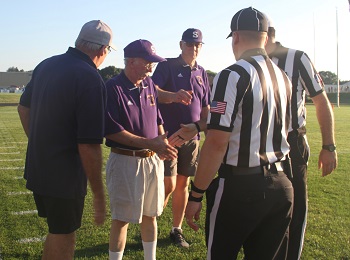
One of the first things the crew does is meet with game officials to coordinate moves.
“When a first down is made, one of us will mark the spot and the other will extend the chain the full extent of the 10 yards,” Bell said. “We hold that position until the officials give us the nod.”
Sometimes the crew has to scamper down the field, which becomes time for Fox’s stand-in to appear.
“When they have a 40- or 50-yard run, David’s nephew (Blake Krum) takes over and runs down the field for me,” Fox said. “At age 72, I’m not that fast anymore.”
Bell said the crew’s goal is to go unnoticed.
“If you hold up the game, that’s real bad,” he said. “You want to do your job, and if you’re not noticed and nobody has anything to say about the chain gang, you’ve done your job. That’s pretty much the way it works.”
Fox said about the only downside of the job is not sitting with their wives at games.
“All our wives sit on the other side without us,” he said. “You’ve got to have understanding wives.”
Sideline service one of many school connections
For Fox, Schoolcraft football has been a generational thing.
He lettered in football all four years and added, “My oldest son (Matthew) was on the championship team in 1990 and my other son, Mark, made all-state on both offense and defense, which was a rarity.”
“I’ve got four grandsons, and they all played for Schoolcraft.”
He also served on the Schoolcraft Board of Education for 34 years.
Bell played basketball for the Eagles and his son, Ross, played on the MHSAA Division 6 champion football team in 2001.
Krum did not play sports, but was a sports enthusiast in school.
He spent 29½ years on the school board.
Although he wasn’t involved in Eagles sports as a student, Goldschmeding’s two sons, John and Josh, played football at Schoolcraft and he was involved in the Athletic Boosters. He also has grandchildren involved in Schoolcraft sports.
 Pam Shebest served as a sportswriter at the Kalamazoo Gazette from 1985-2009 after 11 years part-time with the Gazette while teaching French and English at White Pigeon High School. She can be reached at [email protected] with story ideas for Calhoun, Kalamazoo and Van Buren counties.
PHOTOS: (Top) Schoolcraft's Jeff Bell, Skip Fox, David Krum, Dick Goldschmeding work the chains during a game this season. (Middle) Clockwise, from top left: Bell, Fox, Goldschmeding and Krum. (Below) From left, Goldschmeding, Bell and Krum meet with game officials. (Photos by Pam Shebest.)
1st & Goal: 2026 Week 3 Review
By
Geoff Kimmerly
MHSAA.com senior editor
September 14, 2026
The highest-scoring game, potentially, in Michigan high school history will put Week 3 in the record books at the end of this season.
 But several more results could send the second weekend of September into school record books across the state if the rest of the regular season plays out as past history dictates it might.
Several matchups that decided 2025 league titles were played at the one-third point this fall. And while we will have to wait another month or more to know for sure, many noted below might end up deciding which teams hoist conference championship trophies later this fall.
Bay & Thumb
HEADLINER Montrose 35, New Lothrop 33 Montrose (2-1) ran its Mid-Michigan Athletic Conference winning streak to 11 with its closest league victory in two years. After only two weeks of league play there are only two teams 2-0 in the MMAC – Montrose joined by Birch Run, and they’ll meet in a Week 8 league finale. Click for more from WJRT.
Watch list Imlay City 22, Croswell-Lexington 0 Imlay City (3-0) already has as many wins as a year ago and with one more victory will match its highest total since 2020. This win reversed a 42-7 loss to Croswell-Lexington (0-3) a year ago and was the Spartans’ first over the Pioneers since 2014.
On the move Armada 28, North Branch 6 The Tigers (2-1) bounced back from a Week 2 loss to Almont to hand North Branch (2-1) its first defeat. Davison 54, Traverse City Central 28 The Cardinals also enjoyed an impressive bounce-back coming off a Week 2 defeat to Detroit Catholic Central with a notable win over a Central team that reached the Regional Finals last fall. Millington 43, Elkton-Pigeon-Bay Port Laker 16 Last season’s Cardinals win over Laker (1-2) in the league finale decided the Big Thumb Conference White title. This season they played in the league opener, and the result might end up doing the same although Caro and Cass City are both undefeated as well and up next for Millington (3-0).
Greater Detroit
HEADLINER Bloomfield Hills Brother Rice 31, Warren De La Salle Collegiate 28 A Marcus Hayes interception returned for a touchdown was the highlight play from this Catholic High School League Central matchup. The end result of the game was Brother Rice (3-0) taking a step as a candidate to be top contender in the league race against Detroit Catholic Central, although Orchard Lake St. Mary’s in Week 5 will present another major challenge. Click for more from the Detroit News.
1-800-CALL-SAM PLAY OF THE WEEK NOMINEE 🏈
Brother Rice's Marcus Hayes with the GAME-CHANGING PICK 6 against Warren De La Salle to defeat them 31-28!
Vote this Friday on the State Champs! Instagram 🗳️
Powered by @CallSam pic.twitter.com/es8s5htcfu— STATE CHAMPS! Michigan (@statechampsmich) September 12, 2026
Watch list Northville 35, Brighton 34 Northville (3-0) finished second in the Kensington Lakes Activities Association West last year thanks in part to a loss to Brighton (2-1), but may be the team to beat in the new KLAA Black after securing this one with a 2-point conversion stop with 24 seconds to play.
On the move Detroit Edison 41, Romulus Summit Academy North 14 After these two shared the championship a year ago Edison (2-1) now joins Ecorse with the early lead in the Charter School Conference Gold, with those two set to meet in Week 8. South Lyon 35, Walled Lake Western 14 This was one of the two big matchups when South Lyon won the Lakes Valley Conference last season, and might prove a decider again although upcoming games with Milford and South Lyon East will influence the race as well. Dearborn Divine Child 14, Detroit Country Day 7 Divine Child (3-0) marched late for the go-ahead score to run its current streak over Country Day to three wins in three seasons, but the close loss also showed how dangerous the Yellowjackets (1-2) could be the rest of the way.
Mid-Michigan
HEADLINER Beal City 42, Springport 13 The Aggies (3-0) stepped away from their Highland Conference repeat pursuit for a week to take on the reigning champion from the Big 8 Conference and busted out in a big way during the second half after leading only 14-7 at the break. It was the first regular-season loss for Springport (2-1) since Week 8 of 2024. Click for more from WLNS.
Watch list Mount Pleasant 28, Midland Dow 7 The Oilers (3-0) began their Saginaw Valley League North repeat pursuit with their best defensive game of the young season as they faced last year’s league runner-up in Dow (1-2).
On the move Grand Ledge 45, Okemos 7 The Comets (3-0) won this matchup of previously undefeated opponents to open Capital Area Activities Conference Blue play. Mason 20, Haslett 7 The Bulldogs (3-0) didn’t let down after a big Week 2 win over DeWitt, opening CAAC Red play by avenging one of last season’s two league losses. Howell 54, Dearborn 14 The Highlanders have reached 40 points all three games this season and 35 points in 11 straight dating back to Week 4 of last fall.
Northern Lower Peninsula
HEADLINER East Jordan 20, Maple City Glen Lake 19 The last three regular-season meetings between these Northern Michigan Football Conference rivals have been decided by a combined four points – and Glen Lake (2-1) also won last year’s District Final matchup by 14 – but this went East Jordan’s way for the first time since 2023. The Red Devils (2-1) quickly have become the only team in the one-division NMFC still without a league loss. Click for more from the Traverse City Record-Eagle.
Watch list Harbor Springs 14, Frankfort 10 Frankfort (2-1) has made the playoffs every season this decade and Harbor Springs (2-1) hasn’t once, but that could be changing as the Rams defeated the Panthers for the first time since 2020.
On the move Kingsley 39, Charlevoix 13 The Stags (3-0) have looked especially impressive in the early going and may have won the eventual decider in the Northern Shores Conference with Charlevoix (2-1) another contender. Cadillac 28, Gaylord 0 The Vikings (2-1) made a big splash against the reigning Big North Conference champion Blue Devils (1-2), and in doing so equaled their win total of a year ago. Oscoda 20, Johannesburg-Lewiston 8 After falling to East Jordan and Harbor Springs to start the fall, the Owls (1-2) are on the board thanks to avenging last season’s 12-point loss to the Cardinals (2-1).
Southeast & Border
HEADLINER Chelsea 49, Adrian 21 These two decided last season’s Southeastern Conference White title, and the early edge this fall goes to reigning champion Chelsea which is now tied for first with Tecumseh. Those co-leaders will meet this week in one of the biggest matchups regionally and beyond. Click for more from the Chelsea Sun Times News.
Watch list Jackson Lumen Christi 45, Traverse City St. Francis 0 The Titans (3-0) have won five straight over the Gladiators (1-2) but handed St. Francis its first shutout since these two met in 2023.
On the move Napoleon 32, Jonesville 12 Napoleon (3-0) moved from the Cascades Conference East to West this season and opened by slowing down a Jonesville offense that had scored 98 points during a 2-0 start. Michigan Center 22, Manchester 16 The reigning Cascades West champion Cardinals (2-1) got an important league win out of the way as Manchester also had impressed during a 2-0 start. Quincy 67, Stockbridge 21 After a rough first half of the decade, Quincy finished it up last season with a solid 5-4 run – and at 3-0 this fall may be in the mix to take another step although the schedule has a number of challenges the rest of the way.
Southwest Corridor
HEADLINER Marshall 52, Hastings 45 The Interstate 8 Athletic Conference race is shaping up to be one of the most intriguing in the southwest with three of seven teams 3-0 overall and others capable of making noise on a given night. Marshall is 3-0 for the first time since 2009 with this win over annual league contender Hastings, which is 1-2 against opponents a combined 8-1 this fall. Click for more from WWMT.
Watch list Union City 22, Bronson 14 Union City is setting up well as a Big 8 Conference contender, moving to 3-0 with this win over Bronson (1-2), which finished second in the Southwest 10 Conference a year ago.
On the move Mattawan 77, Battle Creek Central 76 (5OT) This was definitely the highest-scoring overtime game in MHSAA football history, the highest-scoring for two teams combined when the loser scores at least 40, and very likely the highest-scoring high school football game in Michigan overall since 1912 (before the MHSAA was formed 12 years later). Kalamazoo United 28, Lawton 7 This was another major step for United (3-0) in the Southwestern Athletic Conference, with the Week 6 date against Schoolcraft now shaping up as a potential league title decider. Lawton (2-1) still gets a shot against Schoolcraft as well, in Week 9. Portage Central 25, Portage Northern 14 Central (2-1) has taken a notable edge in this rivalry with a fifth-straight win, and these two will not meet again this season as they’re in different playoff divisions.
Upper Peninsula
HEADLINER Bark River-Harris 38, Iron Mountain 33 Bark River-Harris’ repeat hopes in the Western Peninsula Athletic Conference Iron got a major boost as this matchup has been the title decider the last two seasons. The Broncos (3-0) defeated Iron Mountain three times a year ago and certainly could see the Mountaineers (1-2) again in the playoffs in two months. Click for more from My UP Now.
Watch list Houghton 54, L’Anse 8 This could be a turning point for the Gremlins (1-2), who topped 50 points for the first time since 2022 and held a L’Anse team that had scored 90 over a 2-0 start.
On the move Calumet 21, Negaunee 18 The Copper Kings (3-0) opened a stretch of Negaunee/Menominee/Kingsford the best way, and for the second-straight season, with the next two games to tell their fortunes in the West-PAC Copper. Escanaba 29, Alpena 12 Escanaba (1-2) ran its winning streak against Alpena (1-2) to five and evened its record in the BNC after opening against the reigning champ. Kingsford 35, Gladstone 0 The Flivvers (3-0) have outscored their first three opponents by a combined 104-22 margin with Negaunee and Calumet up next.
West Michigan
HEADLINER Caledonia 35, Rockford 23 The Fighting Scots (2-1) impressively bounced back from the disappointment of taking a forfeit loss Week 1 by defeating the Rams (1-2) for the first time since their 2022 Division 1 District Final. Caledonia capitalized on three turnovers and a blocked punt, and also returned a kickoff for a score. Click for more from WOOD TV.
Watch list Muskegon Orchard View 22, Whitehall 8 The Cardinals (2-1) didn’t even have a team five seasons ago, but they won five of their last six games last fall and continued this early surge by defeating Whitehall for the first time in their five years together in the West Michigan Conference Lakes.
On the move Grand Rapids West Catholic 45, Grand Rapids South Christian 34 The Falcons (2-1) bounced back from a Week 2 loss to hand the Sailors (2-1) their first this season. Coopersville 20, Petoskey 17 (OT) The Broncos are now 3-0 against teams that went a combined 27-4 a year ago. Hudsonville 42, Grand Haven 14 Six of eight Ottawa-Kent Conference Red teams are 2-1 or better, including both of these after Hudsonville handed Grand Haven its first loss.
8-Player
HEADLINER Rudyard 42, Indian River Inland Lakes 36 (3OT) It took three overtimes, but Rudyard (2-1) ended Inland Lakes’ 25-game regular-season winning streak dating back to 2023. This was their first meeting since 2013, and an important one as they are both in the first-year Bridge Alliance Straits this fall. Click for more from the Cheboygan Daily Tribune.
Watch list Litchfield 28, Battle Creek St. Philip 6 The Terriers are 3-0 for the first time since 2022 as they seek their first playoff berth since 2011. They’ve actually won six of their last seven games going back to last season.
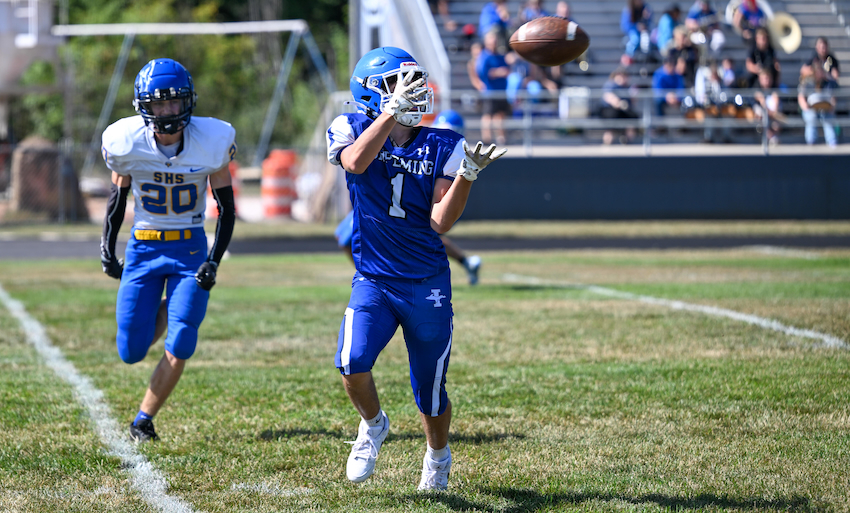
On the move Bay City All Saints 33, Kinde North Huron 14 The Cougars (3-0) took a major step as they pursue a fourth-straight league title, even as North Huron (2-1) gave them their closest game in the series since 2022. Ishpeming 80, Stephenson 42 The Hematites (2-1) equaled their win total from a year ago and are just 18 points shy of equaling their scoring for all of 2025. Bridgman 48, Marcellus 18 The Bees (3-0) picked up what might end up a key win in the Southern Michigan 8-Man Football League Red, as Marcellus (2-1) was coming off a victory over reigning Division 1 champ Martin.
MHSAA.com's weekly “1st & Goal” previews and reviews are powered by MI Student Aid, a division within the Department of Lifelong Education, Advancement, and Potential (MiLEAP). MI Student Aid encourages students to pursue postsecondary education by providing access to student financial resources and information. MI Student Aid administers the state’s scholarship and grant programs that help make college Accessible, Affordable and Attainable for you. Click to connect with MI Student Aid and find more information on Facebook and Twitter @mistudentaid.
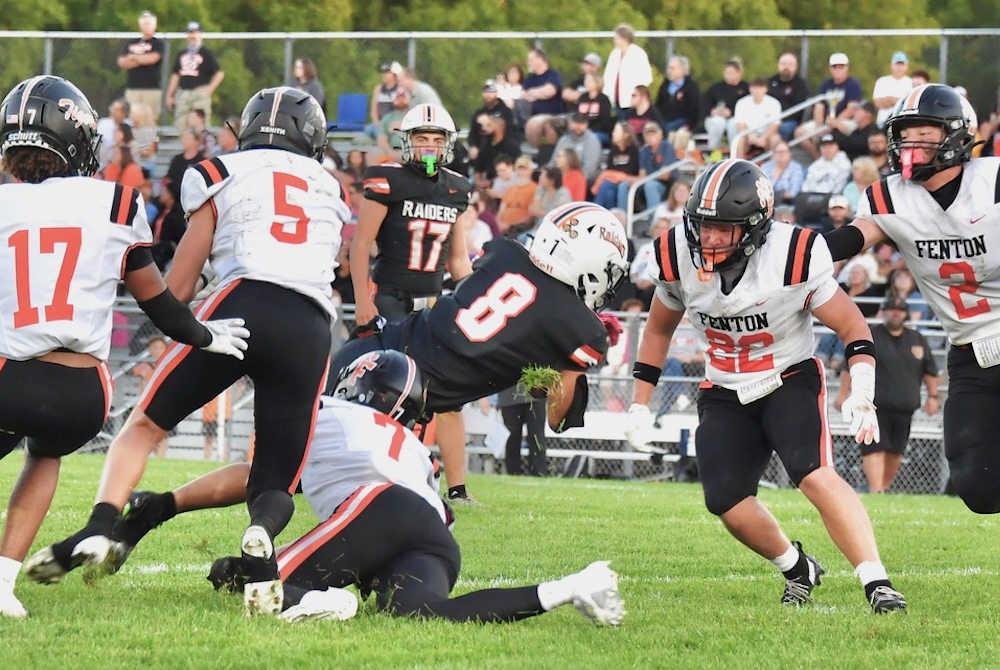
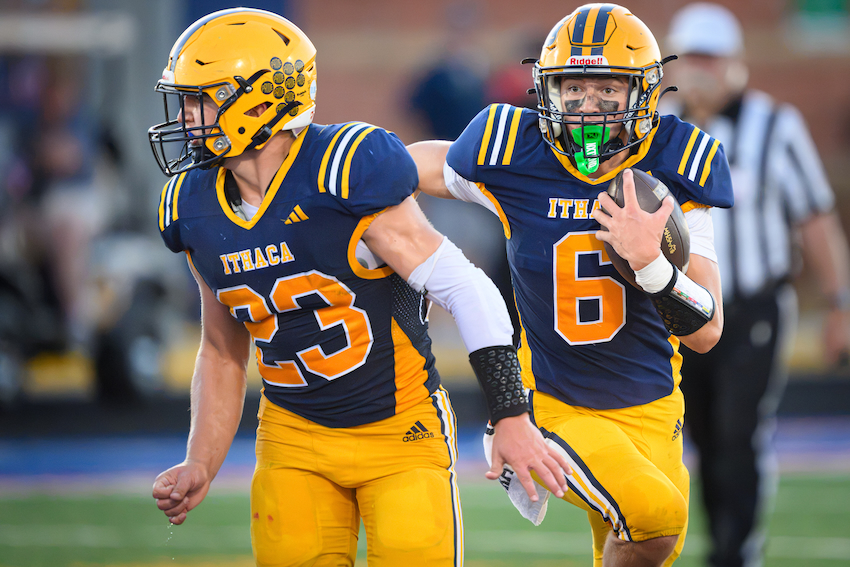
PHOTOS (Top) Fenton defenders close in on a tackle during the Tigers’ 26-14 win over Flushing. (Middle) Ithaca’s Greyson Merchant (6) follows senior Harper Merchant for a first down during the Yellowjackets’ 63-7 win over Saginaw Nouvel Catholic Central. (Below) Ishpeming’s Donovan Snyder (1) pulls in a pass against Stephenson. (Fenton/Flushing photo by Terry Lyons. Ithaca/Nouvel photo by Kolleth Photography. Ishpeming/Stephenson photo by Randy Ritari.)